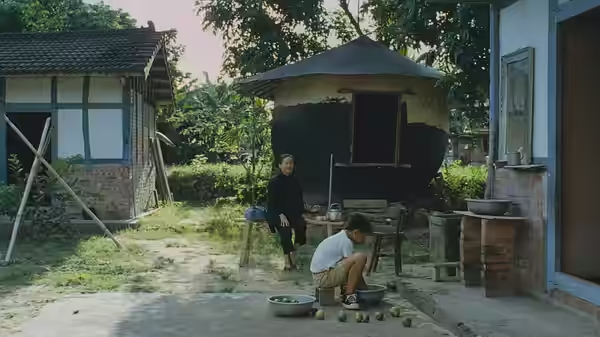
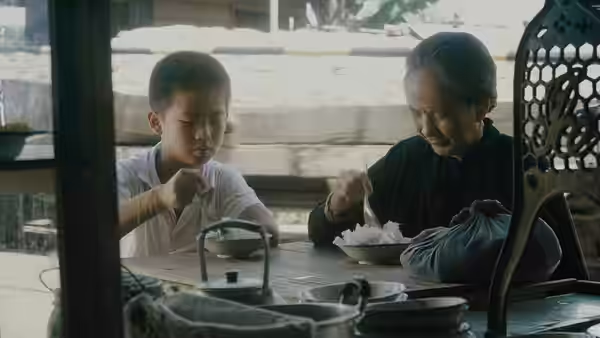
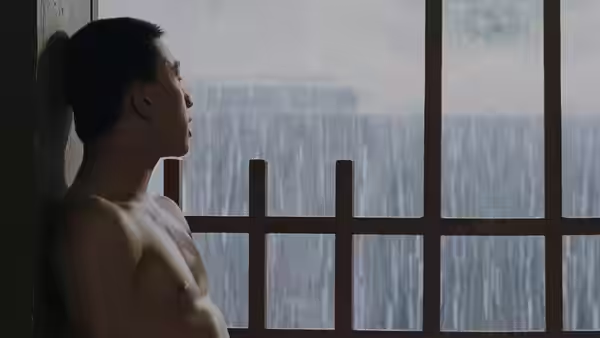
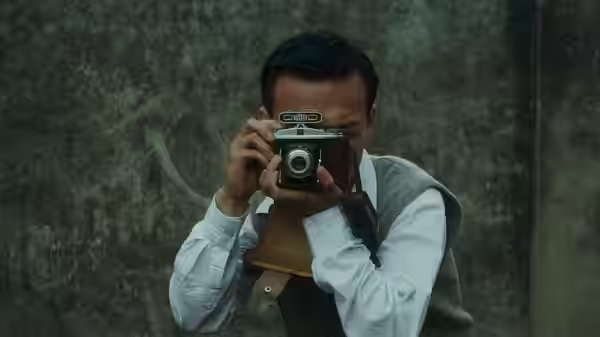
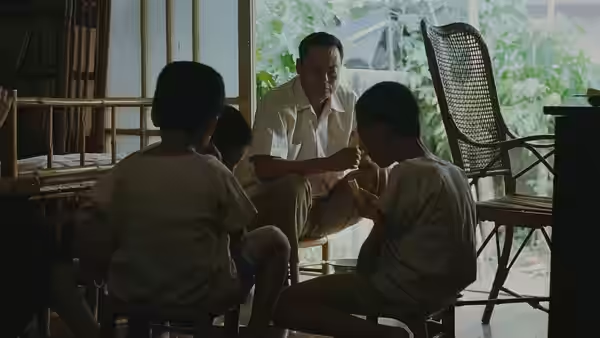
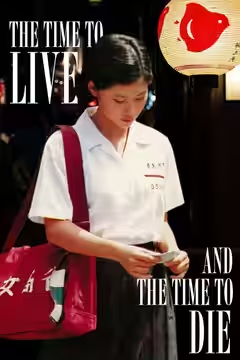
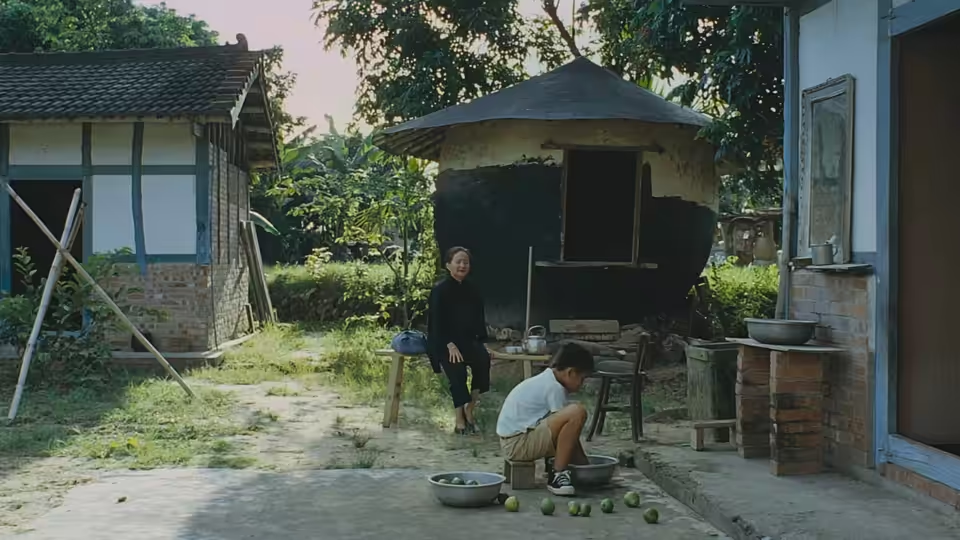
A young man crouches beside washbasins in a courtyard as an elderly woman sits nearby
Film review

The Time to Live and the Time to Die

1985 · Directed by Hou Hsiao-hsien · 2h 16m

In a sentenceGrandma is looking for the road back to the mainland, and nobody has the heart to tell her it is a sea

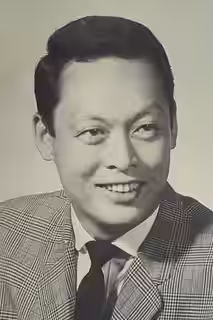
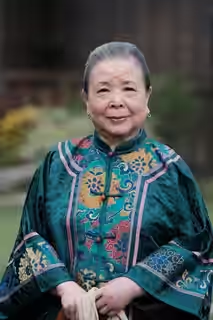
Southern Taiwan, the late 1940s onward. A family from Meixian in Guangdong has crossed to the island expecting to go back, and has settled instead in a Japanese-style bungalow in Fengshan. The father, Hou Fen Ming (Tien Feng), a civil servant with a cough, keeps to his desk and his distance from the children. The mother (Fang Mei) runs the house. The grandmother (Tang Ru-Yun) keeps walking out of the gate to find the road home, and the children fetch her back. Among them is Ah Ha, called Ah Hsiao at home, who steals guavas, plays marbles for money and does badly at school. The film follows him from small boy to the teenager played by Yu An-shun, while the radio brings news from the mainland.

Plays from YouTube when you press play; nothing loads from them until then.

Fi1m review

Hou Hsiao-hsien’s account of his own childhood in postwar Taiwan is plain, still and quietly devastating, told in long takes through open doorways. The teenage half is looser than the childhood, but we would send anyone to it who can sit still.

A voice tells us at the start that what follows is a memory of childhood, and above all of a father. The family came from Meixian in Guangdong to Taiwan in the late 1940s, expecting to go back, and did not. Hou Hsiao-hsien, who wrote the script with Chu Tien-Wen, is telling his own story, with almost no plot. Children grow. Adults sicken. Ah Ha, called Ah Hsiao at home, steals guavas, gambles at marbles, does badly at school and then, as a teenager played by Yu An-shun, gets into fights. It is one of the best films we know about growing up, and we would send a stranger to it, provided the stranger can sit through 136 minutes.

Tien Feng plays the father, Hou Fen Ming, a civil servant with a cough who sits apart from his children and does not explain why. Fang Mei is the mother, who runs the house and rarely sits down. Tang Ru-Yun is the grandmother, who keeps setting off on foot to find the road back to the mainland and has to be fetched back. The house is a Japanese-style bungalow with sliding screens and a yard, and Hou returns to the same three or four views of it: the front room from the corridor, the yard from the front room, the road from the gate.

Mark Lee Ping-Bing shoots nearly all of it from a distance, in long held takes, often through a doorway, and rarely moves the camera. Daylight comes in from the yard; the rooms stay dim. So we watch this family the way a child watches adults, from the next room, catching what we can. Liao Ching-sung and Wang Chi-yang hold each shot a beat past the action, so an empty doorway stays on screen after someone has gone through it. The music by Ng Choh-Choh and Chang Hung-Yi is a spare theme used half a dozen times. The rest of the soundtrack is cicadas, rain on a roof, a bicycle bell and the radio.

The scene we will keep is the grandmother’s walk. She takes the small Ah Hsiao with her to find the bridge to Meixian, as though the village were a few miles down the road rather than across a strait. They walk a long way, the boy trotting to keep up, and end up eating guavas in an orchard, the old woman content, the child baffled by her questions. It moved us more than we expected, because Hou plays it for neither laughs nor tears. She is simply wrong about the geography, and nobody in the house has the heart to keep telling her.

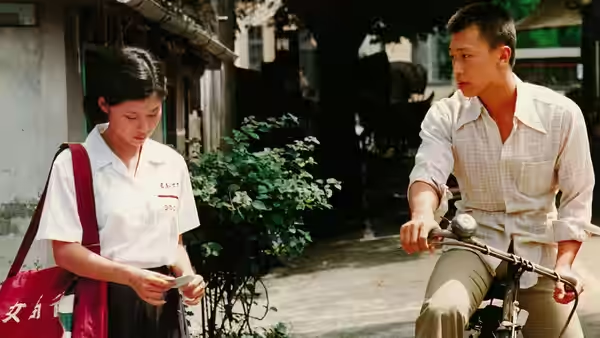
The second half belongs to Yu An-shun, who plays the teenage Ah Ha with a slouch and a stare and hardly any lines. He runs with a gang, gets into street fights, and follows a schoolgirl, Wu Shumei (Hsin Shu-Fen), home without speaking to her. The losses arrive in this half, staged with the camera kept well back from the bed, and we will not describe them. Still, one late scene left us with something close to horror, not at anything shown, but at how ordinary the bedroom looked while it happened, and Hou holds the shot until we had finished noticing that for ourselves.

It is not flawless. The gang scenes are staged more loosely than the domestic ones, and a couple of the fights look like boys pretending to fight. Several smaller performances are pitched flat, as non-professionals’ often are, and a few lines land as recitation. An audience with no knowledge of Taiwan’s postwar history will miss some of what the radio is telling the family.

Hou made more elaborate films afterwards, and more famous ones. We are not sure he made a more direct one. What the reviews so far have praised, its honesty and its natural acting, is real, but it undersells how carefully it is built. Nothing here is loose; every doorway is a decision.

Watch it in the evening with the windows open, if the weather allows. It is a film of rooms with the doors left ajar, and it is best seen from one.
Critical consensus AI synthesised

3 of 6
Positive
3
Mixed
0
Negative
0
The Guardian
3 August 2000 · Derek Malcolm
90*

Malcolm presents the film as one of Hou Hsiao-hsien’s simplest and most universal works. He especially praises its emotional honesty, sound, cinematography, and natural acting.

Read the full review →
Radio Times
★★★★ · David Parkinson
80

The critic praises the film as a fond, perceptive autobiographical portrait of family life and adolescence. You Anshun’s performance stands out for conveying turbulent emotions and reinforcing the story’s allegorical dimension.

Read the full review →
Time Out
· GA
80*

The review describes the film as subtle and deeply moving. It praises how Taiwanese history is seen through a boy’s perspective.

Read the full review →

Straight answers AI written, from our review

Is The Time to Live and the Time to Die worth watching?
The Time to Live and the Time to Die is worth watching for anyone who can sit still for 136 minutes of quiet family life, and we scored it 90. Hou Hsiao-hsien tells his own postwar childhood in long takes through open doorways, with almost no plot. The teenage half is looser than the childhood, and some of the radio news will pass by anyone unfamiliar with Taiwan's history.
How long is The Time to Live and the Time to Die, and what is it rated?
The Time to Live and the Time to Die runs 2h 16m. It is a drama film.
Where can I watch The Time to Live and the Time to Die in Peru?
The Time to Live and the Time to Die is not on any streaming or rental service in Peru at the moment. Availability is checked daily.
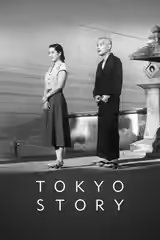
How does The Time to Live and the Time to Die compare to Tokyo Story?
The Time to Live and the Time to Die is a memoir of a childhood; Tokyo Story is about ageing parents visiting grown children who neglect them. Both keep the camera low and still and wait for ordinary life to hurt. Hou's film is the plainer and more personal, Ozu's the more finely acted and tightly built; we would send a newcomer to slow cinema to Ozu first.
What should I watch after The Time to Live and the Time to Die?
After The Time to Live and the Time to Die, try A Brighter Summer Day (1991, Fi1m 90): Edward Yang’s Taipei teenagers, knives and radios; the same island a decade on, and angrier. Then Tokyo Story (1953, Fi1m 92): Ozu’s parents visit their children; the camera sits low and waits, as Hou’s does; and Pather Panchali (1955, Fi1m 93): Satyajit Ray’s Bengali village childhood, poor, patient and alert to what children miss.

Cast

If you liked this, try…

  1. A Brighter Summer Day (1991, Fi1m 90)Edward Yang’s Taipei teenagers, knives and radios; the same island a decade on, and angrier.

  2. Tokyo Story (1953, Fi1m 92)Ozu’s parents visit their children; the camera sits low and waits, as Hou’s does.

  3. Pather Panchali (1955, Fi1m 93)Satyajit Ray’s Bengali village childhood, poor, patient and alert to what children miss.

  4. The Spirit of the Beehive (1973, Fi1m 87)Victor Erice’s postwar Spain through a small girl’s eyes; history heard, never explained.

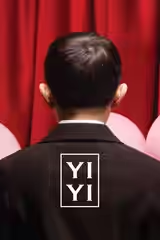
  5. Yi Yi (2000, Fi1m 92)Yang’s three generations in a Taipei flat, each keeping something from the others.

The Time to Live and the Time to Die (1985) review: Hou’s own childhoo (Peru) | Fi1m