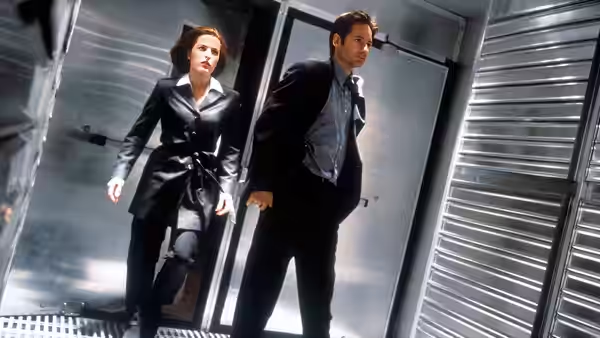
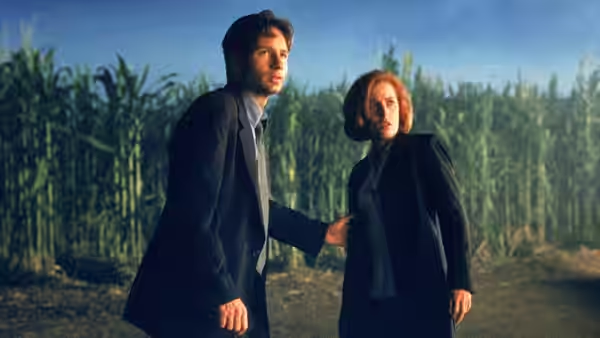
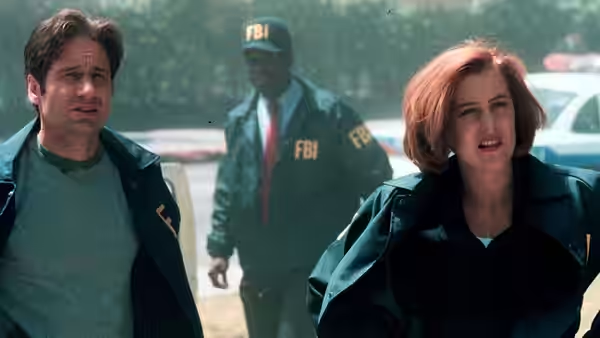
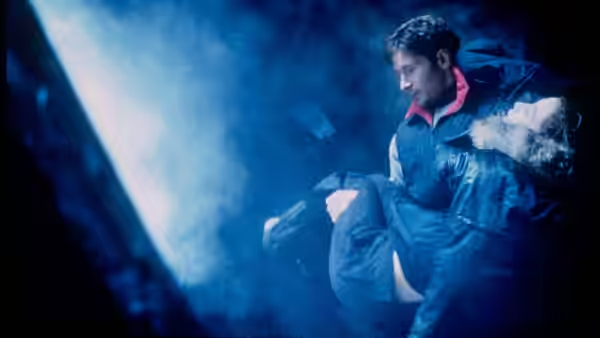
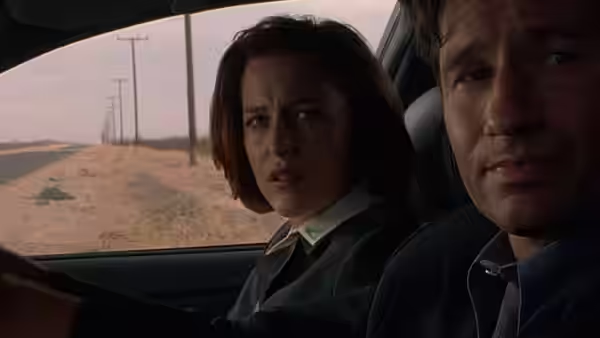
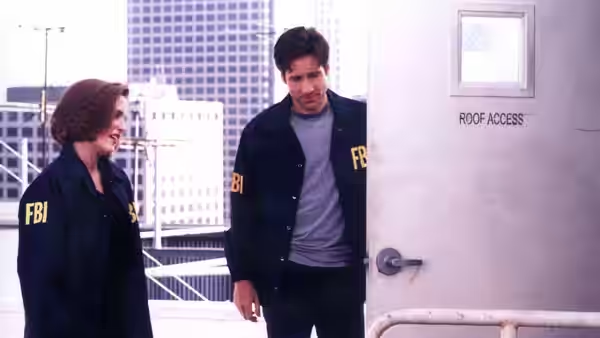
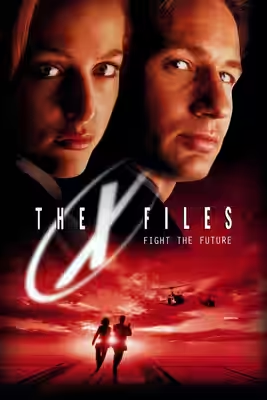
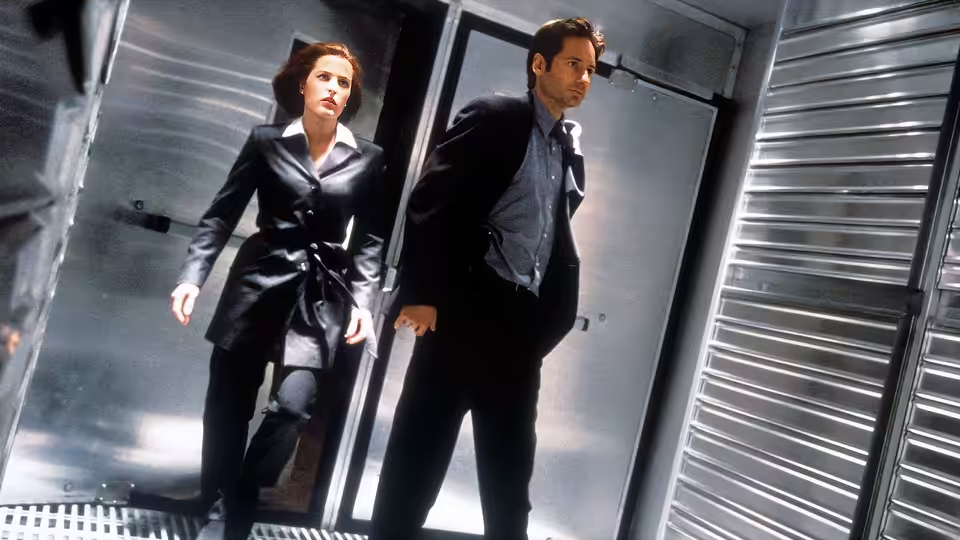
Dana Scully (Gillian Anderson) and Fox Mulder (David Duchovny) walk through a metal corridor
Film review

The X-Files

1998 · Directed by Rob Bowman · 2h 01m

In a sentenceFox Mulder and Dana Scully remain good company, even when the plot would rather we took notes

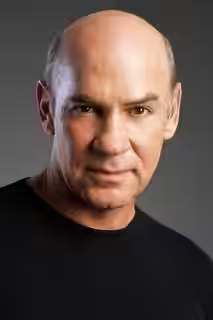
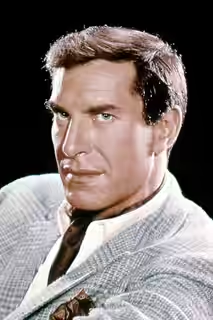
Fox Mulder (David Duchovny) and Dana Scully (Gillian Anderson) take the central roles in a feature-length science-fiction mystery drawn from the television series. Walter Skinner (Mitch Pileggi), Kurtzweil (Martin Landau) and Cassidy (Blythe Danner) also figure in the story, alongside The Well-Manicured Man (John Neville). The film combines the series’ central partnership with thriller action on a larger scale. Written by Chris Carter from a story by Chris Carter and Frank Spotnitz, it runs 121 minutes and carries a 15 certificate.

Fi1m review

The X-Files makes a decent thriller out of an awkward transition from television. David Duchovny and Gillian Anderson make it worth considering, despite a tangled story and action that too often feels routine.

Rob Bowman’s The X-Files is an entertaining but uneven thriller whose strongest reason for becoming a film remains its leading pair. The move from television makes room for larger set pieces without finding a consistently stronger story to put between them. We can see the attraction of giving these characters more space, and the film occasionally makes good use of it. At 121 minutes, though, it asks for more patience than its mystery earns.

David Duchovny and Gillian Anderson give Fox Mulder and Dana Scully enough mutual attention to keep their relationship interesting when the surrounding plot grows laborious. Their exchanges remain engaging without requiring us to remember every detail of the series. We warmed to them more than we expected to. That comes from the actors’ responsiveness to each other: even when the dialogue has information to deliver, they keep us interested in the person listening.

Chris Carter’s screenplay, from a story by Chris Carter and Frank Spotnitz, is less dependable. There is wit in the dialogue, and the central partnership remains easy to care about as the plotting becomes harder to follow. A complicated mystery should make us eager for the next piece of information; here, keeping track can begin to feel like an obligation. We do not need everything explained, but we need to understand why a new complication matters. Too often, the script moves on before it has persuaded us.

Ward Russell’s cinematography gives the larger-scale passages enough visual interest to justify the move to cinema. The wider sense of space is welcome, and Christopher Nowak’s production design helps the film look substantial, although individual settings do not always make a lasting impression. Rob Bowman can deliver an imposing set piece, but the action within it is often conventional. Once we have registered the size of the undertaking, there is not always much else to enjoy in its staging.

Stephen Mark’s editing keeps individual action passages moving, yet the film as a whole feels longer than it needs to. The difficulty comes when the immediate excitement passes and the story has to get going again. Mark Snow’s music sustains some unease through these stretches, though the writing leaves it with too much work to do. We repeatedly find ourselves waiting for the next exchange between the leads to restore our interest.

The feature-length television adaptation has to give familiar characters something worth leaving their usual format for. This one preserves enough of the series’ identity to make the exercise understandable, and its affection for the central pair is persuasive. But the larger set pieces cannot entirely disguise how often it feels like an extended instalment. A thriller needs to make its next scene feel necessary, and this one sometimes relies too heavily on our willingness to stay with the characters.

It is a reasonable choice for an evening when the attraction is spending more time with Fox Mulder and Dana Scully. Anyone arriving primarily for a tightly organised mystery should lower their expectations. Bring an existing fondness for the pair rather than a demand for brisk answers.
Critical consensus AI synthesised

56
Positive
2
Mixed
2
Negative
2

The reviews are evenly divided between positive, mixed and negative responses, with no firm agreement that The X-Files benefits from becoming a feature film. Praise centres on its visual style, ambitious locations and the chemistry between Mulder and Scully. The more enthusiastic critics find an entertaining science-fiction thriller that preserves the television series’ identity, with a sharp script and enough spectacle to justify the larger scale.

The chief disagreement is over how far that transition succeeds: some find the film entertaining but too much like an extended episode, while others see a more substantial disappointment. Variety acknowledges the leads’ appeal and the larger set pieces, but finds the action routine and the atmosphere lacking. Time Out’s objection centres on a convoluted story that is difficult to follow. The spread is broad, with visual ambition and familiar characters carrying considerably more weight for some critics than others.

Empire
1 January 2000 · Neil Jeffries
75*

The critic finds the film an impressive, entertaining big-screen transition that should satisfy fans and surprise sceptics. He particularly praises its striking visual style and the impressive locations, especially Antarctica.

Read the full review →
The New York Times
19 June 1998 · Janet Maslin
64*

The review’s verdict and specific praise or complaint cannot be verified from the inaccessible page. The available page text contains no review content.

Read the full review →
RogerEbert.com
19 June 1998 · ★★½/4 · Roger Ebert
62

Ebert finds the film entertaining but not especially compelling as a feature-length installment. He singles out its resemblance to an extended episode of the television series.

Read the full review →
Variety
19 June 1998 · Todd McCarthy
35*

McCarthy finds the film caught between a worthwhile feature and an overblown television episode, with its conventional approach making it underwhelming. He praises the leads’ appeal and the larger-scale set pieces, while criticizing the routine action and lack of atmosphere.

Read the full review →
Time Out
· TJ
30*

The critic’s verdict is negative, finding the film’s story difficult to follow. The review’s available description singles out the convoluted plot as a complaint, with no praise discernible.

Read the full review →
Eye for Film
19 January 2001 · Angus Wolfe Murray
75*

The critic finds it an entertaining sci-fi thriller that successfully preserves the series’ identity. The sharp script and the chemistry between Mulder and Scully stand out positively.

Read the full review →

Straight answers AI written, from our review

Is The X-Files worth watching?
The X-Files is worth considering for Mulder and Scully’s partnership rather than its mystery, and we score it 64 out of 100. Duchovny and Anderson keep their exchanges engaging, but the tangled plotting and routine action make this a better choice for those already fond of the pair than anyone seeking a tightly organised thriller.
How long is The X-Files, and what is it rated?
The X-Files runs 2h 01m. It is a mystery and science fiction film.
Where can I watch The X-Files in Thailand?
The X-Files is not on any streaming or rental service in Thailand at the moment. It is available in 48 other countries; change your country at the top of the page to see where. Availability is checked daily.
How violent or frightening is The X-Files, and is it suitable for children?
The X-Files carries a UK 15 certificate, so it is not suitable for children under 15. Its science-fiction mystery includes thriller action and music that sustains unease, but we cannot give a more precise warning about violence or frightening material from those details alone; the certificate is the clearest guide for younger viewers.
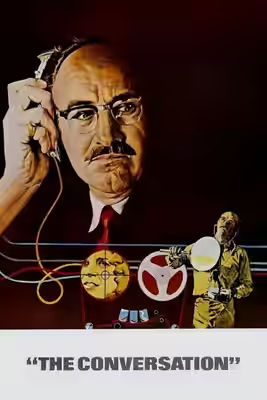
How does The X-Files compare to The Conversation?
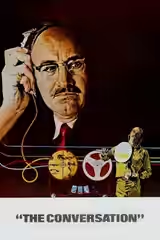
The X-Files is the less assured thriller beside The Conversation, which we recommend more strongly for its gripping suspense and mystery that earns its unease. Choose The X-Files for the engaging central partnership and larger-scale action; choose The Conversation for patient suspicion, careful listening and Gene Hackman’s portrayal of loneliness, despite a few over-arranged plot decisions.
What should I watch after The X-Files?
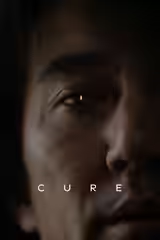
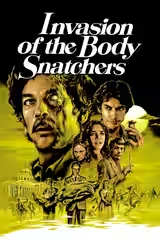
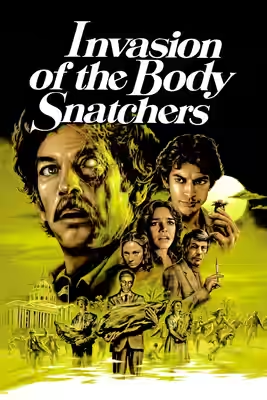
After The X-Files, try The Conversation (1974, Fi1m 92): For patient suspicion, careful listening and a mystery that earns its unease. Then Cure (1997, Fi1m 85): A quieter investigation, with dread accumulating through encounters rather than spectacle; and Invasion of the Body Snatchers (1978, Fi1m 86): For alien anxiety that gives everyday encounters an unpleasant second meaning.

Cast

If you liked this, try…

  1. The Conversation (1974, Fi1m 92)For patient suspicion, careful listening and a mystery that earns its unease.

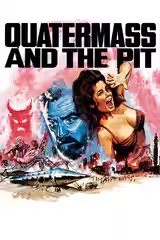
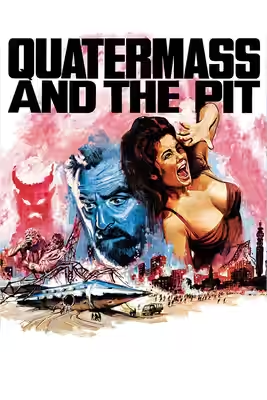
  2. Quatermass and the Pit (1967) · not reviewed yetAnother investigation where scientific curiosity leads somewhere distinctly uncomfortable.

  3. Cure (1997, Fi1m 85)A quieter investigation, with dread accumulating through encounters rather than spectacle.

  4. Invasion of the Body Snatchers (1978, Fi1m 86)For alien anxiety that gives everyday encounters an unpleasant second meaning.

  5. Arrival (2016, Fi1m 86)For science fiction that makes the work of understanding someone feel urgent.

Free account

Know what to watch tonight

Two lists that know where things are streaming, collections you can share, your own score beside ours, and Discover that remembers what you have seen.

  • Want to see, sorted by what is streaming now
  • Seen, with your score out of ten
  • No adverts, ever