Lin-Manuel Miranda’s first film as director is a thank-you note to Jonathan Larson, and it is best when it stops being grateful and lets Andrew Garfield fret at a piano. Hurried and uneven, and more moving than it has any right to be.
Jonathan Larson wrote Rent, and he died the night before its first preview in 1996, aged 35. Before that he wrote a one-man show about turning 30 with nothing produced. Lin-Manuel Miranda has made it his first film as director, and the result is a warm, busy, often touching 120 minutes, best when it slows down and weakest when it is trying to be helpful. We liked it more than its parts add up to, and most of the reason is Andrew Garfield.
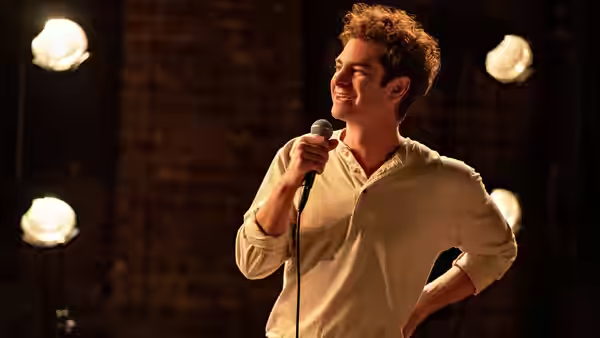
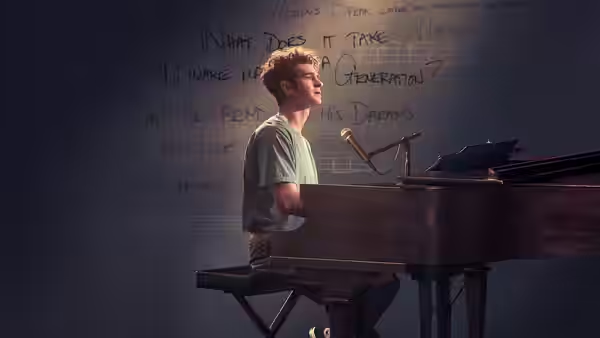
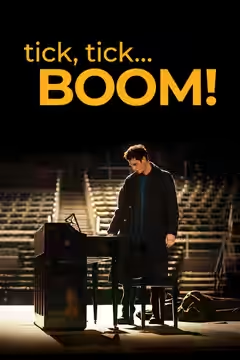
Steven Levenson’s screenplay frames the piece as a performance. Garfield’s Jon sits at a piano on a bare stage in 1992 with a small band behind him, Vanessa Hudgens and Joshua Henry singing at his shoulder, and tells an audience about 1990. The film then cuts out to the year itself: the diner, the flat, the rehearsal room, the workshop eight days away. The device is neat and it is also the film’s main trouble, because Miranda cannot resist cutting back to the stage the moment a scene in the flat threatens to go quiet. Scenes that need a breath do not get one.
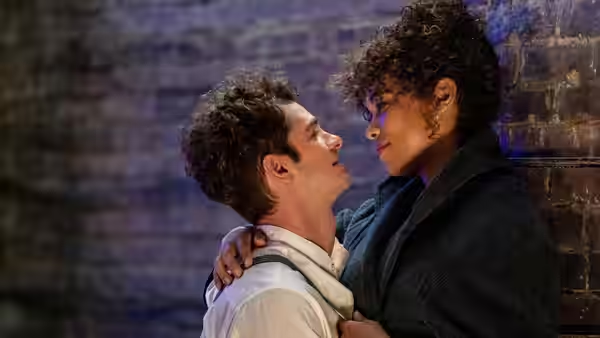
Garfield is the thing to see it for. He sings, he plays, and he does both as a man who cannot hear a compliment without checking the clock. Jon is needy, self-absorbed and hard to live with, and the film adores him; Garfield is more careful, and lets us see how tiring he must have been to everyone around him. The eyes are the performance. In the diner, at the piano, at a party, they keep flicking to some private countdown, and Garfield never lets the anxiety curdle into shtick.
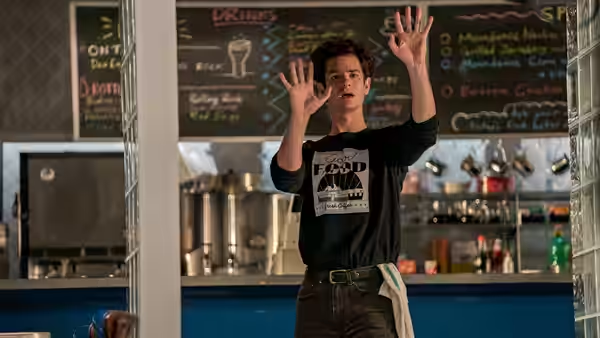
The numbers, when Miranda trusts them, are the case for his direction. In “Sunday”, a brunch shift at the Moondance Diner becomes a hymn to coffee refills and the ceiling appears to lift off; we grinned through the whole thing, then noticed we had spent half of it spotting the stage veterans Miranda has planted at the tables, and the gratitude got between us and the song. “Therapy”, a bright duet about a relationship falling apart, is cut against the real argument it describes, and the editors Andrew Weisblum and Myron Kerstein land the cheerful tune and the unhappy fight on the same beat. Alice Brooks lights the flat in yellow lamplight and the 1992 stage in a cool, thin blue, so we always know which year we are in.
Robin de Jesús is the second reason to watch. His Michael, who has swapped the theatre for an advertising agency, plays every scene with the ease of a man who has stopped arguing with his own decision, and his exchanges with Garfield are the film’s real love story. Alexandra Shipp’s Susan gets less to do than she deserves; Levenson writes her as a question Jon keeps not answering. Judith Light is brisk and funny as the agent Rosa Stevens, and Bradley Whitford, as Stephen Sondheim, appears briefly and gets the voice unnervingly right.
What does not work is the hurry. Alex DiGerlando and Lydia Marks fill Jon’s flat with sheet music on every surface and a bathtub in the kitchen, and Melissa Toth keeps him in the same striped jumper for what feels like a fortnight; these details say more about a life on no money than the script finds time to. The friends dealing with illness, Ben Levi Ross and Michaela Jaé Rodriguez among them, become a footnote the film does not mean to write.
And then, near the end, a number sung alone at a piano moved us a good deal more than we expected. We had been told at the outset how Larson’s story ends, and it still got past us, because Garfield plays it as a man realising how long the road is rather than how short his time will be. It is the film’s one moment of stillness, and it makes the case for a few more.
See it, preferably with someone who has been told they are running out of time, which is more or less everyone. It runs 120 minutes and carries a 12A.