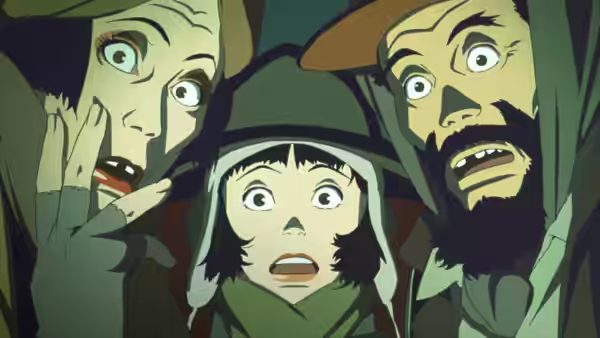
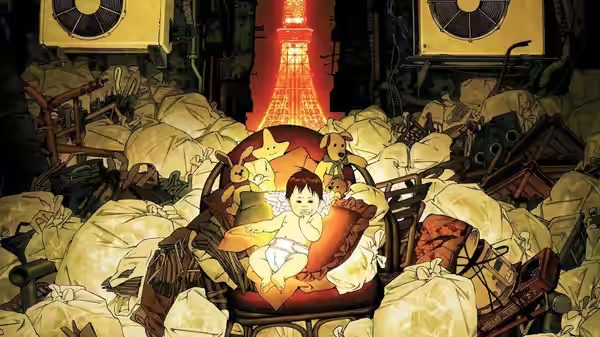
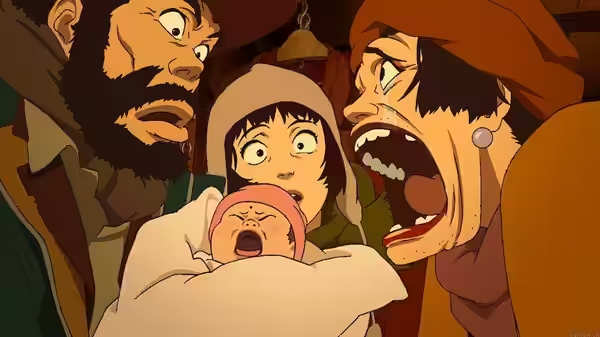
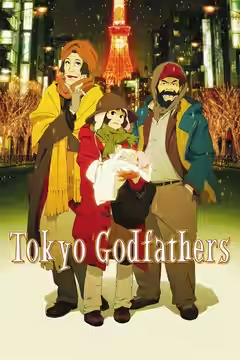
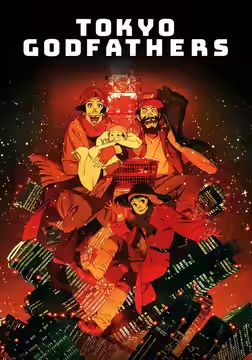
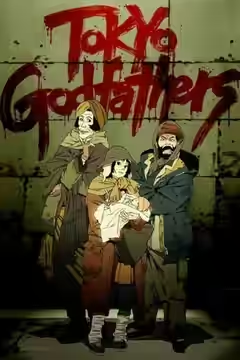
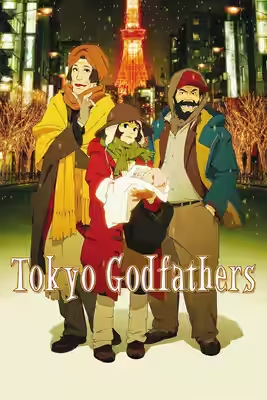
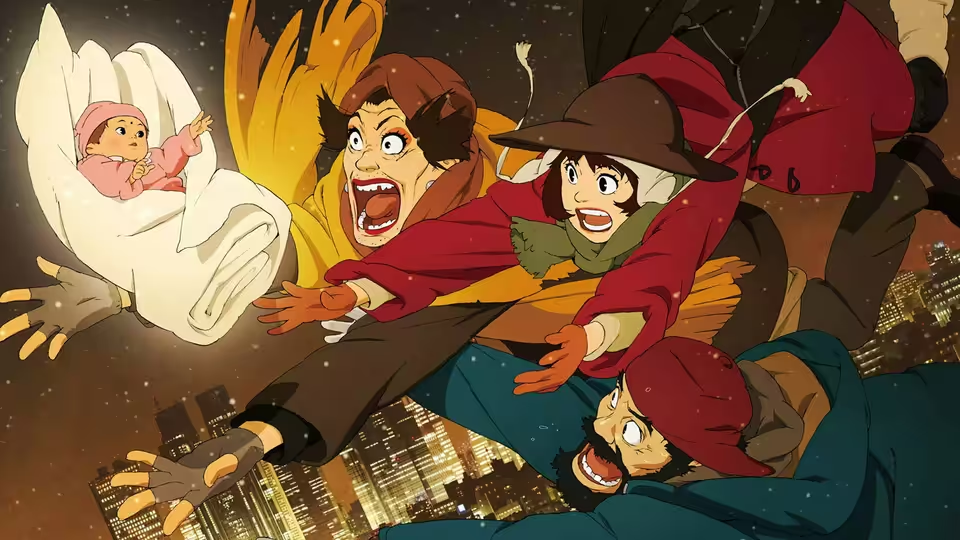
Hana, Gin and Miyuki fall through the night sky clutching baby Kiyoko
Film review

Tokyo Godfathers

2003 · Directed by Satoshi Kon · 1h 32m

In a sentenceThree rough sleepers, one foundling and a Tokyo where every passing stranger turns out to be somebody’s long-lost relation

Tokyo, Christmas Eve, in the snow. Gin (Tohru Emori), a drinker with a story about the family he says he lost, Hana (Yoshiaki Umegaki), a former drag performer who has always wanted a child, and Miyuki (Aya Okamoto), a teenage runaway, share a cardboard shelter and a church soup queue. Rooting through rubbish that night they find a newborn girl wrapped in a blanket, with a bag beside her holding a locker key and a photograph. Hana names her Kiyoko, declares her a gift from God, and refuses to hand her to the police. The three set out across the city to find the mother themselves, with no money, no plan and the baby needing milk.

Plays from YouTube when you press play; nothing loads from them until then.

Fi1m review

Satoshi Kon puts three homeless people and an abandoned baby into Tokyo on Christmas Eve and lets chance do the rest. It is funny, drawn with real affection for a cold city, and it moved us more than a plot this contrived has any right to.

Satoshi Kon’s first two films, Perfect Blue and Millennium Actress, were about people who could no longer tell where their lives ended and their fantasies began. Tokyo Godfathers is a plainer thing: a Christmas story. Three homeless people find a baby in a rubbish heap on Christmas Eve and set out across Tokyo to return her to her mother. Kon and his co-writer Keiko Nobumoto have borrowed the shape from John Ford’s 3 Godfathers, and they have made the warmest film Kon put his name to. It is also built almost entirely on coincidence, and how much that bothers you will decide how much you love it. We loved it a good deal and it bothered us a little.

The three are drawn with a broad pen and then given room to surprise you. Gin (Tohru Emori) is a drunk with a red nose and a story about the family he says he lost, which changes depending on how much he has had. Hana (Yoshiaki Umegaki) used to sing in a drag bar, calls herself a mother without a womb, and treats the baby as a parcel delivered to her personally. Miyuki (Aya Okamoto) is a teenage runaway who has decided to be rude to both of them before they can be rude to her. They bicker like people who have shared a shelter for years. Hana names the child Kiyoko, refuses to take her to the police, and the others follow because it is Christmas and they have nothing else on.

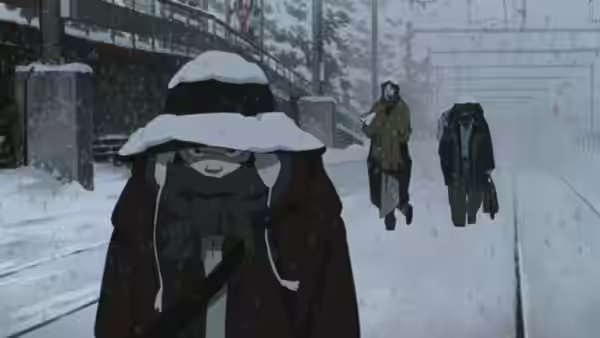
The city is the fourth character, and it is drawn with more care than most live-action films give it. Katsutoshi Sugai keeps the light low and blue for most of the running time: slush, overpasses, blue tarpaulin shelters, vending machines glowing on empty streets. The people are caricatures, Hana’s jaw the size of a shoebox, Gin’s stubble drawn a bristle at a time, and they walk through backgrounds so exact you could find your way home by them. The contrast is the point. Takeshi Seyama and Kashiko Kimura cut in Kon’s manner, a memory dropping into the present on a single hard edit, a night’s drinking done in three shots, and it never feels like showing off.

Keiichi Suzuki’s score is a brass band that has had a drink, swinging along under the arguments. It is loud, and some of the reviews have found it grating; there are moments, mainly in the chases, where it underlines a joke that has already landed. But when the arrangement of Beethoven arrives at the end it earns its noise. We had been smiling for an hour and a half and found that we were crying, which we do not often report about a cartoon with a pratfall in it.

What got us was Hana. Umegaki plays her enormous, all gesture and poetry and self-pity, and for the first half hour we laughed at her and then felt slightly ashamed of ourselves. There is a scene, around the midpoint, where she explains in a few flat sentences why the baby must go back to her own mother and not to a home, and the film stops joking for about a minute. It is the quietest Umegaki gets, and it is where the film turns from a comedy about tramps into something kinder. We were caught off guard, and we had been warned.

The coincidences are the caveat. A key in the baby’s bag leads the three into the city, and from then on the story runs on chance: the right stranger in the right doorway at the right minute, again and again, each meeting tied to one of their pasts. Kon knows exactly what he is doing and calls it a Christmas miracle, which covers a lot, and by the last third it covers too much. Miyuki is also the thinnest of the three; Okamoto is given a sulk, a shout and one phone call, and her story is told to us rather than shown. A chase late on runs past the point where it is funny.

Against Kon’s own work it is the least clever and the easiest to hand to someone who thinks they do not like anime. It does not want to frighten or dazzle you; it wants you to look at three people you would step round on the pavement. At 92 minutes it does not overstay. Watch it in the week before Christmas, when the heating is on and you are inclined to forgive things, and do not count the coincidences. They add up faster than you would like, and it does not matter.

Critical consensus AI synthesised

79
Positive
9
Mixed
0
Negative
1

Most critics like Tokyo Godfathers, and nine of the ten reviews come down on its side. The praise gathers around the story itself: three homeless people in Tokyo who find an abandoned baby on Christmas Eve and set out to return it, a set-up several reviews trace to a John Ford western. Critics find the balance of comedy and pathos well judged, with the jokes keeping the sentiment in check, and they admire the pulpy, comic-book look and the affection for the city’s streets.

The reservations are about plot. Even the admirers mention the run of coincidences and the melodrama, and Eye for Film finds them enough to make the story predictable, while also objecting to the score that Variety praises. The AV Club calls it slight next to Kon’s earlier films, with blander animation. Slant Magazine is the lone dissenter, faulting mawkish coincidences and screechy comic relief. The later reviews are noticeably warmer than the early ones.

Los Angeles Times
16 January 2004 · Manohla Dargis
90*

The critic finds warmth amid harsh reality in this animated feature about three misfits who become makeshift parents to a baby they discover while scavenging. It singles out the pulp visual style, the well-told story delivered with heart, and the film's refusal to sacrifice pleasure for moralizing.

Read the full review →
The New York Times
16 January 2004 · A.O. Scott
90*

The review calls the film a heartfelt urban fable and neorealist cartoon about three down-and-out characters caring for a foundling baby, inspired by a John Ford western. It singles out the visual and narrative joys, the cool comic-book style that defuses sentiment, and the exuberant love of modern Tokyo.

Read the full review →
Variety
7 December 2003 · festival review
90*

The review highlights the film's masterful grasp of comedy, pathos, social commentary, and mystical weirdness, which takes anime to a new level. It singles out the buoyant mood from the jazzy score, visual poetry, and the search that forces characters to confront their family histories, leading to satisfying narrative resolution.

Read the full review →
The AV Club
13 January 2004 · B+ · Tasha Robinson
83

The critic finds the film funny and touching in its Christmas miracle story of three homeless outcasts finding an abandoned baby, but notes it is slight and pandering compared to the director's earlier works. The lighter tone limits the visual bravura and leaves the animation feeling bland.

Read the full review →
RogerEbert.com
30 January 2004 · Roger Ebert
70*

The critic praises the animated film as both harrowing and heartwarming, following three homeless people who find and care for an abandoned baby on Christmas Eve in Tokyo. The story's coincidences, melodrama, and warm resolution are highlighted alongside the effective use of animation to handle difficult themes.

Read the full review →
Slant Magazine
14 January 2004
40*

The critic sees the film as a straightforward Christmas tale of Tokyo outcasts inspired by a John Ford western, with some dreamlike passages and visual flourishes, but faults its mawkish coincidences, screechy comic relief, and lack of surreal kick or motivational depth for the characters.

Read the full review →

Straight answers AI written, from our review

Is Tokyo Godfathers worth watching?
Tokyo Godfathers is worth watching for anyone who wants a Christmas film with three homeless people at its centre, and we scored it 82. It is funny, drawn with great care for a cold Tokyo, and it moved us more than a plot this reliant on coincidence should. The chance meetings pile up in the last third; do not count them.
How long is Tokyo Godfathers, and what is it rated?
Tokyo Godfathers runs 1h 32m. It is an animation and drama film.
Where can I watch Tokyo Godfathers in Iceland?
Tokyo Godfathers is not on any streaming or rental service in Iceland at the moment. It is available in 21 other countries; change your country at the top of the page to see where. Availability is checked daily.
How does Tokyo Godfathers compare to Millennium Actress?
Tokyo Godfathers is the plainer and warmer of the two, a Christmas story told straight, where Millennium Actress is trickier and stranger, folding a woman's life into the films she made. The earlier film is the cleverer; this one is the easier to hand to someone who thinks they do not like anime. We recommend both, and would start here.
What should I watch after Tokyo Godfathers?
After Tokyo Godfathers, try Millennium Actress (2001, Fi1m 86): Kon’s previous film, trickier and stranger, about a life told through the films it made. Then Shoplifters (2018, Fi1m 89): Kore-eda’s makeshift Tokyo family, living on the margins and looking after a child nobody wanted; and Ernest & Celestine (2012, Fi1m 84): A bear and a mouse form a household the world disapproves of; gentle, hand-drawn, funny.

Cast

If you liked this, try…

  1. 3 Godfathers (1948) · not reviewed yetJohn Ford’s original: three outlaws, one baby, a desert instead of the snow.

  2. Millennium Actress (2001, Fi1m 86)Kon’s previous film, trickier and stranger, about a life told through the films it made.

  3. Shoplifters (2018, Fi1m 89)Kore-eda’s makeshift Tokyo family, living on the margins and looking after a child nobody wanted.

  4. Ernest & Celestine (2012, Fi1m 84)A bear and a mouse form a household the world disapproves of; gentle, hand-drawn, funny.

  5. It's a Wonderful Life (1946, Fi1m 91)The Christmas film this one is arguing with, darker than its reputation and just as forgiving.

Free account

Know what to watch tonight

Two lists that know where things are streaming, collections you can share, your own score beside ours, and Discover that remembers what you have seen.

  • Want to see, sorted by what is streaming now
  • Seen, with your score out of ten
  • No adverts, ever