Michael Bay’s fourth Transformers film has a new cast, a new country and Stanley Tucci in a lab coat, and none of it stops the machine. At 165 minutes it is the longest and least coherent of the series.
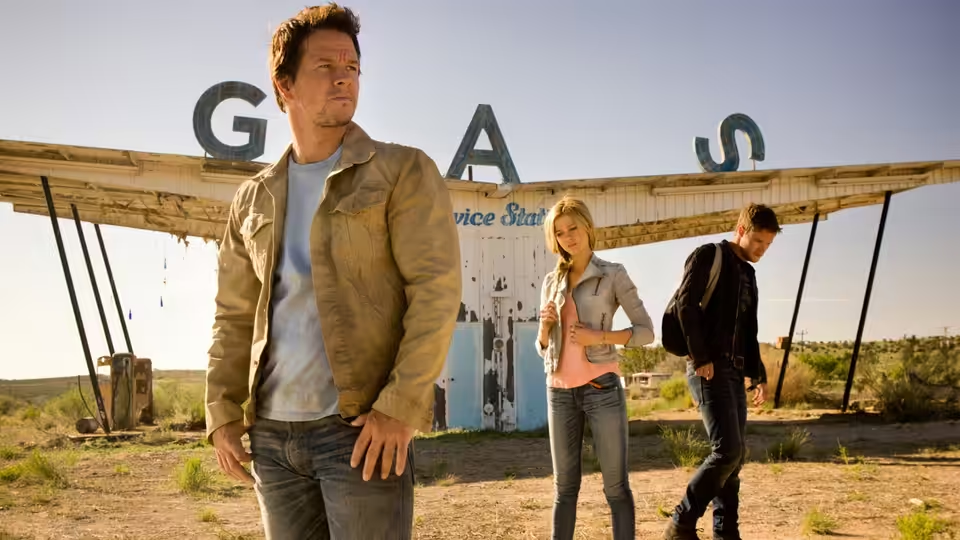
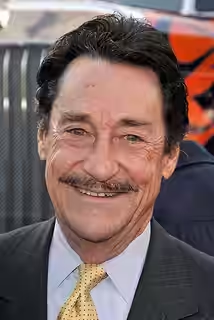
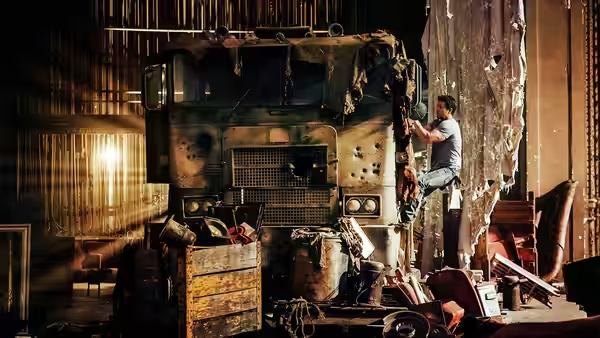
Michael Bay’s fourth Transformers film starts again. Ehren Kruger’s script moves the story to Texas, where Cade Yeager (Mark Wahlberg), a broke inventor, buys a wrecked lorry for parts and finds it is Optimus Prime (Peter Cullen). The Autobots are now fugitives, hunted by a CIA man, Harold Attinger (Kelsey Grammer), and sold for scrap to an industrialist, Joshua Joyce (Stanley Tucci), who is building his own. It is a reasonable idea for a fresh start. The film then runs for 165 minutes, longer than any of the three before it, and the fresh start lasts about forty of them.
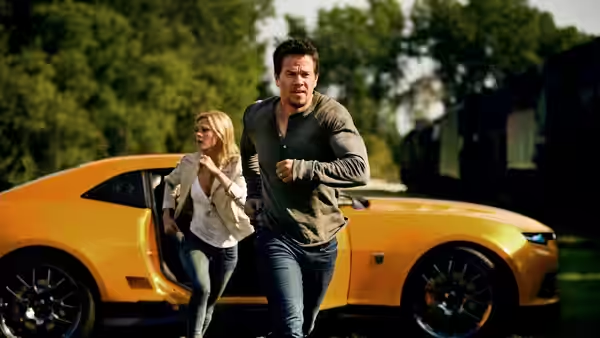
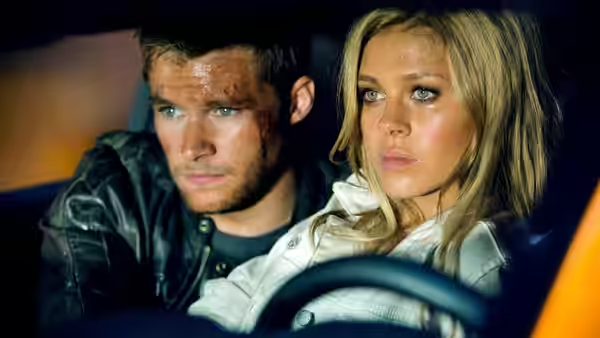
The first act is the best stretch, mostly because it is the only one at a scale a person can read. Amir Mokri shoots the Texas farm in low evening light, with the camera down near the dirt and the sky doing most of the work, and when Attinger’s men arrive and Cade’s barn goes up, Bay stages it as a raid rather than a battle. Wahlberg plays Cade as an exasperated dad who happens to be able to build a robot, and he is likeable in it. Jack Reynor’s Shane, the rally driver dating Cade’s daughter Tessa (Nicola Peltz), carries a laminated card explaining why that is legal in Texas, and the film thinks this is funny. It is not, and it tells you how little thought went into either of them.
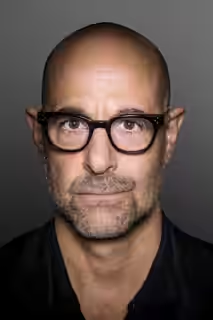
Stanley Tucci is the reason to sit through the middle. His Joyce is a smooth, nervy salesman who has reverse-engineered the dead robots into a metal he can shape at will, and Tucci plays him as a man discovering, one line at a time, that he is out of his depth. Jeffrey Beecroft’s design for the company headquarters is a clean white laboratory in Chicago where a block of the stuff turns itself into a handgun and then a loudspeaker, and it is the one sequence in which the effects are allowed to be strange rather than loud. We laughed properly at Tucci twice, which is twice more than the rest of the cast managed between them.
Then the machine takes over. Roger Barton, William Goldenberg and Paul Rubell are credited as editors, three of them, and even so we spent long stretches unable to say where anyone was standing, who was firing, or why. A fight in a city street cuts to a robot’s shoulder, to a car flipping, to Peltz screaming, to a slow pan up a product, and back. Steve Jablonsky’s score runs underneath all of it at one volume, so there is no quiet to measure the noise against. Somewhere in the second hour we stopped trying to follow it and began watching the clock, and by the third we were angry about that, because the robots themselves look better than they ever have. You can see Hound (John Goodman) and Drift (Ken Watanabe) as separate bodies rather than a heap of parts, and nobody gives them a scene worth the detail.
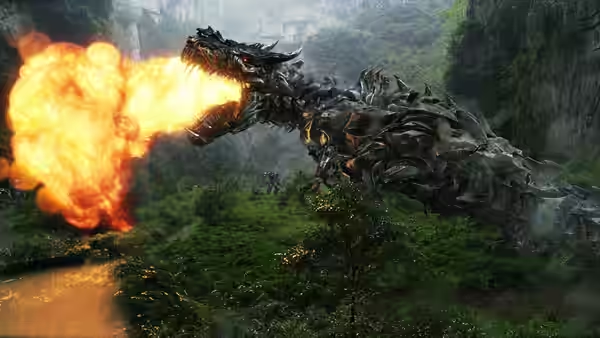
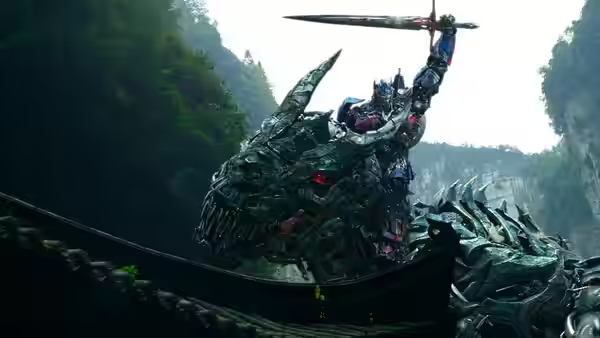
The last hour moves to Hong Kong, and we will not describe what arrives there beyond saying it is on the poster. Mokri’s helicopter shots of the harbour are handsome, and the film treats the city as a place to break, which is what it did to Chicago. Marie-Sylvie Deveau’s job on Peltz is a pair of cut-off shorts and a camera angle. Li Bingbing’s Su Yueming is given a motorbike, a fight and no character. Kelsey Grammer glowers in a good suit.
Bay made Pain & Gain the year before this, a small, mean film that at least knew what it thought of its characters. Here he is back on the assembly line, and the difference shows. The first three Transformers films were loud and silly and had, at their best, a cheerful vulgarity; this one is loud and silly and solemn, and the solemnity is what wears you down. Most critics landed near where we have, and the few who enjoyed it mostly said they were enjoying the noise and not much else.
If you have a twelve-year-old who wants to see robots hit each other, there is nothing here that will harm them beyond the running time, and the 12A is fair. Everyone else should take the Tucci scenes and leave. We would not say that about a film we thought was lazy; this one is the opposite, every frame worked over by hundreds of people, which is the sad part.