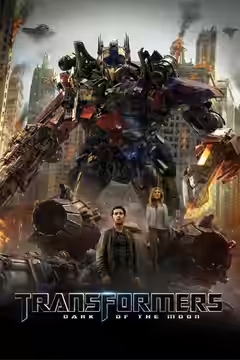
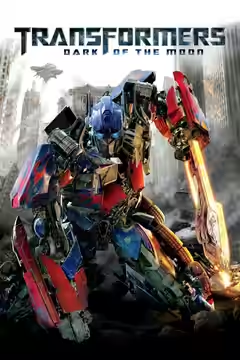
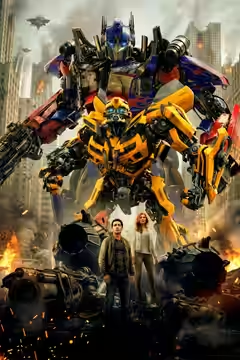
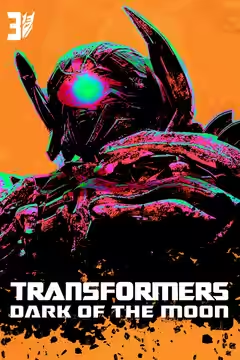
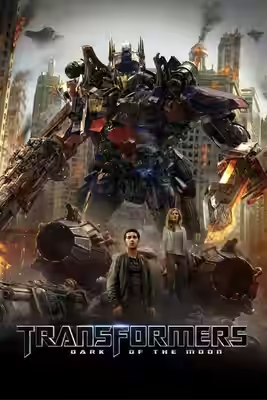
Michael Bay’s third Transformers film hides, in its last hour, the clearest action he has staged in the series and a tilting skyscraper that had us gripping the armrest. Getting there means an hour of Shia LaBeouf shouting through a domestic comedy, which is too much.
Michael Bay’s third Transformers film opens with the best idea the series has had. In Ehren Kruger’s script, the Apollo 11 landing of 1969 was, among other things, a mission to look at a wrecked Cybertronian ship on the far side of the moon, and Bay stages the cover-up with archive footage, lookalikes and a hushed Mission Control, cut with real care. It is a tight, witty ten minutes. The film then runs for 154 minutes, most of which are neither, though the last hour contains the best action Bay has staged in the series. That is our verdict, and the proportions are the problem.
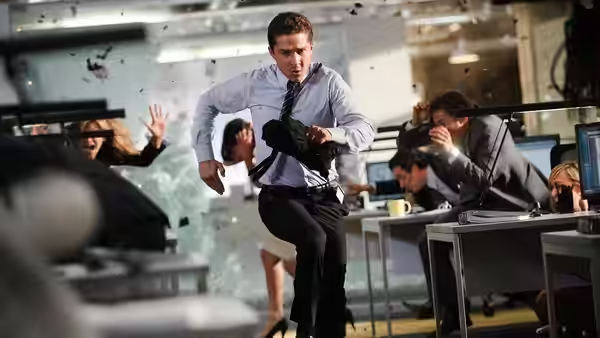
The trouble starts when we come down from the moon. Sam Witwicky (Shia LaBeouf) is back, with Carly (Rosie Huntington-Whiteley) beside him, and Kruger spends the best part of an hour on their civilian life, played as comedy. LaBeouf plays all of it at a yelp. John Malkovich, as Bruce Brazos, turns himself up to match and earns stares rather than laughs. Kevin Dunn’s Ron Witwicky is back and given little to do. We looked at our watch during this stretch, which we had not expected in a film about alien robots.
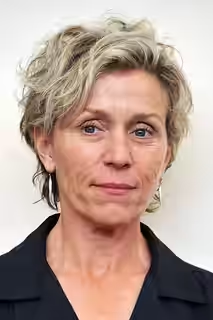
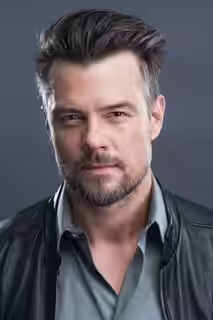
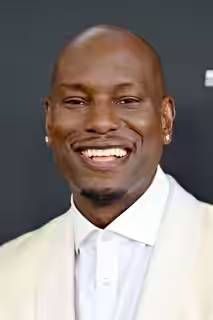
The grown-ups fare better. Frances McDormand plays Mearing, the intelligence chief who oversees the robots’ human unit, as a woman who has read the file and is not impressed by any of it, and she gets the only laughs that were meant as laughs. John Turturro’s Simmons is back, louder and richer than before, and we were glad of him for about two scenes. Josh Duhamel and Tyrese Gibson, as the soldiers Lennox and Epps, do what they did in the earlier films, which is run towards things.
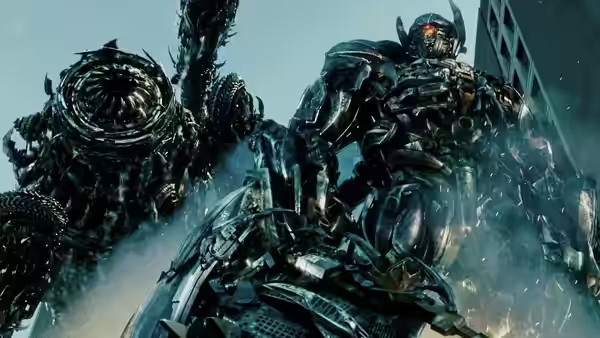
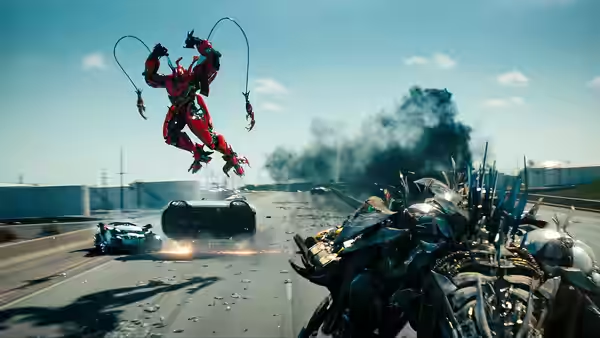
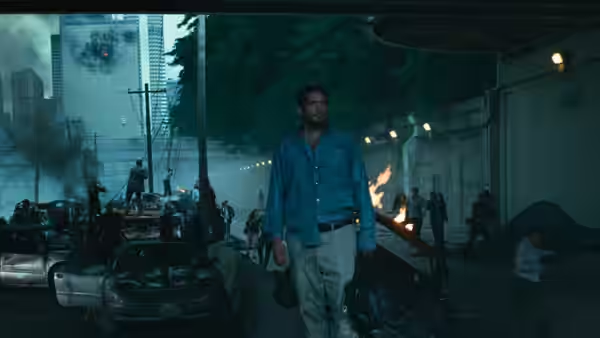
The robots are another matter, and here Bay has learned something. Amir Mokri shoots the fighting wider and holds it longer than the previous film did, so that for the first time you can usually tell which machine is hitting which. William Goldenberg, Roger Barton and Joel Negron cut at a speed the eye can follow more often than not. Nigel Phelps’s production design gives the wrecked ship on the moon a proper scale, all dead corridors and dust, and when the action reaches Chicago in the last hour the streets are dressed as a city that has already lost. Leonard Nimoy’s voice as Sentinel Prime is the one piece of gravity among the machines. Hugo Weaving’s Megatron spends much of the film sulking under a tarpaulin.
The office tower is the sequence everyone talks about, and they are right to. It comes late, so we will say only that Bay stages it mostly from inside the building, in long takes, and that our stomach went. We gripped the armrest for perhaps three minutes, which we cannot remember doing in either of the earlier films. Nothing else in the last hour lands like that.
That is the film’s difficulty. Steve Jablonsky scores the last hour with choirs and drums at one pitch throughout, the editors keep the cuts coming, and the fighting goes on well past the point where any of it costs anything. Huntington-Whiteley is photographed in Deborah Lynn Scott’s white dress the way Bay photographs cars, from low down and at length, and is asked to do nothing else. By the end we had watched a city destroyed in enormous detail and felt about it roughly what we feel about a demolition on the news.
Against Bay’s own work it sits in the middle. Revenge of the Fallen, from 2009, was a mess nobody could read; this one can be read, which is an improvement; it is still an hour too long. The first film had a boy and his car and knew that was enough. Here the boy has a girlfriend, a government and a war to worry about, and the film cares about none of them.
See it for the tower and the last forty minutes, and only if a city falling over is your idea of an evening. If you are watching at home, the first hour is a good time to make dinner. The film will not notice.