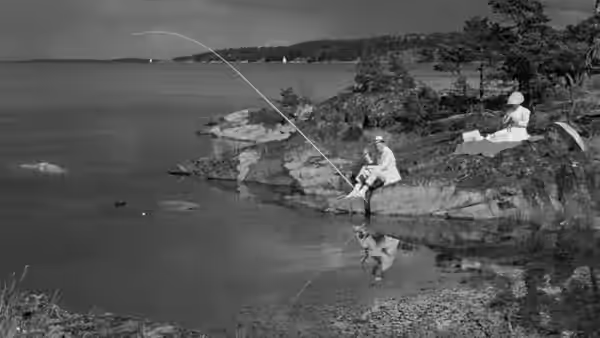
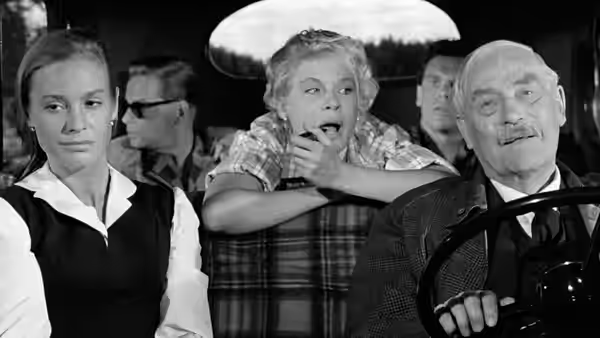
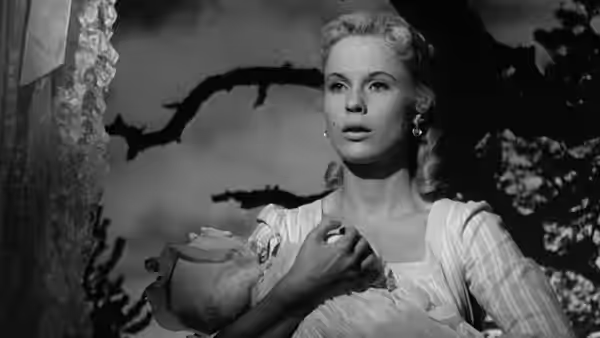
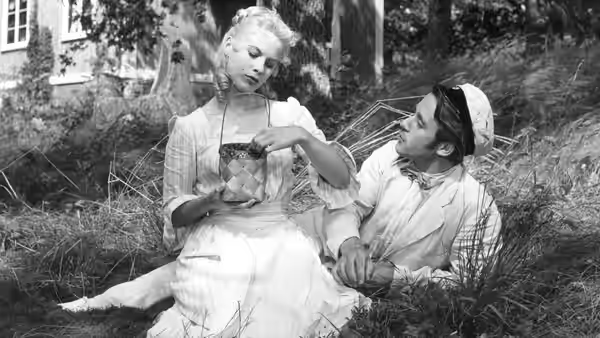
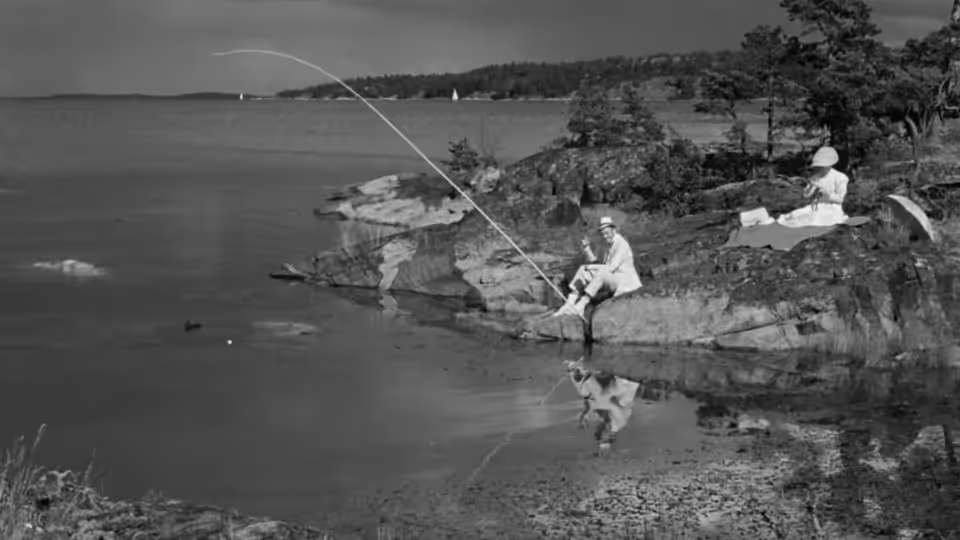
A man fishes from the rocky shore while another person sits beside the water
Film review

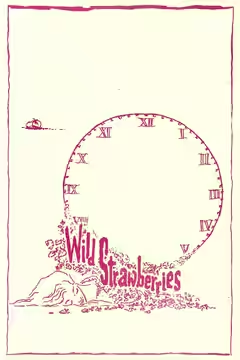
Wild Strawberries

1957 · Directed by Ingmar Bergman · 1h 31m

In a sentenceNinety-one minutes with a lonely professor, and we would happily have stayed longer

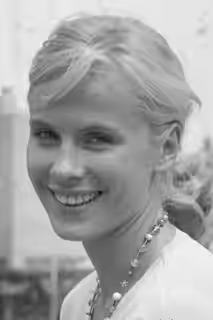
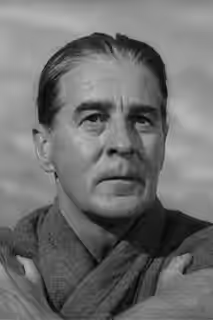
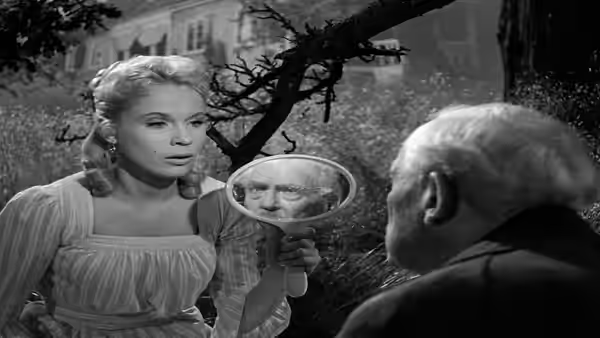
Professor Isak Borg (Victor Sjöström) is an elderly academic whose journey turns his attention towards the life he has led. Marianne (Ingrid Thulin) and Sara (Bibi Andersson) are among the people around him as he begins to reckon with his isolation. He wants to escape that loneliness, but the habit of keeping others at a distance is difficult to break. A nightmare gives his fears a shape, while the journey provides time for reflection. His regrets accompany him as he considers how much of his unhappiness he has brought upon himself.

Plays from YouTube when you press play; nothing loads from them until then.

Fi1m review

Victor Sjöström makes an isolated professor worth caring about without asking us to excuse him. Ingmar Bergman’s drama is warm, unsettling and occasionally too insistent with its symbolism, but the performance keeps it human.

Wild Strawberries is a moving film about a man whose loneliness has something to do with how he has treated other people. Ingmar Bergman allows the professor regret without treating it as sufficient reason to forgive him, and that makes the warmth convincing. We recommend it, with one reservation: some of the symbolism presses a point already clear in the performance. Victor Sjöström gives the film enough awkwardness and vulnerability to keep those heavier passages from taking over.

Victor Sjöström makes the professor’s reserve seem habitual. There is no need to strain for a grand explanation of the man when the performance keeps us attentive to the difficulty he has dealing with other people. We found his loneliness more upsetting than we expected, because he never seems entirely innocent of it. The character remains difficult company, and the actor trusts us to stay interested without making him charming whenever our sympathy might ebb.

The nightmare frightened us. It makes the professor’s fear immediate enough to interrupt the more comfortable business of watching an elderly man reflect. Gunnar Fischer’s careful compositions matter here: they encourage us to look closely and give the unease time to build. The sequence makes the professor’s distress harder to regard from a safe distance, and its disturbance stays with the gentler material.

Oscar Rosander’s editing gives the film room to move from melancholy towards gaiety without treating the lighter stretches as an interruption. That matters in a drama concerned with age: an unbroken procession of solemn thoughts would soon become oppressive. The music credited to Erik Nordgren and Göte Lovén supports the feeling without insisting that every regret deserves a swell of pity. At 91 minutes, the film gives reflection time without making slowness a virtue in itself.

Gittan Gustafsson’s production design is unobtrusive enough to keep our attention on the people. The surroundings leave us free to study the faces, which is where this film does its most persuasive work. Ingmar Bergman’s screenplay is less discreet when it reaches for symbols, and there are passages where interpretation becomes too easy. The difficulty is small but persistent: we would rather be allowed to watch the professor than feel his condition being explained for us.

For a reflective drama, it has a welcome interest in the pleasures of being alive. The changes in mood prevent the professor’s regrets from becoming the only things we are permitted to notice, and the lighter passages make his isolation more painful. That is also what makes the occasional heavy emphasis frustrating: the film has already shown how much it can communicate through a performance and a change of mood. Its humour deserves as much attention as its solemnity.

Save it for an evening when quiet attention feels possible. The nightmare makes it an unwise choice if the plan is simply to find something soothing. Give Victor Sjöström the uninterrupted 91 minutes.
Critical consensus AI synthesised

86
Positive
8
Mixed
0
Negative
0

The consensus on Wild Strawberries is warmly positive, with all eight reviews finding much to admire in Bergman’s account of an elderly professor reckoning with his life. Praise centres on Victor Sjöström’s sensitive performance, particularly his handling of nostalgia, dread and regret without losing the character’s humanity. The reviews also stress Bergman’s empathy towards Borg’s isolation. Careful composition and graceful shifts between melancholy and gaiety support a film repeatedly described as warm, moving and accessible.

The differences are chiefly matters of degree, with no outright dissent and reservations confined to particular choices. Total Film finds some of the symbolism overdone, while still admiring the complexity of the character portrait. Empire offers the most qualified response, finding that parts creak but praising the evocation of old age. Neither reservation substantially weakens the shared appreciation of Sjöström’s performance.

Radio Times
★★★★★ · David Parkinson
100

Parkinson calls it Bergman’s warmest and most accessible film. He particularly praises Victor Sjöström’s magisterial performance as the professor.

Read the full review →
Slant Magazine
8 June 2013 · ★★★★★ · Chuck Bowen
100

Bowen praises the film’s emotional depth and its humane, moving conclusion. He singles out Bergman’s empathy and the film’s precise portrayal of Borg’s struggle to escape his self-imposed isolation.

Read the full review →
IndieWire
1 August 2014 · Max O'Connell
85*

O’Connell presents the film as a warm, modest reflection on a man reckoning with his life. He praises the balance between Bergman’s introspection and Sjöström’s nuanced, bittersweet portrayal of Borg.

Read the full review →
The Guardian
· Peter Bradshaw
85*

Bradshaw finds the film deeply satisfying and praises its careful composition. He singles out its graceful shifts between melancholy and gaiety.

Read the full review →
Time Out
· GA
85*

The review presents the film as one of Bergman’s warmest and finest. It singles out the emotional warmth of an elderly academic’s journey.

Read the full review →
Los Angeles Times
14 June 2013 · Andy Klein
80*

Klein treats the film as an enduring Bergman classic, with a chilling nightmare scene standing out. He also praises the Criterion Blu-ray’s excellent commentary and top-notch extras.

Read the full review →

Straight answers AI written, from our review

Is Wild Strawberries worth watching?
Wild Strawberries is worth watching for its moving portrait of a lonely professor, and we score it 88 out of 100. Victor Sjöström makes him worth caring about without excusing his behaviour; the symbolism sometimes labours what his performance already tells us, but we recommend it for an evening of quiet attention.
How long is Wild Strawberries, and what is it rated?
Wild Strawberries runs 1h 31m. It is a drama film.
Where can I watch Wild Strawberries in Estonia?
Wild Strawberries is not on any streaming or rental service in Estonia at the moment. It is available in 9 other countries; change your country at the top of the page to see where. Availability is checked daily.
How violent or frightening is Wild Strawberries, and is it suitable for children?
Wild Strawberries has a UK 15 certificate, and its frightening nightmare makes it unsuitable for a soothing family evening or for children under 15. The nightmare frightened us because it makes the professor’s fear immediate; older teenagers comfortable with unsettling material may find the reflective drama rewarding.
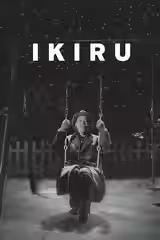
How does Wild Strawberries compare to Ikiru?
Wild Strawberries is the more inward-looking companion to Ikiru: its professor considers his loneliness, while the dying civil servant in Ikiru considers what his remaining time might be good for. We recommend Ikiru more broadly and Wild Strawberries particularly for quiet reflection; both rely on affecting central performances, though Bergman’s symbolism and Kurosawa’s satire sometimes explain what is already clear.
What should I watch after Wild Strawberries?
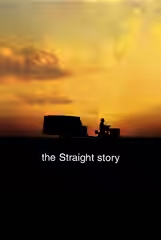
After Wild Strawberries, try Ikiru (1952, Fi1m 92): A public servant considers what his remaining time might be good for. Then The Straight Story (1999, Fi1m 88): An elderly traveller, family regret and a journey made at human speed; and Poetry (2010, Fi1m 87): Everyday duties and difficult moral questions gather around another quietly absorbing older protagonist.

Cast

Awards

Academy Awards, 1960

Nominated
Best Writing, Original Screenplay

Berlin International Film Festival, 1958

Won
Golden Bear

Silver nugget for the best foreign film, 1958

Won
Silver nugget for the best foreign film

If you liked this, try…

  1. Ikiru (1952, Fi1m 92)A public servant considers what his remaining time might be good for.

  2. The Straight Story (1999, Fi1m 88)An elderly traveller, family regret and a journey made at human speed.

  3. Poetry (2010, Fi1m 87)Everyday duties and difficult moral questions gather around another quietly absorbing older protagonist.

  4. The Green Ray (1986) · not on Fi1m yetLoneliness and awkward company, observed with patience and a welcome sense of humour.

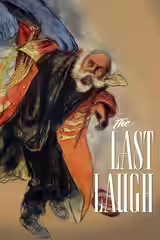
  5. The Last Laugh (1924, Fi1m 84)An ageing man’s pride and humiliation, conveyed through a closely watched performance.