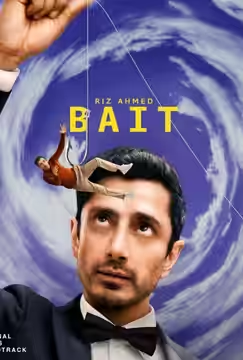
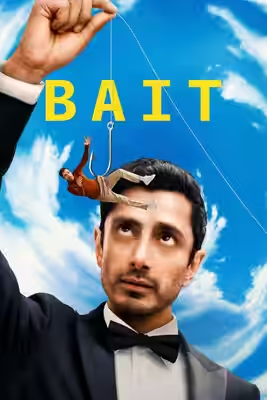
Riz Ahmed makes Bait a funny, uneasy comedy about an actor trying to win a job and please far too many people. Its family scenes cut deepest; some supporting characters deserve more attention.
Bait is at its funniest when Shah Latif’s professional ambition starts to sound like a public duty. Riz Ahmed plays a struggling Muslim actor auditioning for James Bond, a job interview that invites everyone else to have an opinion about his worth. The six-part series makes sharp, often uncomfortable comedy from that disproportion, and we recommend it with a reservation about how little space some other people get. Getting the job would be hard enough without having to decide whose approval would make it worth having.
Ahmed is good at making the desire for approval look embarrassing without making Shah seem beneath our concern. We felt for him more than we expected: the prospect of a Bond role keeps becoming a question about a Muslim actor’s right to belong, rather than his ability to act. He is allowed to be funny and needy at once. That matters in a satire which could easily make its central performer too sensible to be caught behaving badly.
The family scenes are where the comedy becomes less dutiful and more alive. Guz Khan, as Zulfi, is a valuable presence in an ensemble that gives Ahmed something to react to, and the pleasure comes from people being funny together rather than taking turns to explain the programme’s concerns. We laughed more readily here than at the industry satire. The family dynamics make questions of belonging feel personal, which is useful when the premise keeps threatening to become a debate.
Directors Tom George and Bassam Tariq let the comedy share space with psychological thriller, and the changes usually keep Shah’s anxiety from becoming repetitive. Frank Lamm and Dan Atherton’s cinematography, together with Steve Summersgill’s production design, gives those changes a polish that suits a story about an actor under scrutiny. It can also make the distress feel a little too tidily presented. We prefer the family scenes, where there is less need for the production to announce how unusual this story is.
Mark Davies, Anthony Boys, Gary Dollner and Jo Walker’s editing keeps the six episodes compact despite the changes of genre. That is an achievement in a comedy which has room for family, industry satire and psychological unease, any one of which could have taken over. Shruti Kumar’s music helps the different moods sit together. We are most persuaded, though, when the programme gives its actors time to respond to each other.
The limitation is in the writing, to which Ahmed also contributes. Some supporting relationships are underdeveloped, leaving other characters too little opportunity to complicate our understanding of Shah. A few self-satisfied moments also ask for more credit for recognising the pressures on him than the comedy has earned. The cast makes those gaps more noticeable, because the glimpses of a wider life are often so enjoyable that we would happily spend longer there.
Comedies about actors can become tiresome when they assume that professional disappointment is interesting by itself. Bait mostly avoids that trap because its audition carries consequences beyond Shah’s career, and because Ahmed is willing to make the hunger for acceptance look foolish. There are enough good jokes to keep the discussion from becoming a lecture. Come for Ahmed, but allow for the irritation of wanting more time with the people around him.