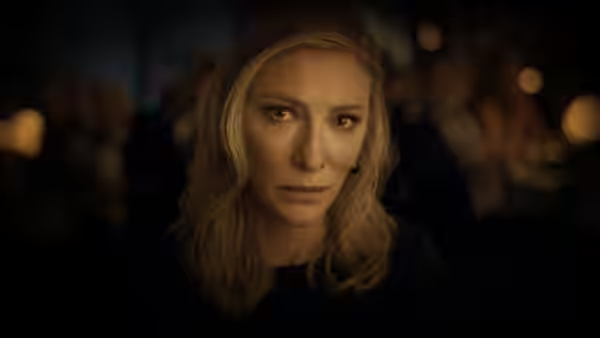
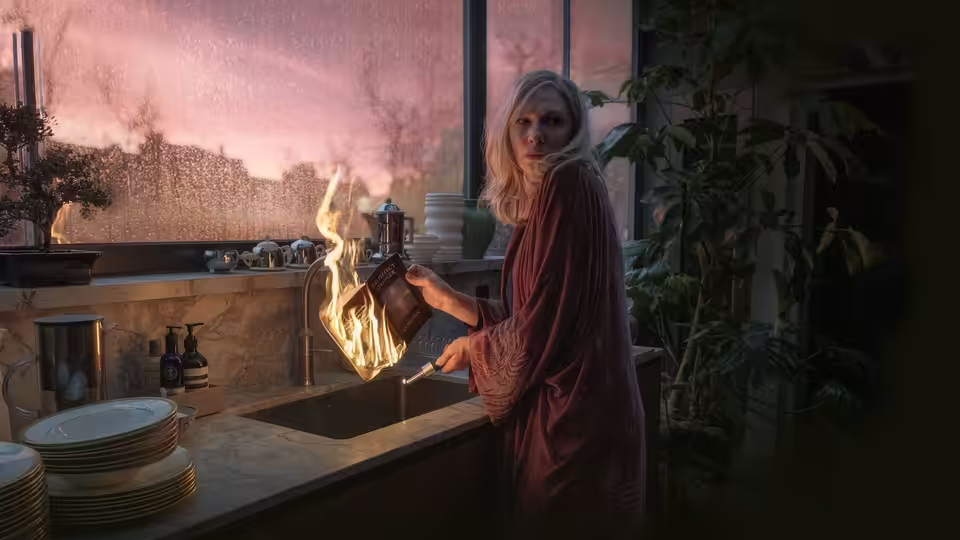
Catherine Ravenscroft (Cate Blanchett) holds a flaming object beside the kitchen sink
Series review

Disclaimer

2024 · Created by Alfonso Cuarón · Series · FSK 16

In a sentenceTwo cinematographers, seven hours and a narrator who will not let you reach a single conclusion on your own

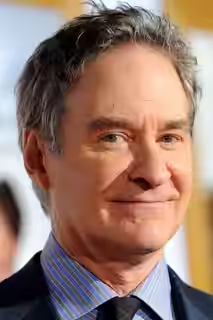
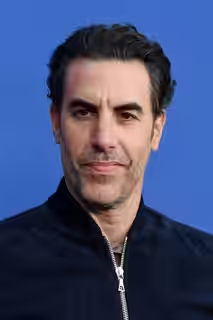
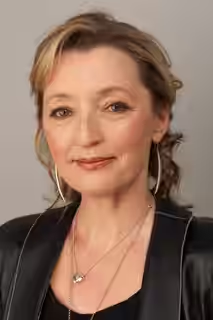
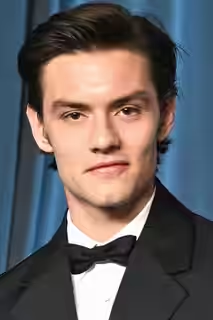
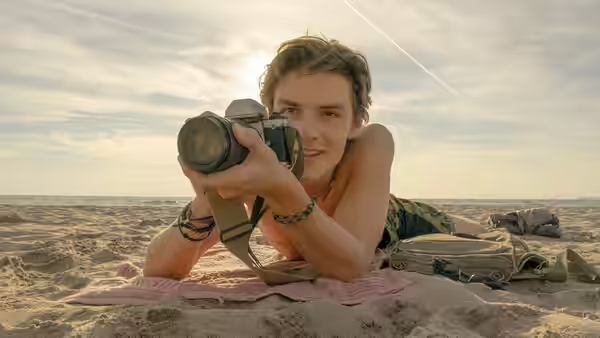
Catherine Ravenscroft (Cate Blanchett) is a London documentary maker with a husband, Robert (Sacha Baron Cohen), and a son, Nicholas (Kodi Smit-McPhee), who lives at home and barely speaks to her. A novel arrives in the post with no note. Its disclaimer, the line about resemblance to real people being coincidental, has been struck through, and the story inside appears to be hers: a summer on an Italian beach years ago, an affair, and a young man who drowned. The sender is Stephen Brigstocke (Kevin Kline), a retired teacher whose late wife Nancy (Lesley Manville) wrote the book and whose son Jonathan (Louis Partridge) was the young man. Stephen has read it, found the photographs, and decided what Catherine owes him. Leila George plays the Catherine of that summer.

Plays from YouTube when you press play; nothing loads from them until then.

Fi1m review

Alfonso Cuarón’s seven-part adaptation of Renée Knight’s novel is as handsome as anything on television and about half as clever as it thinks. Cate Blanchett and Kevin Kline are worth watching; the narrator telling us what to make of them is not.

Alfonso Cuarón writes and directs Disclaimer, seven episodes from Renée Knight’s novel, and what it is trying to do is plain. Take a woman who has made a career out of deciding what other people’s stories mean. Hand her a story about herself, written by someone else. Then see whether anyone, including the people at home, will let her tell her own version. That is a good idea for a thriller and a tight two-hour film. Cuarón has given it seven hours, and the length is the first thing wrong with it.

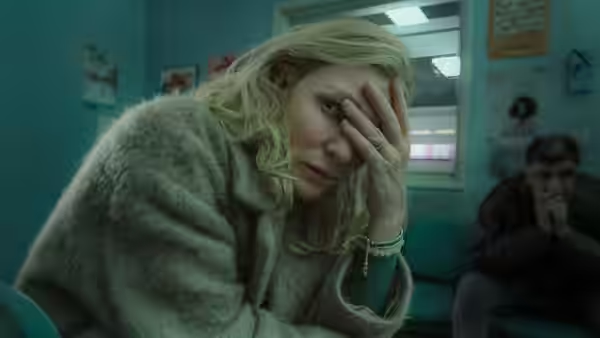
There are three strands, and the series looks different in each. Bruno Delbonnel and Emmanuel Lubezki share the camera credit, and between them the London of Catherine Ravenscroft (Cate Blanchett) is rain, glass and grey wool, while the Italian beach where young Catherine (Leila George) spent a summer is shot so bright that skin and sand come out the same colour. Neil Lamont gives the Ravenscrofts a house that is mostly window and Stephen Brigstocke (Kevin Kline) a terrace that has not been dusted since his wife died. Jany Temime puts Blanchett in cream and camel and keeps Kline in the same cardigan for most of the run. It looks expensive because it is, and it looks like the work of people who cared.

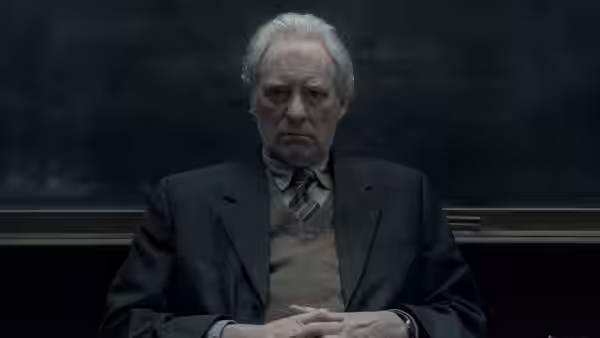
Kline is the reason to keep going. His Stephen is a retired teacher who has found, late in life, that grief gives him permission to be vile, and he enjoys it; he makes a trip to the shops look like a threat. Blanchett has the harder job. The part asks Catherine to be unreadable for six of the seven hours, and Blanchett does unreadable as well as anyone working, but a series that hides its lead from us for that long is asking for a great deal of patience. Sacha Baron Cohen is quietly good as her husband Robert, a weak man who mistakes his weakness for fairness, and Kodi Smit-McPhee is handed a sulk rather than a son to play.

Lesley Manville got at us. She has perhaps a dozen scenes as Nancy Brigstocke, the mother who wrote the book, and in one of them she simply sits down to write, turning what she cannot say out loud into pages, and it moved us more than anything else in the seven hours. She does it without raising her voice and mostly without dialogue. The series is at its best when she is on screen, and she is barely on screen.

Then there is the narrator. Indira Varma’s voice addresses Catherine as “you” and everyone else in the third person, and it is on almost constantly, telling us what a face means a second or two after the face has told us. By episode three we were bored, and by episode four we were cross about being bored, because the pictures were doing the job and the voice kept doing it again. Adam Gough cuts between the three strands cleanly enough that we never once lost our place; the voiceover behaves as if we might. Finneas O’Connell’s score, mostly piano and low strings, presses the same points a third time.

The whole thing rests on the gap between what the novel inside the series says happened and what happened, and the later episodes take a turn we will not describe. What we can say is that the turn depends on us having believed the book, and that the series spends six hours giving us no reason not to, so when the correction arrives the earlier hours look less like a mystery than a delay. Cuarón’s films, Children of Men, Gravity, Roma, held a shot until it earned its meaning. Here the shots are as good as ever and he does not trust them.

Most critics have split straight down the middle on this, and we can see both halves. Watch the first two episodes for Kline and Manville and for the beach, which earns the 18 certificate on its own. Varma’s voice had not sent us to bed by then, and it did not later, but we found the remaining five hours a handsome, slow, well-acted wait for a piece of information.

Critical consensus AI synthesised

52
Positive
6
Mixed
1
Negative
6

The reviews split almost evenly, six in favour and six against, with one sitting between. What nearly everyone agrees on is how it looks: Cuarón’s cinematography, the sepia-tinted Italian scenes and the editing across timelines are praised by admirers and detractors alike. Kevin Kline is the most consistently praised performer, with Cate Blanchett close behind, and Collider singles out Leila George as the younger Catherine.

The disagreement is over whether the story deserves the style. IndieWire, The AV Club and Den of Geek find the shifting perspectives compelling and smart. The Guardian calls it slow and turgid and Vulture calls it pretentious and airless, while The i Paper and Variety fault predictable twists, an intrusive voiceover and a mishandled central reveal. The spread is wide, from top grades to outright dismissal, and The Ringer’s complaint that it resembles prestige television from five years ago sums up what the sceptics think.

IndieWire
30 August 2024 · A- · Ben Travers
90

Travers calls the series a cunning, all-consuming psychological thriller whose provocative ideas remain tightly connected to its entertainment value. He particularly praises Cuarón’s balancing of three perspectives and the visual storytelling that makes the shifting narratives compelling.

Read the full review →
The AV Club
11 October 2024 · A- · Brian Tallerico
90

Tallerico praises the premiere as a nuanced, riveting adaptation that lives up to its prestigious production. He especially singles out its seamless editing across timelines and its striking cinematography and visual design.

Read the full review →
Evening Standard
10 October 2024 · ★★★★ · Madeleine Spencer
80

Spencer finds the series stylish, slick, sexy and compelling, despite a narrative that jumps around and lacks a clear thread early on. She singles out Cuarón’s visually stunning cinematography, especially the sepia-tinted Italian scenes, for praise.

Read the full review →
The Hollywood Reporter
30 August 2024 · festival review · Daniel Fienberg
55*

Fienberg finds the series dazzling in the moment but somewhat silly and thin on reflection. He praises the performances, especially Cate Blanchett and Kevin Kline, while criticizing the story for feeling perfunctory.

Read the full review →
The i Paper
11 October 2024 · Francesca Steele
25*

Steele finds the series an enjoyable but forgettable thriller that mistakes itself for something more profound. She praises Kevin Kline’s ferocious performance, while faulting the predictable twists and intrusive voiceover.

Read the full review →
Variety
11 October 2024 · Alison Herman
20*

The critic finds the series a failed feminist thriller, undone by its drawn-out pacing and ineffective handling of its central reveal. She praises Cuarón’s striking imagery but says it cannot make the story work.

Read the full review →

Straight answers AI written, from our review

Is Disclaimer worth watching?
Disclaimer is worth watching only for Kevin Kline and Lesley Manville, and we scored it 56. Alfonso Cuarón's seven-part series is as handsome as anything on television, but a narrator keeps explaining faces that have already explained themselves, and the mystery turns out to be a long wait for one piece of information.

How long is Disclaimer, and what is it rated?
Disclaimer is rated 16 by the FSK in Germany. It is a drama and mystery series.
Where can I watch Disclaimer in Germany?
Disclaimer is streaming on Apple TV in Germany. Availability is checked daily; the links above go straight to each service.
How violent or frightening is Disclaimer, and is it suitable for children?
Disclaimer carries an 18 certificate in the UK and is not for children or younger teenagers. The Italian beach scenes alone earn the rating, and the series is adult in subject throughout, dealing with an affair, a drowning and a grieving father's campaign against the woman he blames. It is not frightening in a horror sense.
How does Disclaimer compare to Caché?
Disclaimer and Caché both begin with an anonymous parcel and a buried secret, but Haneke's film never once tells you what it means, while Cuarón's series has a narrator telling you constantly. Caché is the tighter and more unsettling of the two; Disclaimer has the better cast and seven times the running length to fill.
Is Disclaimer based on a true story or a book?
Disclaimer is based on Renée Knight's novel of the same name, not on a true story. Cuarón's series keeps the book's device of a novel arriving in the post with its disclaimer struck through, and you need not have read Knight to follow it; the series explains itself more than enough.
What should I watch after Disclaimer?
After Disclaimer, try Caché (2005, Fi1m 88): Anonymous videotapes arrive at a Paris door; Haneke never once tells you what they mean. Then The Hunt (2012, Fi1m 82): A Danish village decides what a man did, and the deciding is the horror; and Atonement (2007, Fi1m 83): A girl’s version of one afternoon ruins three lives; fiction as a weapon, done in two hours.

Cast

If you liked this, try…

  1. Caché (2005, Fi1m 88)Anonymous videotapes arrive at a Paris door; Haneke never once tells you what they mean.

  2. Notes on a Scandal (2006) · not on Fi1m yetBlanchett again, a secret again, and a narrator whose account you should not trust.

  3. The Hunt (2012, Fi1m 82)A Danish village decides what a man did, and the deciding is the horror.

  4. Atonement (2007, Fi1m 83)A girl’s version of one afternoon ruins three lives; fiction as a weapon, done in two hours.

  5. The Undoing (2020, Fi1m 61)Rich people, a death, six episodes and a lead who may not be telling us everything.

Disclaimer (2024) review: handsome, well acted, talked to death (Germany) | Fi1m