Alfonso Cuarón’s seven-part adaptation of Renée Knight’s novel is as handsome as anything on television and about half as clever as it thinks. Cate Blanchett and Kevin Kline are worth watching; the narrator telling us what to make of them is not.
Alfonso Cuarón writes and directs Disclaimer, seven episodes from Renée Knight’s novel, and what it is trying to do is plain. Take a woman who has made a career out of deciding what other people’s stories mean. Hand her a story about herself, written by someone else. Then see whether anyone, including the people at home, will let her tell her own version. That is a good idea for a thriller and a tight two-hour film. Cuarón has given it seven hours, and the length is the first thing wrong with it.
There are three strands, and the series looks different in each. Bruno Delbonnel and Emmanuel Lubezki share the camera credit, and between them the London of Catherine Ravenscroft (Cate Blanchett) is rain, glass and grey wool, while the Italian beach where young Catherine (Leila George) spent a summer is shot so bright that skin and sand come out the same colour. Neil Lamont gives the Ravenscrofts a house that is mostly window and Stephen Brigstocke (Kevin Kline) a terrace that has not been dusted since his wife died. Jany Temime puts Blanchett in cream and camel and keeps Kline in the same cardigan for most of the run. It looks expensive because it is, and it looks like the work of people who cared.
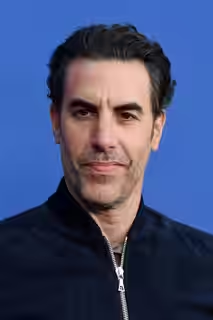
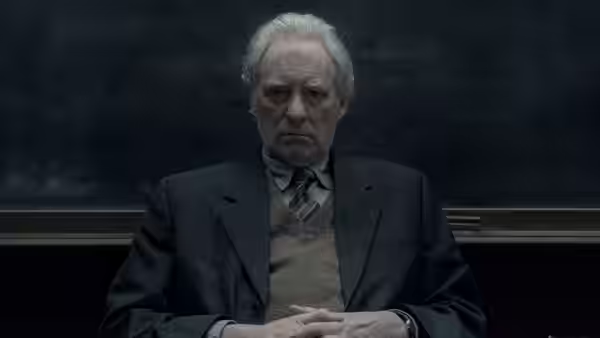
Kline is the reason to keep going. His Stephen is a retired teacher who has found, late in life, that grief gives him permission to be vile, and he enjoys it; he makes a trip to the shops look like a threat. Blanchett has the harder job. The part asks Catherine to be unreadable for six of the seven hours, and Blanchett does unreadable as well as anyone working, but a series that hides its lead from us for that long is asking for a great deal of patience. Sacha Baron Cohen is quietly good as her husband Robert, a weak man who mistakes his weakness for fairness, and Kodi Smit-McPhee is handed a sulk rather than a son to play.
Lesley Manville got at us. She has perhaps a dozen scenes as Nancy Brigstocke, the mother who wrote the book, and in one of them she simply sits down to write, turning what she cannot say out loud into pages, and it moved us more than anything else in the seven hours. She does it without raising her voice and mostly without dialogue. The series is at its best when she is on screen, and she is barely on screen.
Then there is the narrator. Indira Varma’s voice addresses Catherine as “you” and everyone else in the third person, and it is on almost constantly, telling us what a face means a second or two after the face has told us. By episode three we were bored, and by episode four we were cross about being bored, because the pictures were doing the job and the voice kept doing it again. Adam Gough cuts between the three strands cleanly enough that we never once lost our place; the voiceover behaves as if we might. Finneas O’Connell’s score, mostly piano and low strings, presses the same points a third time.
The whole thing rests on the gap between what the novel inside the series says happened and what happened, and the later episodes take a turn we will not describe. What we can say is that the turn depends on us having believed the book, and that the series spends six hours giving us no reason not to, so when the correction arrives the earlier hours look less like a mystery than a delay. Cuarón’s films, Children of Men, Gravity, Roma, held a shot until it earned its meaning. Here the shots are as good as ever and he does not trust them.
Most critics have split straight down the middle on this, and we can see both halves. Watch the first two episodes for Kline and Manville and for the beach, which earns the 18 certificate on its own. Varma’s voice had not sent us to bed by then, and it did not later, but we found the remaining five hours a handsome, slow, well-acted wait for a piece of information.