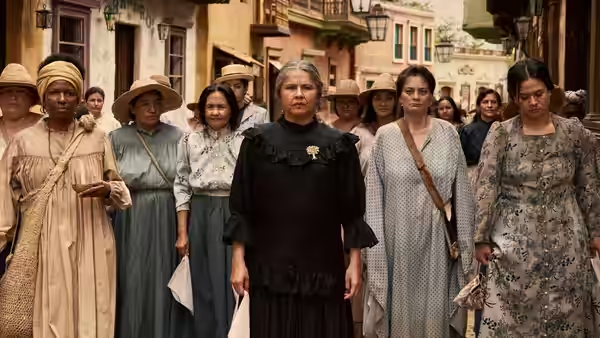
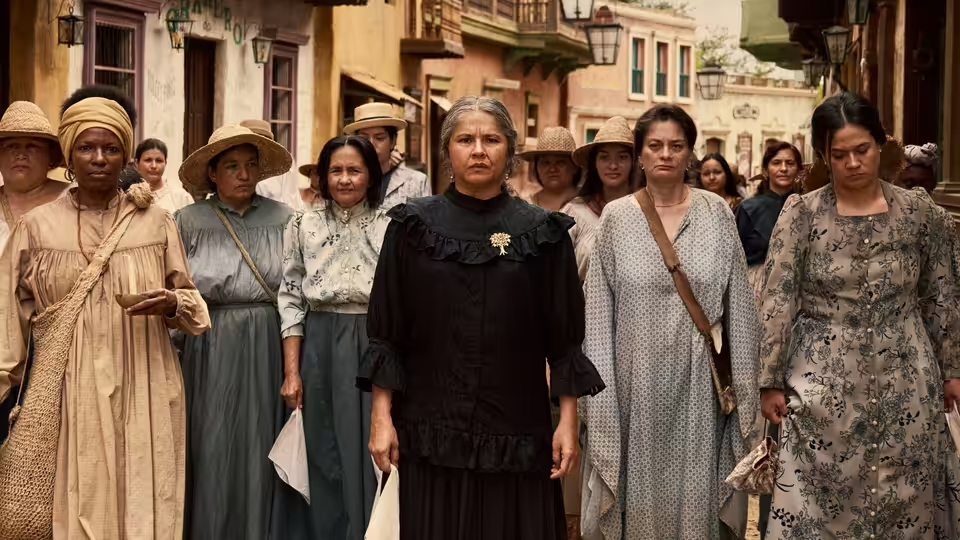
Several women in long dresses stand together on a town street
Series review

One Hundred Years of Solitude

2024 · Series

In a sentenceMacondo is real at last, and someone keeps reading the book over the top of it

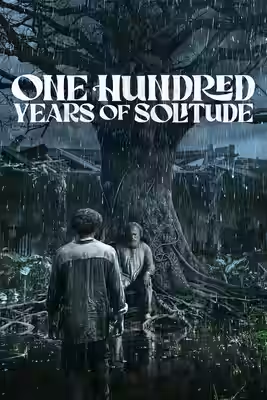
In Macondo, the riverbank village that José Arcadio Buendía and his wife Úrsula Iguarán have founded and built with their own hands, the Buendía family grows up in the house at its centre. The first episodes follow the founders’ sons: José Arcadio (Emmanuel Restrepo), big and restless and drawn to the card-reader Pilar Ternera (Viña Machado), and his younger brother, the future Colonel Aureliano Buendía (Claudio Cataño), quiet and watchful, who works silver in a back room. Gypsies arrive each year with magnets, a telescope and, one March, a block of ice. Pilar bears Aureliano a son, Aureliano José (Emiliano Pernía). Strangers begin to find the road in, a magistrate turns up with orders from the capital, and the family’s sense that it is alone in the world starts to fail.

Plays from YouTube when you press play; nothing loads from them until then.

Fi1m review

García Márquez’s novel gets the long, Spanish-language, made-in-Colombia treatment it always needed, and a Macondo built to grow old on camera. It is often beautiful, and it has a narrator reading the book over the pictures, which we think is a loss of nerve.

Gabriel García Márquez’s novel spent decades being called unfilmable. This version has been made properly: in Spanish, in Colombia, with Colombian actors, over sixteen episodes in two parts of eight, the first released on 10 December 2024 and the second in August 2026. It is handsome, patient and careful with the strange parts. It is also more obedient to the book than it needed to be, and that is where it goes wrong.

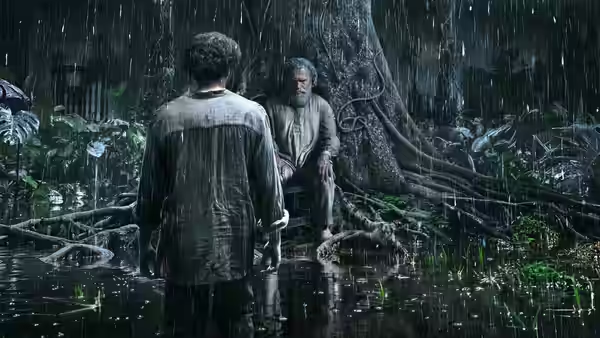
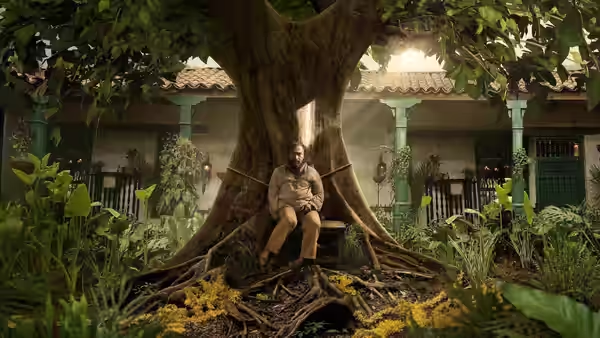
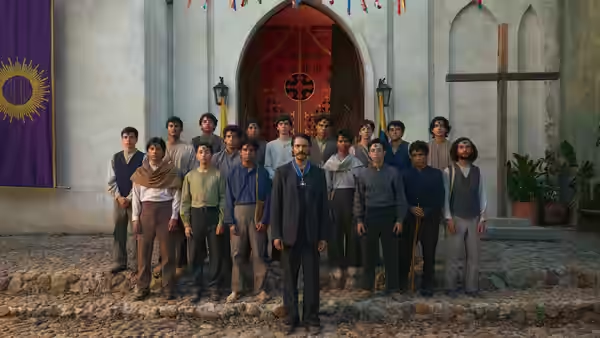
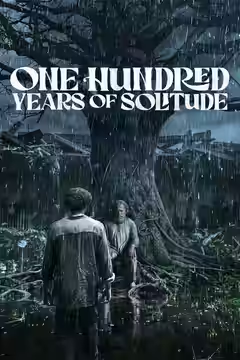
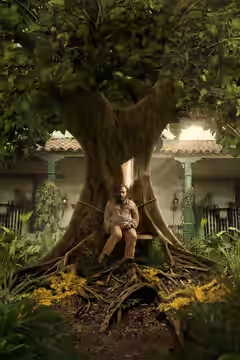
The best decision was to build Macondo and let it grow old. Production designers Eugenio Caballero and Bárbara Enríquez start with mud and cane on a riverbank and add to it as the family does: whitewash, roof tiles, a magistrate’s house, a street of almond trees. The Buendía house gains a room each time it gains a child, and you can see the joins. Catherine Rodríguez’s costumes make the same journey, from homespun to starch. Paulo Perez shoots most of it in flat, hot daylight and saves the trickery for the long takes, in which the camera walks in at the front door, goes down a corridor and comes out with the children grown. Those shots are the programme’s one real idea about time.

The magic is done without a raised eyebrow. Melquíades’s magnets drag pots off shelves; a dead man stands in the kitchen with a cloth to his throat, asking for water; a block of ice is shown to a child, who takes it for a miracle. What got at us most was the insomnia plague. Nobody in Macondo can sleep, then nobody can remember, so they write the names of things on the things, until a cow wears a sign explaining that she is a cow and must be milked. The directors, Alex Garcia Lopez, Carlos Moreno and Laura Mora Ortega, play it straight, with no music and no wonder on anybody’s face, and we found it more upsetting than we expected. Camilo Sanabria and Juancho Valencia’s music keeps out of these scenes, and when the yellow flowers fall they fall to almost nothing.

Then there is the voice. A narrator reads the book to us, and not sparingly: whole paragraphs laid over scenes that were already doing the work. When the camera has shown Úrsula counting the coins, the voice tells us Úrsula counted the coins. The writers, José Rivera and María Camila Arias among them, have kept García Márquez’s sentences because they are wonderful sentences. But a programme is not a reading, and by the fourth episode we were bored by the voice, and then cross with ourselves for being bored by prose we love. Most critics have counted this as fidelity. We think it is a loss of nerve.

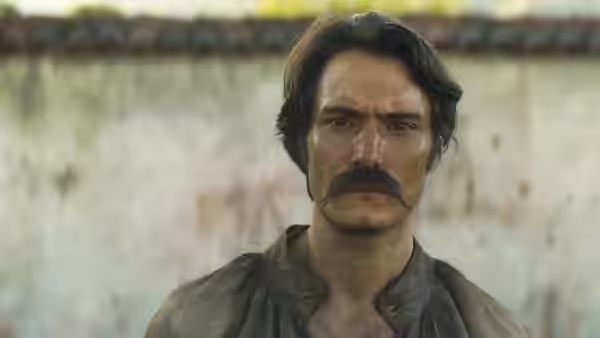
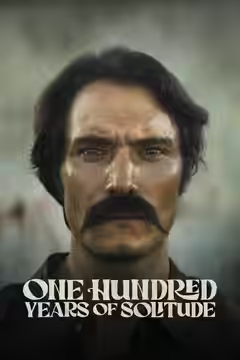
The recasting across the decades is handled well. Pilar Ternera, the card-reader, is Viña Machado in her prime and Obeida Benavides later; Fernanda del Carpio passes from Laura Taylor to Carla Baratta the same way. Claudio Cataño plays Colonel Aureliano Buendía as a man who watches everything and says little, which is right and makes him easy to lose in a crowded house. Emmanuel Restrepo’s José Arcadio is a walking appetite. Úrsula, played at more than one age, is the spine of it, and whoever was on screen as her, we believed she had been there for a century.

The book’s habits with women have come across intact. Pilar takes the Buendía boys to bed when they are barely boys; Aureliano falls for a girl who has not stopped playing with dolls, and the courtship is filmed with the same tenderness as everything else. The novel narrates these things flatly and lets the chill in. The series has a narrator, could have used him here, and does not.

Eight hours for half a book is a lot of hours, and the middle episodes know it: scenes run past their point. It is more honest than most literary adaptations, with no English, no famous faces and no shortcut through the difficult chapters. Watch it in Spanish with the subtitles on and give it three episodes. If the ice has you, the rest will keep you. It is an 18 certificate, and it earns it inside the first hour.

Critical consensus AI synthesised

83
Positive
8
Mixed
0
Negative
0

The reviews are uniformly positive: all eight critics recommend the series, and most call it a faithful, carefully made adaptation. The praise gathers around the physical world of Macondo, which several reviewers single out for its detail and for the way the town changes across the years, and around the photography, with the long tracking shots and the rain of yellow flowers mentioned more than once. The Colombian cast is generally admired, and Paste reserves particular praise for Marledy Soto as the elder Úrsula.

The reservations are minor and mostly about tempo. Several critics find the pacing slow and some sequences allowed to linger; Empire suggests the fidelity is at times excessive. The Hollywood Reporter, the coolest of the eight, thinks the series weakens whenever it turns literal or conventionally dramatic, and The Guardian is troubled by how the source novel’s sexual politics are handled. The spread runs from warm to ecstatic, with nobody below approval.

Empire
20 December 2024 · David Opie
90*

Opie finds the adaptation remarkably successful, capturing the novel’s magical realism with awe-inspiring effect. He praises the naturalistic cast and lavish, evolving production, while noting occasional pacing issues and excessive fidelity.

Read the full review →
Evening Standard
11 December 2024 · ★★★★ · William Mata
80

The critic calls the adaptation a magnificent achievement and praises its cohesive, epic storytelling. The performances and painstaking recreation of Macondo help bring García Márquez’s novel to the screen with scale and authenticity.

Read the full review →
Variety
11 December 2024 · Aramide Tinubu
78*

Tinubu finds the adaptation faithful, eloquent, and visually stunning, though its pacing can feel too slow and some sequences unnecessarily linger. She particularly praises the intricate imagery and production design that bring Macondo and its magical realism to life.

Read the full review →
The Guardian
11 December 2024 · Jack Seale
75*

Seale finds the adaptation a big, gorgeous success, though its handling of the source novel’s sexual politics is troubling. He especially praises the care and startling beauty of the scenes depicting the rain of yellow flowers and the trail of blood across Macondo.

Read the full review →
The Hollywood Reporter
10 December 2024 · Daniel Fienberg
70*

The critic finds the adaptation honorable, beautiful, and ambitious, though uneven and less effective when it becomes literal or conventionally dramatic. He praises the directors’ visual imagination, especially the striking long tracking shots that make time and space feel fluid.

Read the full review →
Collider
10 December 2024 · 10/10 · Carly Lane
100

Lane calls the adaptation an ambitious filmmaking triumph that brings the novel to life with care and authenticity. She especially praises its striking cinematography and the detailed, changing depiction of Macondo.

Read the full review →

Straight answers AI written, from our review

Is One Hundred Years of Solitude worth watching?
One Hundred Years of Solitude is worth watching for patient viewers drawn to family drama and matter-of-fact magic; we score it 77. Macondo’s growth and the handling of time make it rewarding, but the narrator repeatedly explains what the pictures already show, and the middle episodes drag. We recommend watching in Spanish with subtitles and giving it three episodes.
Where can I watch One Hundred Years of Solitude in Thailand?
One Hundred Years of Solitude is streaming on Netflix in Thailand. Availability is checked daily; the links above go straight to each service.
How violent or frightening is One Hundred Years of Solitude, and is it suitable for children?
One Hundred Years of Solitude carries a UK 18 certificate and is not suitable for children. Its adult material includes sexual relationships involving the barely adolescent Buendía boys and an adult man’s courtship of a girl still playing with dolls. Ghostly appearances and a plague that robs people of sleep and memory can also unsettle; we found the latter unexpectedly upsetting.
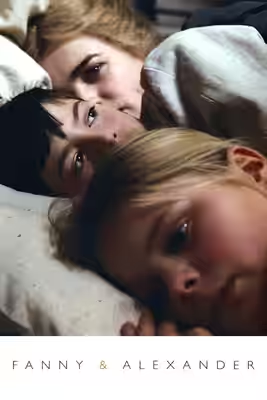
How does One Hundred Years of Solitude compare to Fanny and Alexander?
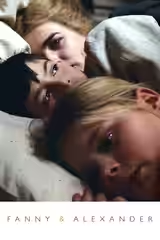
One Hundred Years of Solitude shares a crowded family home and matter-of-fact ghosts with Fanny and Alexander, but we recommend Bergman’s film more strongly. Its warmth, humour and frightening view of childhood make it the better choice for a single evening; the Colombian series suits viewers willing to spend longer watching a family and village grow, despite intrusive narration.
Is One Hundred Years of Solitude based on a true story or a book?
One Hundred Years of Solitude adapts Gabriel García Márquez’s novel rather than a true story, and no prior reading is needed. The Spanish-language production preserves the book’s strangeness and difficult material, but we find its fidelity too cautious when whole paragraphs of narration repeat what the actors and pictures already tell us.
What should I watch after One Hundred Years of Solitude?
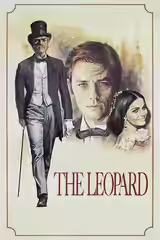
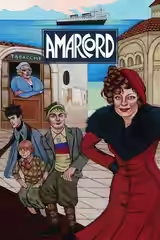
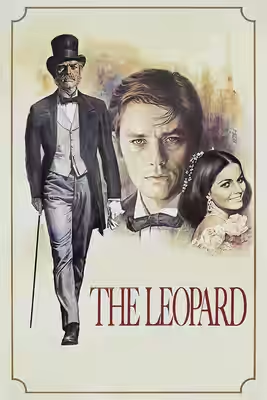
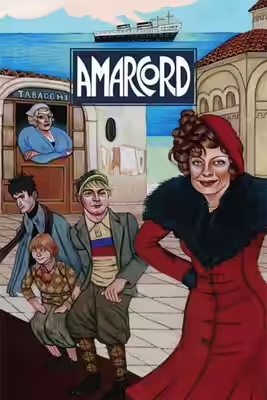
After One Hundred Years of Solitude, try Fanny and Alexander (1982, Fi1m 92): Bergman’s big house full of relatives, ghosts included, and a child who sees them all. Then The Leopard (1963, Fi1m 88): Visconti on a family and a country changing under them, and a ballroom to end it; and Amarcord (1973, Fi1m 82): Fellini’s town as a single character, remembered fondly and not quite accurately.

Cast

If you liked this, try…

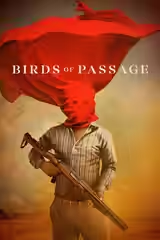
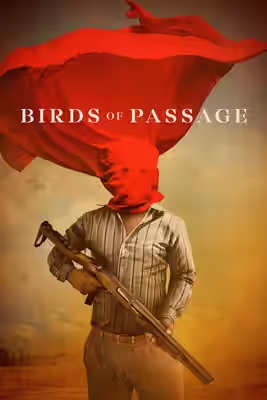
  1. Birds of Passage (2018) · not reviewed yetA Colombian family rises and falls across decades, with the same dry eye for omens.

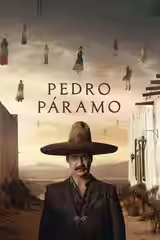
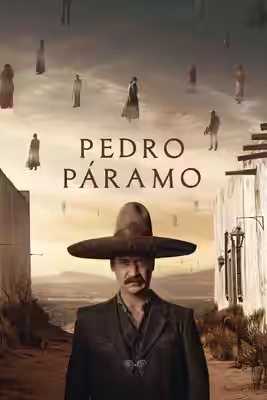
  2. Pedro Páramo (2024) · not reviewed yetJuan Rulfo’s town of the dead, filmed at last; Macondo’s older, quieter cousin.

  3. Fanny and Alexander (1982, Fi1m 92)Bergman’s big house full of relatives, ghosts included, and a child who sees them all.

  4. The Leopard (1963, Fi1m 88)Visconti on a family and a country changing under them, and a ballroom to end it.

  5. Amarcord (1973, Fi1m 82)Fellini’s town as a single character, remembered fondly and not quite accurately.

Free account

Know what to watch tonight

Two lists that know where things are streaming, collections you can share, your own score beside ours, and Discover that remembers what you have seen.

  • Want to see, sorted by what is streaming now
  • Seen, with your score out of ten
  • No adverts, ever