The published reviews make a stronger case for Igby Rigney and the period setting than for the mystery. On that evidence, our assessment is mixed: there is much to admire, but too little confidence in sustained suspense.
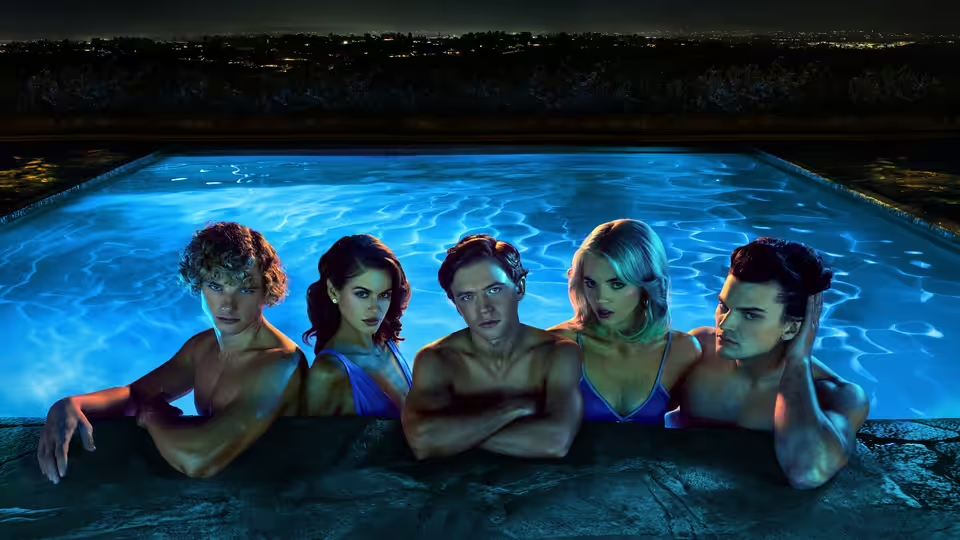
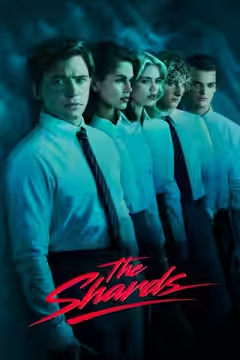
The Shards is a mixed prospect: a strong lead and carefully made period surroundings offer considerable appeal, but unreliable suspense is a serious weakness. Creators Bret Easton Ellis and Ryan Murphy put privileged Los Angeles teenagers within reach of a serial killer, with suspicion gathering around a mysterious newcomer. The nine-episode format gives that suspicion room to develop. It also makes the diversions harder to excuse, particularly when the central mystery already struggles to maintain tension.
Igby Rigney, playing Bret Easton Ellis, supplies the clearest reason to consider it. Praise for his performance survives even in sharply negative assessments, which makes it more persuasive than general enthusiasm for the series’ style. The part asks him to make adolescent uncertainty interesting while keeping the mystery alive, a difficult combination when the protagonist must remain compelling without becoming easy to read. His contribution matters because the surrounding drama cannot always sustain that interest on its own.
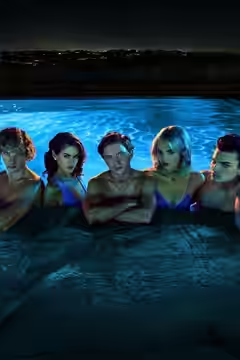
Cat Smith’s production design recreates Los Angeles in 1981, making the teenagers’ affluent surroundings a substantial part of the appeal. Cinematographers Eric Koretz, Cory Geryak and Jason McCormick help establish a setting that invites attention beyond the murder plot. Taking this world seriously enough to make nostalgia part of its attraction is a worthwhile choice. The difficulty is keeping those surroundings interesting once the drugs, convertibles and privilege are familiar, rather than relying on their attractiveness to carry another scene.
The dance-competition detour interrupts the thriller’s progress. We find that choice frustrating, because a mystery with uncertain suspense has little room for a diversion that further disrupts its tone. A competition could deepen our understanding of these teenagers, but it still needs to preserve concern about what happens next. Editors Julia Franklin, Travis Weaver, Ken Ramos and Adam Penn share the cutting credits, and assigning the unevenness to any one of them would be unfair. The broader problem is deciding what belongs in the story before the cutting begins.
David Klotz and Morgan Kibby are credited with music, another element drawing praise for its contribution to the period atmosphere. That deserves weight in an assessment of a programme whose appeal depends so much on its setting. Heavy-handed narration is a more consequential problem, because a drama built around uncertainty needs to leave space for doubt. Explaining a character’s thoughts too insistently gives us less to consider for ourselves, weakening the tension the serial-killer story needs to supply.
The adaptation’s relationship with Bret Easton Ellis’s novel raises a related concern about how much ambiguity survives the transfer. We would happily accept substantial changes if they produced more convincing drama; fidelity alone is no reason to spend nine episodes with anyone. The additions and changes of tone need to earn their place through character or suspense. Adolescent longing and anxiety about identity offer ample material, without requiring every departure from the mystery to become a separate attraction.
For a mystery, we place more weight on sustained suspicion than on watching affluent teenagers inhabit an attractive setting. That is why the strong case for Rigney and the production design leaves us interested without making this a recommendation. Those drawn primarily to adolescent identity and nostalgia may reasonably give those pleasures greater weight. For an evening of dependable suspense, we would choose something else.