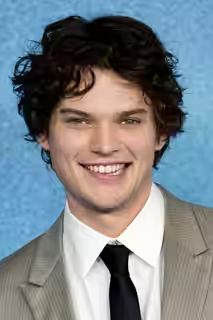
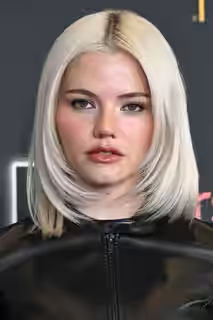
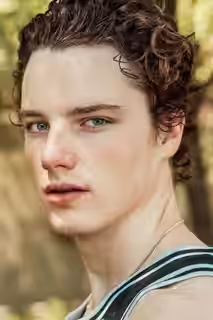
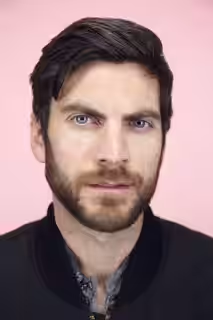
Five young adults with wet hair leaning on the edge of a pool at night
Series review

The Shards

2026 · Created by Ryan Murphy, Bret Easton Ellis · Series

In a sentenceA serial-killer drama that finds time for a dance competition has some explaining to do

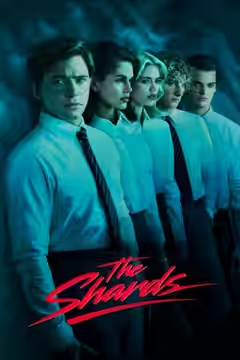
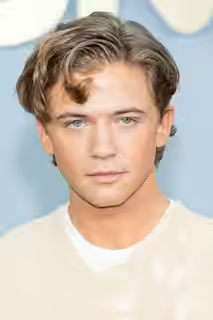
Los Angeles, 1981. A serial killer threatens a circle of privileged teenagers, and a mysterious newcomer becomes the focus of suspicion. Bret Easton Ellis (Igby Rigney) is at the centre of this account of adolescence, identity and paranoia. Susan Reynolds (Kaia Gerber) and Robert Mallory (Homer Gere) are among the characters in his world. Drugs and convertibles belong to these teenagers’ affluent surroundings; the killings bring a different kind of danger. As questions gather around the newcomer, the mystery runs alongside the private anxieties of young people growing up amid money and privilege.

Plays from YouTube when you press play; nothing loads from them until then.

Fi1m review

The published reviews make a stronger case for Igby Rigney and the period setting than for the mystery. On that evidence, our assessment is mixed: there is much to admire, but too little confidence in sustained suspense.

The Shards is a mixed prospect: a strong lead and carefully made period surroundings offer considerable appeal, but unreliable suspense is a serious weakness. Creators Bret Easton Ellis and Ryan Murphy put privileged Los Angeles teenagers within reach of a serial killer, with suspicion gathering around a mysterious newcomer. The nine-episode format gives that suspicion room to develop. It also makes the diversions harder to excuse, particularly when the central mystery already struggles to maintain tension.

Igby Rigney, playing Bret Easton Ellis, supplies the clearest reason to consider it. Praise for his performance survives even in sharply negative assessments, which makes it more persuasive than general enthusiasm for the series’ style. The part asks him to make adolescent uncertainty interesting while keeping the mystery alive, a difficult combination when the protagonist must remain compelling without becoming easy to read. His contribution matters because the surrounding drama cannot always sustain that interest on its own.

Cat Smith’s production design recreates Los Angeles in 1981, making the teenagers’ affluent surroundings a substantial part of the appeal. Cinematographers Eric Koretz, Cory Geryak and Jason McCormick help establish a setting that invites attention beyond the murder plot. Taking this world seriously enough to make nostalgia part of its attraction is a worthwhile choice. The difficulty is keeping those surroundings interesting once the drugs, convertibles and privilege are familiar, rather than relying on their attractiveness to carry another scene.

The dance-competition detour interrupts the thriller’s progress. We find that choice frustrating, because a mystery with uncertain suspense has little room for a diversion that further disrupts its tone. A competition could deepen our understanding of these teenagers, but it still needs to preserve concern about what happens next. Editors Julia Franklin, Travis Weaver, Ken Ramos and Adam Penn share the cutting credits, and assigning the unevenness to any one of them would be unfair. The broader problem is deciding what belongs in the story before the cutting begins.

David Klotz and Morgan Kibby are credited with music, another element drawing praise for its contribution to the period atmosphere. That deserves weight in an assessment of a programme whose appeal depends so much on its setting. Heavy-handed narration is a more consequential problem, because a drama built around uncertainty needs to leave space for doubt. Explaining a character’s thoughts too insistently gives us less to consider for ourselves, weakening the tension the serial-killer story needs to supply.

The adaptation’s relationship with Bret Easton Ellis’s novel raises a related concern about how much ambiguity survives the transfer. We would happily accept substantial changes if they produced more convincing drama; fidelity alone is no reason to spend nine episodes with anyone. The additions and changes of tone need to earn their place through character or suspense. Adolescent longing and anxiety about identity offer ample material, without requiring every departure from the mystery to become a separate attraction.

For a mystery, we place more weight on sustained suspicion than on watching affluent teenagers inhabit an attractive setting. That is why the strong case for Rigney and the production design leaves us interested without making this a recommendation. Those drawn primarily to adolescent identity and nostalgia may reasonably give those pleasures greater weight. For an evening of dependable suspense, we would choose something else.

Critical consensus AI synthesised

56
Positive
5
Mixed
2
Negative
3

The reviews are sharply divided, with half positive and the rest mixed or negative. Praise clusters around the recreation of 1981 Los Angeles, the visual style and Igby Rigney’s lead performance, which earns approval even from some detractors. Supporters find a compelling mix of adolescent unease, nostalgia and lurid horror in the adaptation of Bret Easton Ellis’s novel. For them, its interest in youth and identity gives the excess something to work with.

The disagreement is over whether that excess remains entertaining or becomes shallow and tedious. Reservations centre on uneven pacing, tonal detours and unreliable suspense; even favourable reviews identify heavy-handed narration or a loss of focus. Variety praises the lead performance but argues that the changes undermine the novel’s mood and ambiguity. Vulture likewise sees an adaptation that loses the book’s nuance, finding neither sufficient fun nor compelling horror.

Radio Times
5 August 2026 · ★★★★ · Helen Daly
80

The critic finds the adaptation an intriguing mix of Ellis's detached blank fiction and Murphy's visual excess and horror elements. Rigney's lead performance is singled out as uncanny and fantastic, though one episode's dance competition detour disrupts the tone before the second half redeems the series.

Read the full review →
The Guardian
5 August 2026
80*

Murphy is back on form with this gorgeously curated, shot and scored adaptation of Bret Easton Ellis’s novel about a serial killer stalking privileged LA teenagers. The serial killer storyline pulls the story along, but its heart is in the longing for an era gone by, for youth flown.

Read the full review →
Evening Standard
· Martin Robinson
50*

This is a watchable, dreamily shallow series about watchable, dreamily shallow kids, made by a watchable, dreamily shallow creator, which occasionally delivers on the horror. Suspense though? Sadly not, and that’s the real measure of excellence.

Read the full review →
The Hollywood Reporter
5 August 2026 · Daniel Fienberg
50*

The series delivers the expected excess from the Murphy-Ellis team-up but is nostalgic, over-the-top and uneven, with a plastic first half faithful to the novel giving way to chaotic but more entertaining later episodes.

Read the full review →
The Telegraph
6 August 2026
30*

This adaptation of Bret Easton Ellis’s novel starring nepo-babies is full of coke, convertibles and crushing tedium, and it is hard to care about the monotonous world of privileged LA high schoolers.

Read the full review →
Variety
5 August 2026 · Alison Herman
30*

The review argues that bold deviations and additions derail the adaptation despite a strong lead performance. It fails to capture the novel's distinctive feeling or sustain its ambiguity and mood.

Read the full review →

Straight answers AI written, from our review

Is The Shards worth watching?
The Shards earns a mixed verdict from us at 56/100: Igby Rigney’s lead performance and the carefully recreated period setting appeal more than the mystery. It may suit viewers interested in adolescent identity and affluent Los Angeles nostalgia, but uneven suspense, heavy-handed narration and distracting detours keep us from recommending it as a thriller.
Where can I watch The Shards in Japan?
The Shards is streaming on Disney+ in Japan. Availability is checked daily; the links above go straight to each service.
How violent or frightening is The Shards, and is it suitable for children?
The Shards carries a US TV-MA certificate, indicating mature-audience material rather than children’s viewing; no UK certificate is supplied. Its story includes a serial killer threatening teenagers, killings and drugs, though our review does not establish how graphically violence is shown. We would treat it as adult viewing, without assuming that its uneven suspense makes the material mild.
How does The Shards compare to Picnic at Hanging Rock?
The Shards is the weaker choice for sustained mystery beside Picnic at Hanging Rock, which we recommend for its patient, unsettling treatment of a school outing and disappearance. Both place danger among sheltered young people, but The Shards leans on period surroundings and adolescent identity while narration and diversions weaken its uncertainty; Peter Weir’s film gives that uncertainty room to work.
What should I watch after The Shards?
After The Shards, try Picnic at Hanging Rock (1975, Fi1m 88): A disappearance unsettles a sheltered school, with uncertainty allowed to do its work. Then The Virgin Suicides (1999, Fi1m 83): For another account of adolescence remembered by people who never fully understood it; and Burning (2018, Fi1m 72): A young man’s suspicions sharpen around wealth, desire and a difficult acquaintance.

Cast

If you liked this, try…

  1. Purple Noon (1960) · not on Fi1m yetSunlit wealth and concealed motives give this thriller a more concentrated unease.

  2. Picnic at Hanging Rock (1975, Fi1m 88)A disappearance unsettles a sheltered school, with uncertainty allowed to do its work.

  3. Twin Peaks (1990) · not on Fi1m yetA teenage murder exposes adult secrets beneath a small town’s respectable habits.

  4. The Virgin Suicides (1999, Fi1m 83)For another account of adolescence remembered by people who never fully understood it.

  5. Burning (2018, Fi1m 72)A young man’s suspicions sharpen around wealth, desire and a difficult acquaintance.