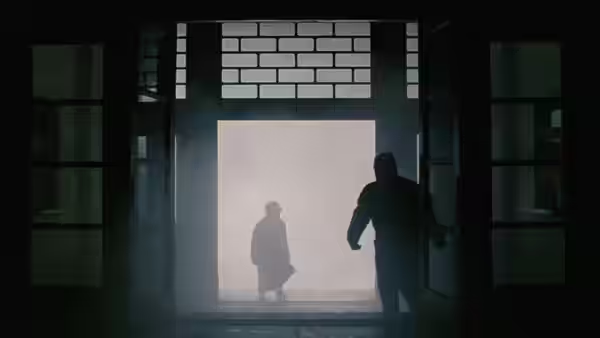
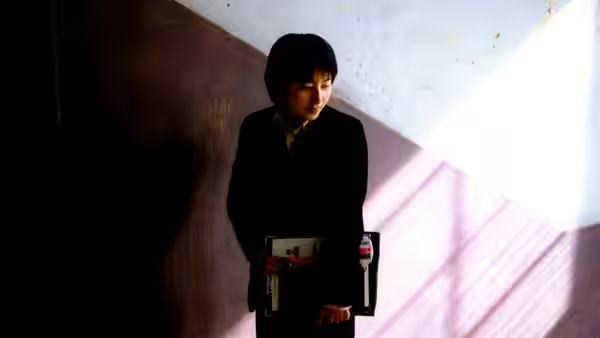
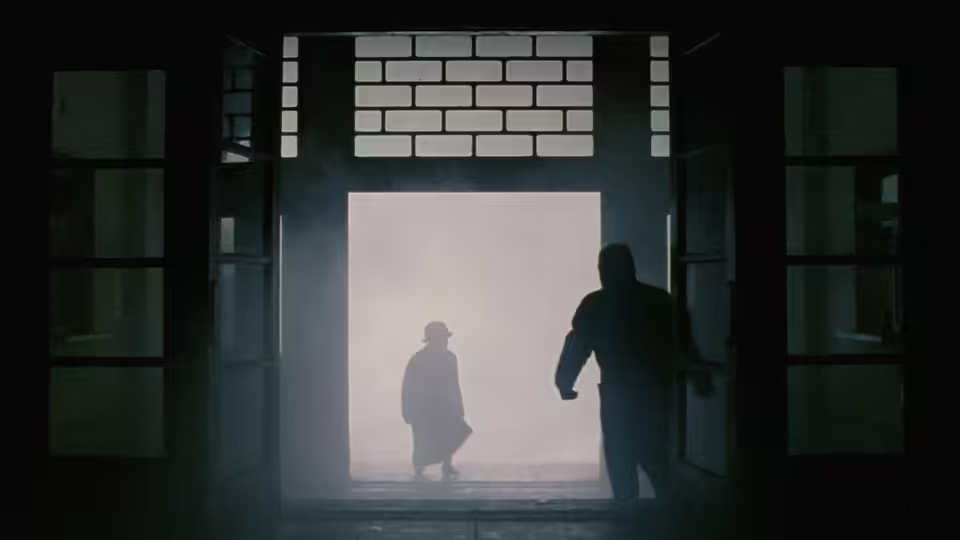
Two figures meet at a bright doorway inside a shadowy building
Film review

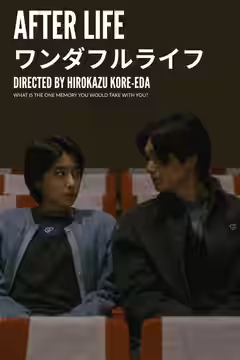
After Life

1999 · Directed by Hirokazu Kore-eda · 1h 58m

In a sentenceThe afterlife is a run-down building where the staff rebuild your best memory out of cotton wool and plywood

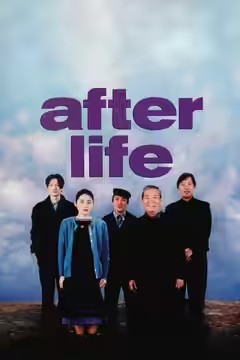
The newly dead arrive at a shabby building where a small staff explain the rules. Each of them must choose one memory from their life to keep. The staff will recreate that memory on film and screen it for them, and the dead will pass on with that memory and nothing else. Caseworkers Takashi Mochizuki (Arata Iura) and Shiori Satonaka (Erika Oda), with their colleague Satoru Kawashima (Susumu Terajima) and their manager Kennosuke Nakamura (Kei Tani), interview the week’s arrivals across a bare desk. Among them are Nobuko Amano (Kazuko Shirakawa), Gisuke Shoda (Tōru Yuri), Kana Yoshino (Sayaka Yoshino) and Yusuke Iseya (Yūsuke Iseya). Some answer at once. Others pause, lose the thread and start again, and the staff wait.

Fi1m review

Hirokazu Kore-eda sends the newly dead to a run-down building where they must pick one memory to keep for ever, and civil servants film it on a shoestring. It is gentle, funny and it moved us badly; only the staff’s own story feels underwritten.

The newly dead, in Hirokazu Kore-eda’s After Life, do not go up or down. They walk out of a bright doorway into a shabby building, sign in at a desk and are told how the week will go. They must choose one memory from their whole life. The staff will build it, film it and screen it, and they will pass on with that memory and nothing else. The Japanese title translates as Wonderful Life, and the film means it.

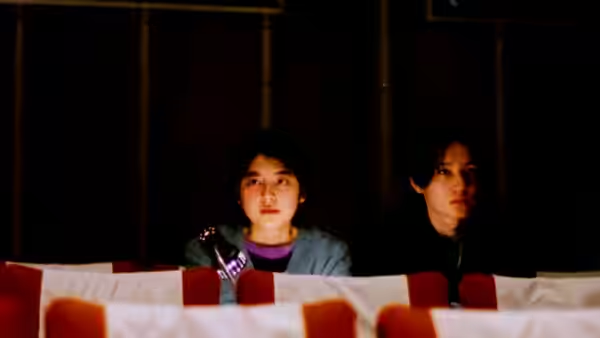
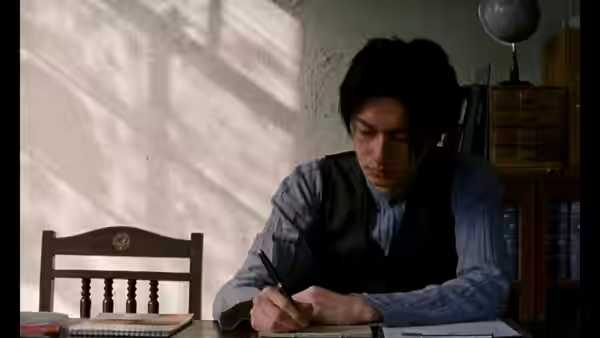
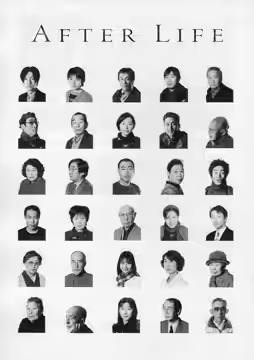
Kore-eda wrote, directed and edited it, and the shape he gives it is a week of interviews. Men and women sit in hard chairs across a desk and try to answer, and many of them are plainly not actors. Yutaka Yamazaki and Masayoshi Sukita shoot these scenes head-on, against a bare wall in flat window light, the camera still, so they look like testimony rather than drama. Nobuko Amano (Kazuko Shirakawa) answers slowly, as if the question were a kindness. Gisuke Shoda (Tōru Yuri) wants to talk about women. Kana Yoshino (Sayaka Yoshino) answers fast and is asked to think again. People pause, lose the thread and start again, and the cutting never hurries them.

The building is the other main character. Production designers Hideo Gunji and Toshihiro Isomi give it peeling paint, cast-iron radiators, a courtyard of bare trees and the quiet of an institution with more rooms than people. Its caseworkers are Takashi Mochizuki (Arata Iura), reserved and careful; Shiori Satonaka (Erika Oda), young and eager; Satoru Kawashima (Susumu Terajima), who treats the job as a job; and their manager, Kennosuke Nakamura (Kei Tani), who handles the awkward cases with decades of patience. The most awkward is Yusuke Iseya (Yūsuke Iseya), a young man who argues with the whole arrangement.

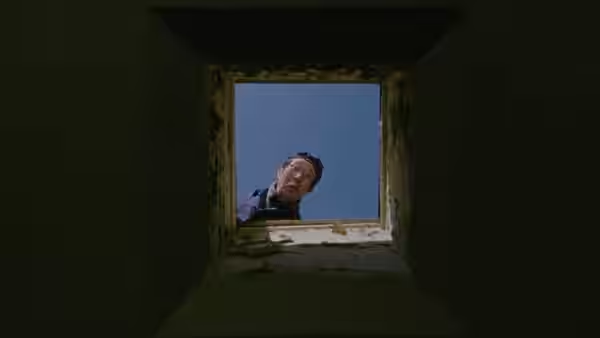
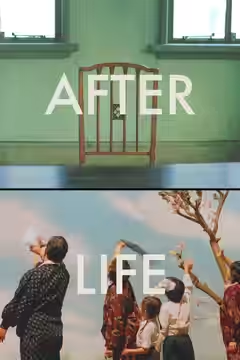
The recreations are where the film finds its tone, and where it got us. The staff have almost no budget. Clouds are cotton wool on wires. A tram is a plywood front and a bell, with someone off camera rocking it. One of the older men sits in front of a window while the crew hold tufts of white outside it and work a fan. We laughed at how shabby it looked. Then he turned his face to the window and something in it changed, and we stopped laughing and found our throat had tightened. Nobody has fooled him. The feeling was never in the cloud.

Yasuhiro Kasamatsu’s score is used so sparingly that long stretches have nothing under them but footsteps and the hum of the building, and the few notes that do arrive count for more because of it. Kore-eda the editor is as restrained as Kore-eda the writer. He holds on faces after the line and leaves in silences a tidier film would have cut.

Not all of it works. The interviews repeat their shape, and the middle hour slackens as the film sits with one undecided case for longer than it needs to. The feelings between Mochizuki and Shiori are done in half-lines and glances, which suits the characters but leaves the one strand of ordinary drama thin. The second half takes a turn we will not describe, involving a woman named Kyoko Watanabe (Kyōko Kagawa). It is handled with tact, but the dead at the desk stay more vivid than the staff behind it.

Set beside Kore-eda’s later family films, Nobody Knows (2004) and Shoplifters (2018), this is the one with a premise from fantasy, and he treats it as if it were a documentary. It is also the film of his we would hand to someone who had never seen one, because it asks a question nobody can avoid answering. At 118 minutes it does not overstay. Expect to spend the rest of the evening choosing your own memory, and to find the first three you think of are not the ones you would keep.
Critical consensus AI synthesised

79
Positive
5
Mixed
2
Negative
0

The reviews lean warmly positive, and they agree on why. Most critics describe the film as humane, thoughtful and quietly moving, and the praise clusters on Kore-eda’s handling of the premise: the dead choosing a single memory to keep, and a plain, observational style that makes a metaphysical idea feel ordinary. Variety notes the mixing of professional actors and non-professionals in the cast, and several others admire the restraint with which the chosen memories are recreated rather than dressed up. The film’s thinking about memory, and about filmmaking itself, comes up in nearly every notice.

Reservations are scarce. Among the reviews whose text we could read, the spread is narrow, running from solid approval to open admiration, and nobody argues that the film is cold or slight. The two lower figures in the tally belong to reviews we could not access in full, so no specific complaint is on record. Read as a group, the critics are closer to agreement than the number suggests.

Empire
1 January 2000 · David Parkinson
90*

Parkinson finds the film a delightful, deeply humane fantasy. He singles out its careful handling of the dead’s memories and the splendid cast.

Read the full review →
Variety
21 September 1998 · festival review · Derek Elley
90*

Elley finds the film slyly humorous, original and moving, predicting strong critical support. He especially praises its humane concept and the way its casting brings together actors and non-professionals.

Read the full review →
The Guardian
3 October 1999 · Philip French
85*

French praises the film as thoughtful, accessible, and immensely suggestive. He singles out its meditation on memory and cinema, especially the moving discovery that one person was part of another’s happiness.

Read the full review →
Slant Magazine
10 August 2021 · ★★★★ · Jake Cole
80

Cole calls the film an understated masterpiece and praises its ability to make profound ideas feel relatable. He singles out its observational approach, which grounds its metaphysical premise in realism.

Read the full review →
The AV Club
29 March 2002 · Joshua Klein
80*

Klein finds the film thought-provoking and touching, with a quietly moving message about memory and existence. He especially praises its mundane, naturalistic approach to recreating the dead characters’ chosen memories.

Read the full review →
RogerEbert.com
64*

The page was blocked by a browser check, so the critic’s verdict cannot be determined. No praise or complaint from the review was available to assess.

Read the full review →

Straight answers AI written, from our review

How long is After Life, and what is it rated?
After Life runs 1h 58m. It is a fantasy and drama film.
Where can I watch After Life in Slovakia?
After Life is not on any streaming or rental service in Slovakia at the moment. It is available in 6 other countries; change your country at the top of the page to see where. Availability is checked daily.
What should I watch after After Life?
After After Life, try A Matter of Life and Death (1946, Fi1m 92): Powell and Pressburger’s airman argues his case before a heavenly court; witty, warm, Technicolor. Then Wings of Desire (1987, Fi1m 88): Wenders’s angels eavesdrop on Berlin and envy the living their coffee and cold hands; and Ikiru (1952, Fi1m 92): Kurosawa’s dying clerk looks for one thing worth doing; the swing scene will stay with you.

Cast

If you liked this, try…

  1. A Matter of Life and Death (1946, Fi1m 92)Powell and Pressburger’s airman argues his case before a heavenly court; witty, warm, Technicolor.

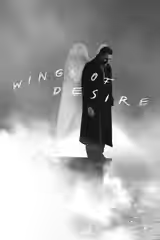
  2. Wings of Desire (1987, Fi1m 88)Wenders’s angels eavesdrop on Berlin and envy the living their coffee and cold hands.

  3. Ikiru (1952, Fi1m 92)Kurosawa’s dying clerk looks for one thing worth doing; the swing scene will stay with you.

  4. Defending Your Life (1991) · not reviewed yetAlbert Brooks plays the afterlife as a tribunal with good restaurants; funnier than it sounds.

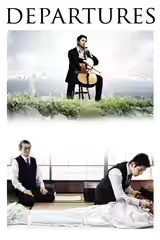
  5. Departures (2008) · not reviewed yetA cellist becomes an undertaker’s assistant; Japanese grief handled with the same unhurried tenderness.