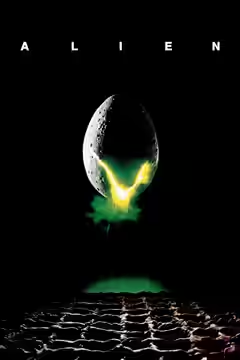
David Fincher’s first film is a funeral with a monster in it: rust, lead and candlelight, shot with more nerve than the script deserves. The people are good and the creature is not, and once the running starts it is a lesser Alien in a bigger building.
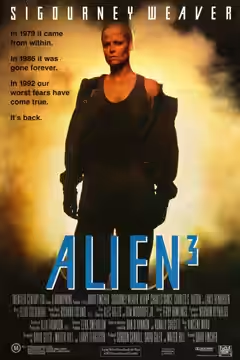
Alien³ begins by throwing away nearly everything the previous film spent two hours earning. Ripley (Sigourney Weaver) crash-lands on Fiorina 161, a lead works the company has turned into a prison, and the other people in the escape pod are dead before she wakes up. The men who pull her out are murderers and rapists who have found God, shaved their heads against lice and stayed on after the place was shut down. David Fincher, directing his first feature at 114 minutes, has decided that the third film about this creature should be slow and grieving rather than another battle, and for about an hour the decision holds.
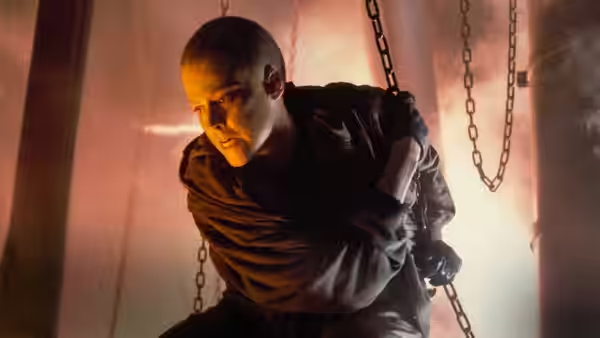
The look is the reason it holds. Alex Thomson shoots from the floor, in amber and rust, with candles and sodium lamps doing most of the work, and Norman Reynolds’ furnaces and pipe-runs are so large that the people crossing them are hard to find. Elliot Goldenthal gives it a choir and a good deal of low brass; the opening credits, which Terry Rawlings and David Crowther cut against the crash, are as fine a piece of dread as the series has produced. Then comes the passage where Charles S. Dutton’s Dillon speaks over a cremation while, elsewhere in the building, something is being born out of an animal. We had come for a monster and were surprised to find ourselves grieving. The crosscut does it: the words of the eulogy land over the wrong body.
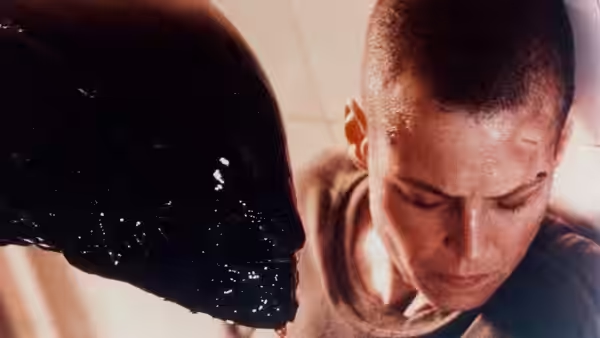
The people are better than a third film has any right to expect. Charles Dance plays Clemens, the prison’s doctor, as a dry, courteous man with a past he would rather not discuss, and his scenes with Weaver have an adult ease the rest of the series never bothered with. Dutton preaches with real weight. Brian Glover’s Andrews reads the rules of the place in a flat northern bark, and Ralph Brown’s Aaron trots behind him being agreed with. Weaver herself is tired, cropped and unsentimental, and the film is at its best when it lets her sit in a room and be looked at by men who have not seen a woman in years.
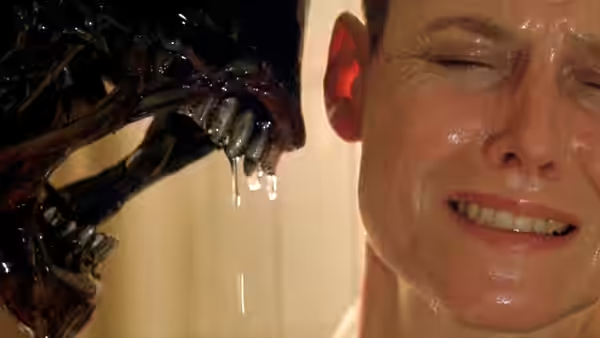
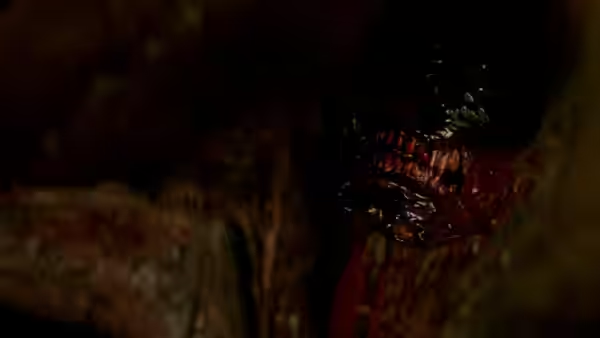
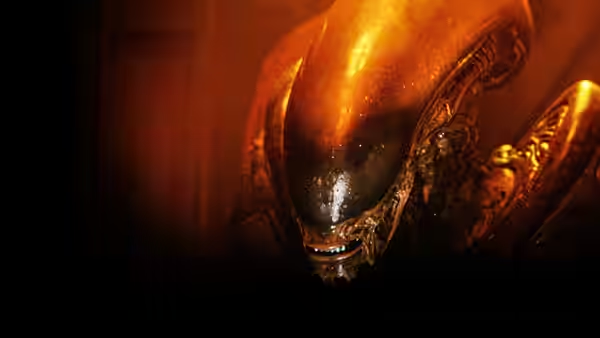
The creature is the trouble. For close work it is a man in a suit and it looks fine. For anything faster it is a puppet composited into the shot, and the edges shimmer, the shadows fall wrong, and it scuttles along ceilings with the weight of a photograph. We winced, and not at the thing; at the seam around it. A film that has built its world out of rust and candlelight cannot afford one element that plainly is not there, and this one is in the frame every time the film asks us to be afraid.
The second half is the other trouble, and we will not describe it beyond its shape. The plan involves corridors, doors, running and a great deal of shouting of names, and since Walter Hill, Larry Ferguson and David Giler’s script, from a story by Vincent Ward, has given us perhaps four prisoners to tell apart out of a couple of dozen, the names mean nothing. Rawlings and Crowther cut the running as a smear, and the effect is of watching the same corridor from several angles while the cast thins. The religion that mattered so much in the first hour stops mattering. A longer version exists that some critics say gives Weaver more room; by their account it does not fix the corridors.
Ridley Scott’s Alien, from 1979, was a haunted house, and James Cameron’s Aliens, from 1986, was a war. This one is a funeral, and it has the nerve to be smaller and slower than either. The set is a real achievement, the score is a proper one, and Dance and Dutton give it two performances the genre rarely gets. What it lacks is the one thing a monster film cannot do without, and four credited writers have not given it a story that could hide the fact.
Most critics split straight down the middle, and we sit a shade above them, because the mood is achieved and the mood is most of what the film is for. Watch it at home with the lights off; the amber holds up and the creature is easier to forgive at that size. The 18 certificate is earned early, in a medical room, and if that scene does not put you off, the rest will not either.