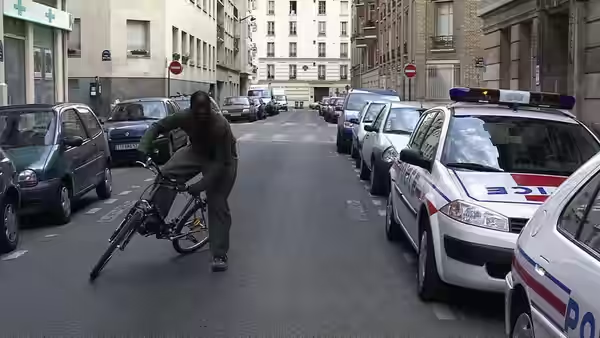
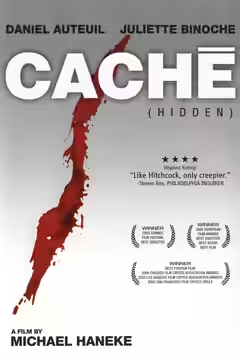
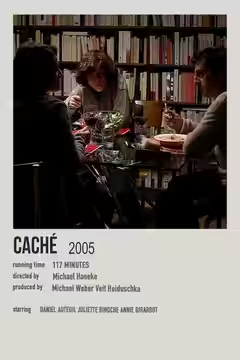
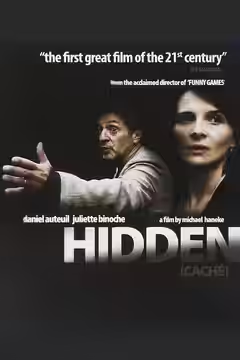
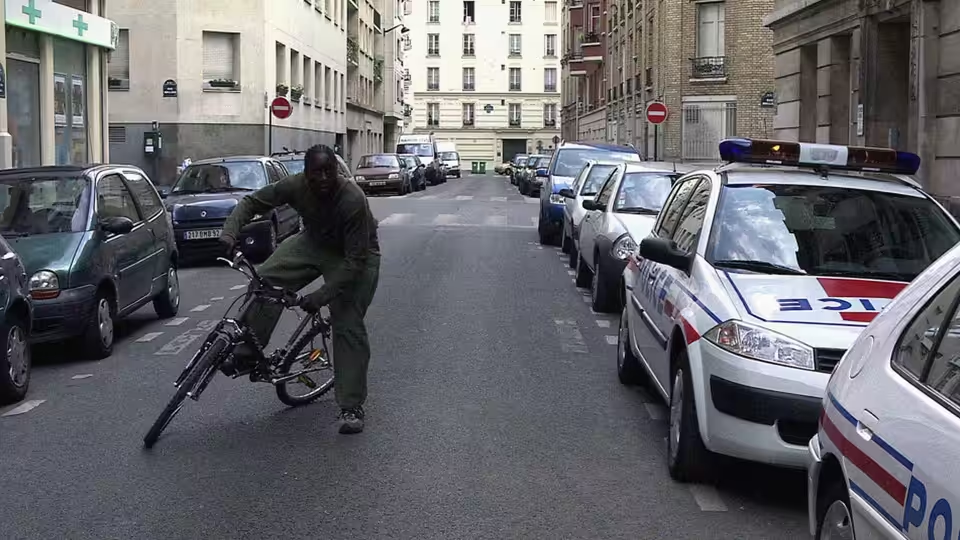
Man on bicycle riding past parked police cars on city street
Film review

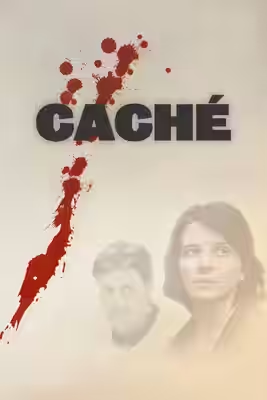
Caché

2005 · Directed by Michael Haneke · 1h 58m · IFCO 18

In a sentenceA recording of your own house should not require this much soul-searching

Georges Laurent (Daniel Auteuil) and Anne Laurent (Juliette Binoche) live in Paris. They receive surveillance videos of their home and drawings, without knowing who is responsible. The recordings turn their attention towards whoever is watching and towards the parts of their lives they would prefer to keep private. As Georges tries to understand the intrusion, questions about his childhood begin to surface. Written and directed by Michael Haneke, the film follows a household whose search for an explanation brings personal history into contact with questions of guilt and responsibility.

Plays from YouTube when you press play; nothing loads from them until then.

Fi1m review

Michael Haneke’s surveillance thriller is absorbing and deeply unsettling, with Daniel Auteuil and Juliette Binoche making its threatened couple painfully credible. His determination to direct our judgement can feel overbearing, but the unease is earned.

Michael Haneke’s Caché is an unnerving thriller, worth seeing for how precisely it makes being watched feel threatening. Georges and Anne Laurent, played by Daniel Auteuil and Juliette Binoche, receive surveillance recordings of their Paris home. The images offer little of the reassurance that evidence is supposed to provide: someone has looked closely at their lives, and the couple cannot control what that person knows. Haneke makes their discomfort hard to dismiss, even as he questions their wish to be left alone.

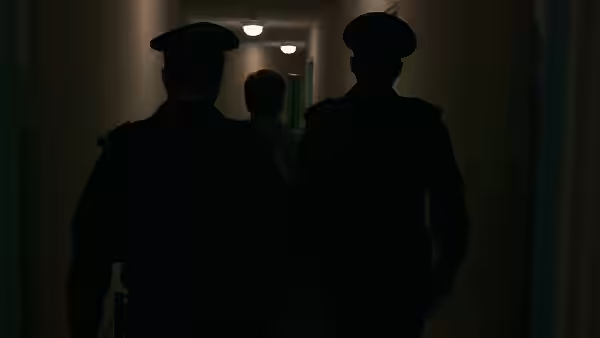
Christian Berger’s static images give us plenty of time to look and little help in deciding what matters. The opening surveillance view of the house seems innocuous, which makes the suggestion that someone is watching it more intrusive. We were unnerved by it: the longer it stayed before us, the harder we searched for a reason to be afraid. An ordinary home starts to feel exposed simply because someone has taken the trouble to watch it.

Editors Nadine Muse and Michael Hudecek make the movement between videotape and the film’s other images difficult to settle into. The long takes deny us the brisk sequence of clues we might expect from a mystery, while those shifts keep us checking what sort of image we are watching. We cannot comfortably assume that the next shot will make anything clearer. The editing works because it allows doubt to develop before offering another image to examine, rather than hurrying us towards an explanation.

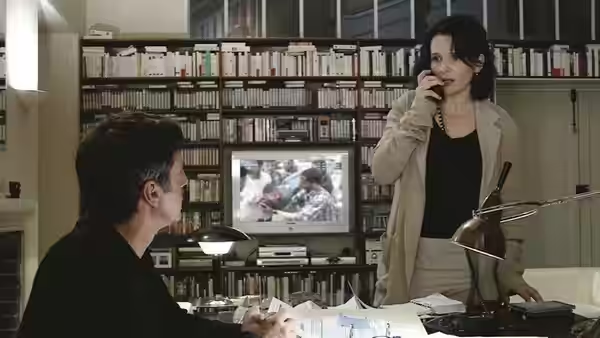
Auteuil is especially good at making Georges’s alarm seem reasonable without making his account of himself easy to accept. His defensiveness gives Haneke’s questions about guilt a human scale: we can understand his fear while disliking the limits he puts on his responsibility. Binoche makes Anne’s unease equally credible, preventing the couple from becoming merely prosperous people waiting for their comeuppance. We care what this intrusion is doing to them, and both performances allow their distress to be unpleasant without becoming exaggerated.

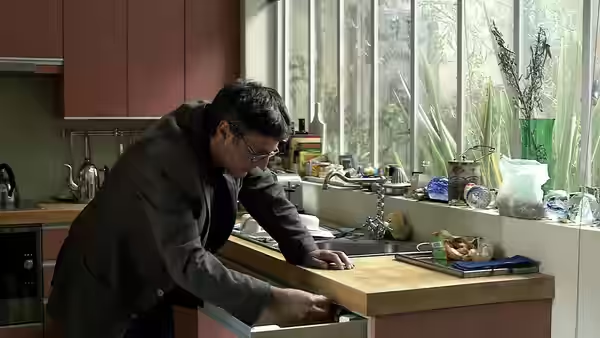
Production designers Christoph Kanter and Emmanuel de Chauvigny supply the comfortable domestic setting that the recordings make threatening. It works because the home gives us no immediate reason to suspect danger; the act of recording it is enough to change how we look at it. Haneke, who also wrote the screenplay, connects the couple’s distress to buried childhood guilt and France’s treatment of Algeria. We need not know the details of Georges’s history to recognise his wish to keep unpleasant knowledge outside a comfortable life.

The reservation is that Haneke’s control can make a response feel compulsory. Georges’s self-protection is examined so insistently that there are stretches when the film seems to have judged him before allowing us to do much judging ourselves. Anne remains persuasive, but we wanted more room for her experience beyond what it reveals about the household. Binoche deserves more time away from Georges and his troubles, where her responses might matter for their own sake.

As a mystery, Caché asks for closer attention than the familiar hunt for a culprit. Its strongest suspense comes from watching people defend their version of events, with consequences they would rather not consider. That is demanding company for an evening, but the performances keep the questions attached to people we believe in. Watch it with someone prepared to disagree about Georges afterwards.

Critical consensus AI synthesised

87
Positive
6
Mixed
0
Negative
0

The reviews are consistently positive about Caché, with praise centred on Haneke’s control of images and his use of surveillance to make watching feel uncomfortable. Critics repeatedly connect the couple’s private unease to questions of denial, racism and France’s colonial history. The long, static shots and uncertain boundary between recorded footage and unfolding action draw particular attention: the suspense comes from questioning what is visible, rather than simply waiting for the mystery to be solved. Performances also receive praise for sustaining that unease.

There is little outright disagreement; the differences concern emphasis more than approval. Some critics concentrate on the political implications, others on guilt, family secrets and the audience’s complicity. Reservations are limited: The Skinny acknowledges frustrations and describes the film as demanding, while still recommending it. Across the reviews, the ambiguity is largely treated as a source of psychological pressure rather than a storytelling weakness.

Slant Magazine
8 October 2005 · ★★★★/4 · Joe McGovern
100

The critic praises Haneke's cunning modern allegory that interlaces bourgeois complacency, subconscious guilt, and the impossibility of truth in film, condemning First World racism through the story of surveillance tapes and repressed colonial history.

Read the full review →
Film Comment
· Paul Arthur
90*

Haneke’s latest provocation is a masterpiece of urban dread and an exceptionally acute inquiry into human behavior and guilt. The director’s control of image, point of view, and the film’s productive enigma stand out as sources of its dramatic and psychological power.

Read the full review →
IndieWire
19 December 2005
80*

The review highlights Haneke's thriller about a couple receiving surveillance tapes that unearth personal and national guilt, commending its tense voyeuristic structure and political allegory.

Read the full review →
Los Angeles Times
23 December 2005 · Kevin Thomas

The critic calls the film a psychological suspense drama of utmost rigor and originality that confronts individual and collective responsibility for past evils, particularly France's treatment of Algeria, through mysterious videos that torment a successful Parisian couple. Haneke's taut, ambiguous storytelling and natural performances keep the focus on uncomfortable truths that linger beyond the final image.

Read the full review →
RogerEbert.com
13 January 2010 · Roger Ebert

The critic describes the film as a thriller that coils tension inward rather than releasing it, focusing on a bourgeois Parisian couple tormented by surveillance videos and drawings that expose buried guilt from Georges's childhood. Haneke's precise camerawork and ambiguity shift attention from the mystery's solution to the psychological and historical consequences for the characters.

Read the full review →
Sight and Sound
· Catherine Wheatley

The critic examines Haneke's use of video surveillance and narrative tricks to explore guilt, denial, and complicity in personal and historical (colonial) contexts. She highlights the film's ability to unsettle viewers through simulation and its socio-political resonance beyond France.

Read the full review →

Straight answers AI written, from our review

Is Caché worth watching?
Caché is worth watching for anyone who wants a thriller built on unease rather than chases, and we scored it 88. Daniel Auteuil and Juliette Binoche make the threatened couple painfully credible, and Christian Berger's static images make an ordinary house feel exposed. Michael Haneke's insistence on directing our judgement of Georges can feel overbearing.
How long is Caché, and what is it rated?
Caché runs 1h 58m and is rated 18 by the IFCO in Ireland. It is a mystery and drama film.
Where can I watch Caché in Ireland?
Caché is not on any streaming or rental service in Ireland at the moment. It is available in 7 other countries; change your country at the top of the page to see where. Availability is checked daily.
How violent or frightening is Caché, and is it suitable for children?
Caché is rated 15 in the UK and R in the US, and it is not suitable for children. The fear comes from being watched rather than from action: long, still shots of a home, surveillance tapes and a couple's mounting distress. The certificate implies adult material we will not detail, so the squeamish should approach with care.
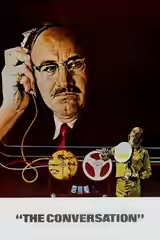
How does Caché compare to The Conversation?
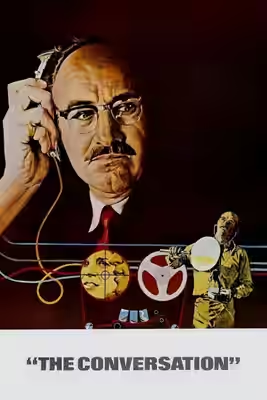
Caché is the colder and more demanding of the two, while The Conversation is the one we would recommend without hesitation. Both make surveillance corrode certainty, but Coppola turns repeated listening into gripping suspense with Gene Hackman's loneliness at its centre, whereas Haneke denies us clues and asks us to judge a defensive man. Choose Coppola for a thriller, Haneke for an argument afterwards.
What should I watch after Caché?
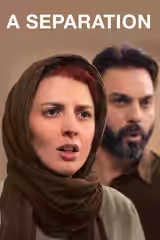
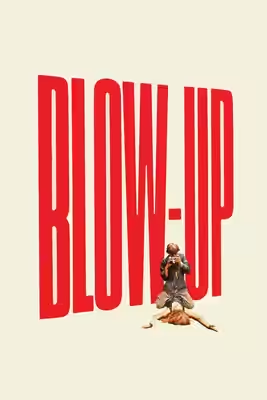
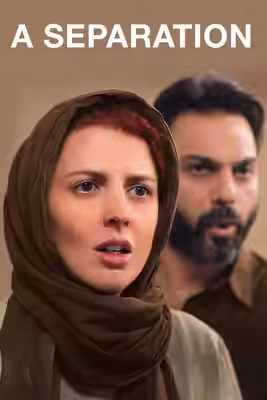
After Caché, try The Conversation (1974, Fi1m 92): Another surveillance thriller in which listening closely makes certainty harder to sustain. Then A Separation (2011, Fi1m 93): A domestic dispute exposes evasions that each participant has reasons to defend; and Blow-Up (1966, Fi1m 74): An image promises evidence, then becomes harder to understand the longer we look.

Cast

Awards

International Submission to the Academy Awards, 2006

Nominated
International Submission to the Academy Awards

Meeting Point Europe Award, 2006

Won
Meeting Point Europe Award

European Film Academy Critics Award, 2005

Won
European Film Academy Critics Award

European Film Award for Best Actor, 2005

Won
European Film Award for Best Actor

European Film Award for Best Actress, 2005

Nominated
European Film Award for Best Actress

European Film Award for Best Cinematographer, 2005

Nominated
European Film Award for Best Cinematographer

European Film Award for Best Director, 2005

Won
European Film Award for Best Director

European Film Award for Best Editor, 2005

Won
European Film Award for Best Editor

European Film Award for Best Film, 2005

Won
European Film Award for Best Film

European Film Award for Best Screenwriter, 2005

Nominated
European Film Award for Best Screenwriter

If you liked this, try…

  1. The Conversation (1974, Fi1m 92)Another surveillance thriller in which listening closely makes certainty harder to sustain.

  2. The Headless Woman (2008) · not reviewed yetLucrecia Martel examines comfortable denial through a woman’s increasingly uncertain account of events.

  3. A Separation (2011, Fi1m 93)A domestic dispute exposes evasions that each participant has reasons to defend.

  4. Blow-Up (1966, Fi1m 74)An image promises evidence, then becomes harder to understand the longer we look.

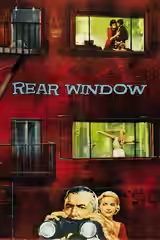
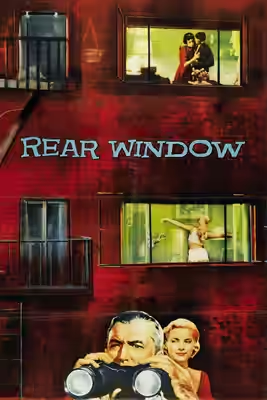
  5. Rear Window (1954, Fi1m 94)Hitchcock makes watching the neighbours pleasurable, then asks what entitles us to look.

Free account

Know what to watch tonight

Two lists that know where things are streaming, collections you can share, your own score beside ours, and Discover that remembers what you have seen.

  • Want to see, sorted by what is streaming now
  • Seen, with your score out of ten
  • No adverts, ever