Alexander Payne shrinks a mild Nebraskan to five inches and, for an hour, makes the funniest and most exact comedy of his career. Then the film forgets how small he is, and drifts. Hong Chau holds it together as long as anyone could.
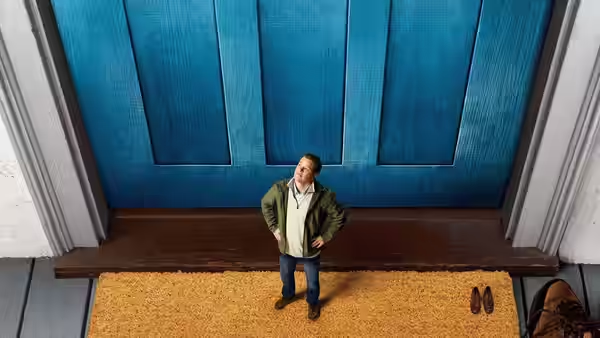
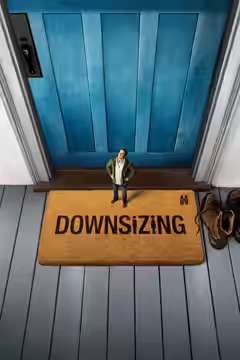
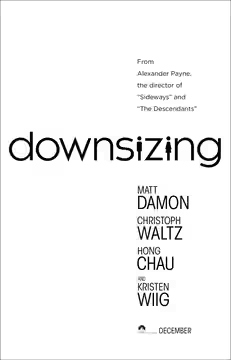
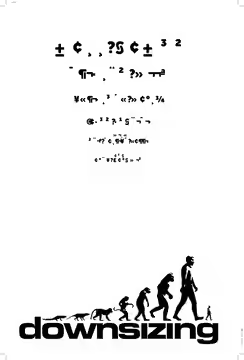
Alexander Payne has spent his career on ordinary American men, finding them a little ridiculous and a little sad. Downsizing gives him a new instrument: a Norwegian laboratory that shrinks people to five inches, so that Paul Safranek (Matt Damon), who cannot afford a bigger house, can move to a domed community called Leisureland and live like a millionaire. The first hour is the best comedy Payne has made in years. The second is a gentler, vaguer film that has mislaid its own idea. We would still send you to it, with reservations.
The first hour works because Payne and his co-writer Jim Taylor treat the premise as paperwork. There is a sales pitch, a contract, a medical. The shrinking itself is a procedure: patients are shaved from head to foot, their fillings are pulled, they are wheeled in rows into a white room, and afterwards nurses lift them off the beds with spatulas. Kevin Tent cuts it as a run of small indignities, and we laughed harder than at anything of Payne’s since Sideways. Jason Sudeikis, as the old friend who has gone small and cannot stop selling it, is exactly the right kind of pleased with himself.
Stefania Cella designs Leisureland as a golf estate under a mesh roof, all beige McMansions and pool furniture, and it looks like any other American suburb until a full-sized rose arrives in a vase the height of a man. Phedon Papamichael keeps finding those frames: a vodka bottle the size of a water tower, a single cracker carried like a tray. The film is funniest when it trusts the effects and says nothing.
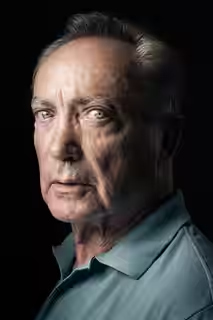
The second movement belongs to Christoph Waltz. Dusan Mirkovic lives upstairs from Paul, throws parties that shake the ceiling, and imports cigars and cognac with his friend Konrad (Udo Kier), who says almost nothing and is the better for it. Waltz plays a man who chose to be small so that his pleasures would be proportionally larger, and he is having a wonderful time. Then his cleaner walks in.
Hong Chau plays Ngoc Lan Tran, a Vietnamese dissident shrunk against her will, who arrived in America in a television box and now cleans Leisureland’s flats on one leg and a bad prosthetic. She speaks in barked, broken imperatives, and some critics flinched; the accent is broad and the film is not always sure whether it is laughing with her or at her. But Chau does not play a stereotype. She plays a person impatient because there is work to do, and she is the only character who wants anything. When she leads Paul through a service door in the dome wall to the tenement where the small poor live, in bunk beds stacked under a single lightbulb, we felt the film sharpen, then look away.
That is the trouble with the last hour. Payne loses interest in size. Once Paul is through the wall the scale gags stop, and what remains is a passive man being told what to do by more interesting people. Damon is good at bewilderment, but 135 minutes is a long time to be bewildered, and the script never gives Paul a want of his own. The final stretch leaves Leisureland and goes somewhere we will not describe. It is where the film says what it means, and what it means is less interesting than shrinking people.
Rolfe Kent’s score is a light, plucked thing that suits the first hour and is asked to carry too much in the second. Wendy Chuck dresses the small rich exactly like the large rich, which is the point, and dresses Ngoc Lan in other people’s cast-offs, which is a better one.
Against Payne’s other films this is the odd one. About Schmidt and Nebraska knew how much to say and stopped. Downsizing has more ideas than either and keeps changing its mind about which one it is for. See it for the procedure, for Waltz’s parties, and for Chau, who deserved a film that kept looking at her. It carries a 15 and runs 135 minutes, and the first sixty are the ones you will remember.