Neill Blomkamp builds a future in which the rich orbit the earth and the sick queue to reach it, and for forty minutes it is sharp, funny science fiction. Then everyone picks up a gun and the film forgets what it was for.
Neill Blomkamp’s second film opens in Los Angeles in 2154 and then cuts to Elysium, a wheel-shaped station in orbit where the rich have lawns, pools and a machine in every house that cures anything. Max (Matt Damon) is a parolee with a factory job at Armadyne, building the robots that police him. The first forty minutes lay this out with wit and a proper sense of grievance. The second hour is a chase and a gunfight about nothing in particular, and the drop between the two is the whole of our complaint.
Philip Ivey’s production design does most of the film’s thinking. Earth is corrugated iron, dust and queues; Elysium is Bel Air in the sky, colonnaded villas and clipped hedges. Trent Opaloch shoots the ground handheld in sunlight that bleaches everything, and the station with a still camera, as if for a property brochure. The robots are the best joke: Max’s parole officer is a painted plastic head that offers him pills when his voice rises, and when two police droids break his arm at a bus stop, the film has said all it needs to about who the machines are for.
Sharlto Copley has the time of his life as Kruger, an Afrikaans mercenary kept on Earth by the station’s defence secretary, Delacourt (Jodie Foster), to do what she cannot be seen to order. He has a beard, a cloak, a katana and a laugh, and treats every killing as Saturday sport. The film needs him, because Foster has chosen an accent from nowhere and delivers her lines as if reading them off a teleprompter. Delacourt shoots down shuttles full of sick people and ought to frighten us; we spent her scenes wondering where she was from. Giorgio Armani and April Ferry share the costume credit, and Delacourt’s suits are the most convincing thing about her.
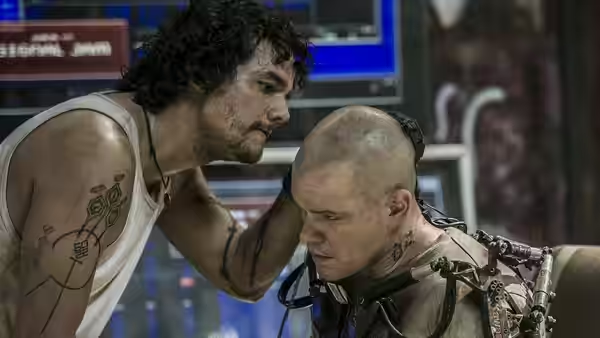
The plot mechanism is where the writing gives up. Max takes a lethal dose of radiation at the factory and goes to Spider (Wagner Moura), who smuggles people to the station, for a ticket. Spider wants whatever is in the head of Armadyne’s owner, John Carlyle (William Fichtner), and fits Max with a steel exoskeleton to get it. Once the data is stolen the film has to keep explaining what it is, and Blomkamp reaches instead for flashbacks, Young Max (Maxwell Perry Cotton), a nun and a promise, cut in whenever the story wants a feeling it has not earned. Frey (Alice Braga), a nurse with a sick daughter, exists so that Max has someone to save who is not himself.
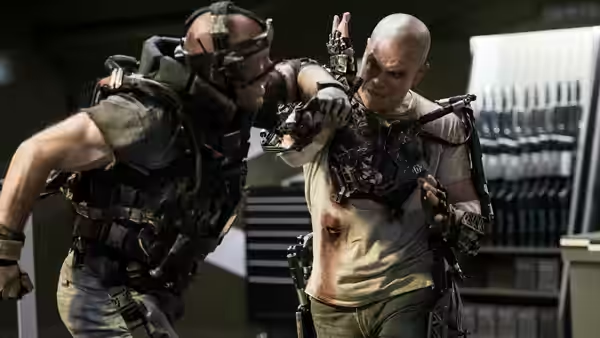
Two things got to us, both early. The accident is staged plainly: a door jams, a supervisor tells Max to go in and clear it, the door shuts behind him and a machine counts down. Then the exoskeleton goes on in a shed with a drill, bolts into the skull and nothing you could call an anaesthetic, and we watched it through our fingers. Once everybody on the station is shooting, we were watching two men in metal frames hit each other in a garden and could not say what was at stake beyond a hard drive. We were not bored so much as unbothered, and the film keeps insisting the fate of the species is on the line.
Lee Smith and Julian Clarke cut the fights in shaking close-up, and since Max and Kruger wear near-identical scaffolding it is often a few seconds before we know who was hit. The robots come apart handsomely; the humans come apart in ways that earn the 15. Ryan Amon’s score is brass and wordless choir turned up loud, telling us to feel the size of things when Ivey’s pictures had already done it.
District 9 (2009) was smaller and had a shape: one man, one change, one idea about who counts as a person. Elysium states its idea well in the first reel and then restates it, louder, while the guns go off. It runs 109 minutes and stops being about anything around the hour mark, so take the first half as science fiction and the second as a shooting gallery with unusually good robots.