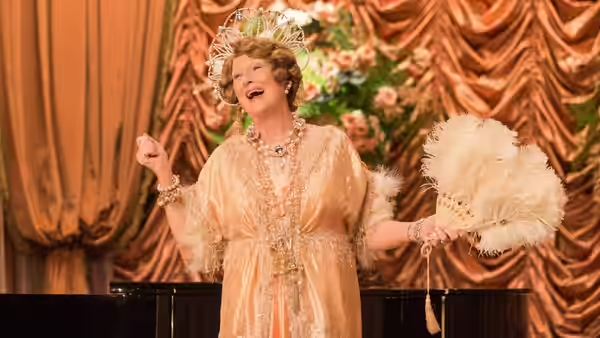
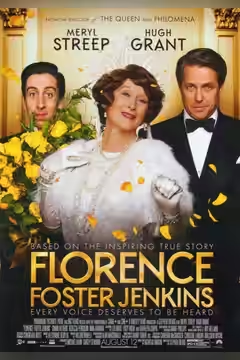
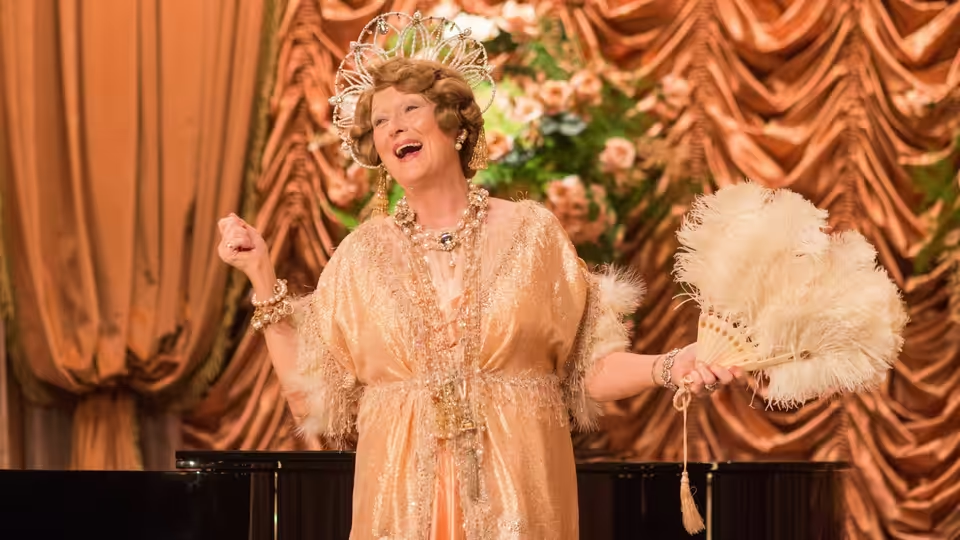
Florence Foster Jenkins (Meryl Streep) sings onstage, holding a feather fan before ornate curtains
Film review

Florence Foster Jenkins

2016 · Directed by Stephen Frears · 1h 50m · FSK 12

In a sentenceHugh Grant applauds every ruined aria as if his life depended on it, which it rather does

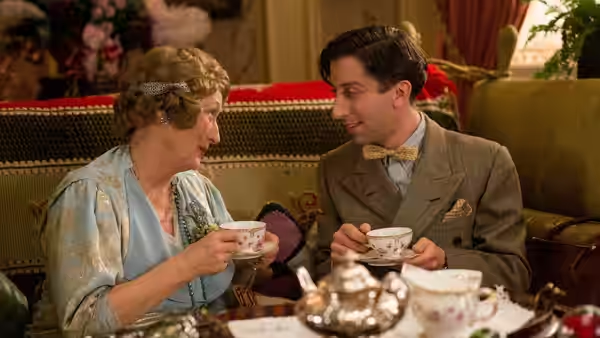
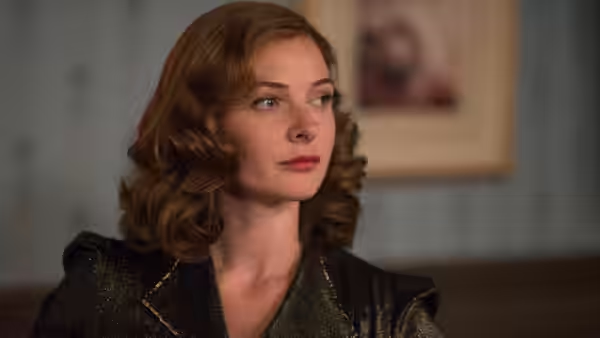
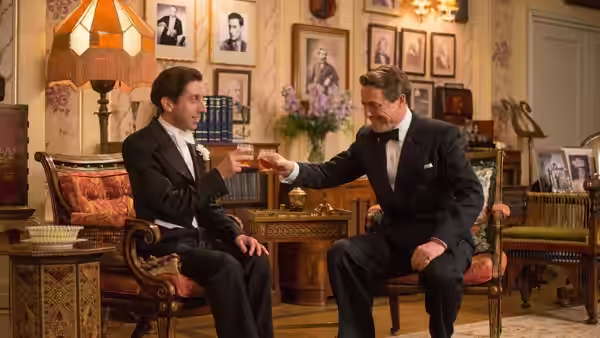
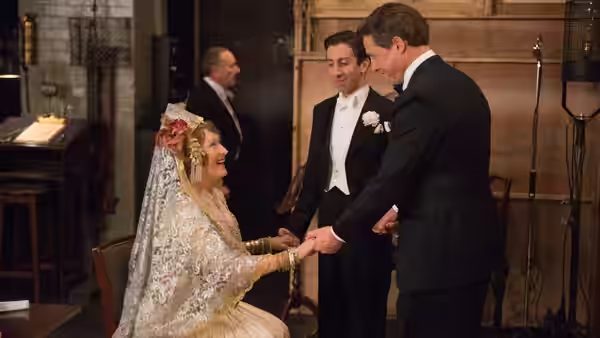
New York, 1944. Florence Foster Jenkins (Meryl Streep), a wealthy heiress and founder of the Verdi Club, stages tableaux for its members, appearing as the angel of inspiration in a pair of wings lowered from the ceiling. Her husband and manager, the English actor St. Clair Bayfield (Hugh Grant), runs her days, puts her to bed each night and then goes home to a second flat and his girlfriend Kathleen (Rebecca Ferguson). Florence decides to sing again. St. Clair hires a nervous young pianist, Cosmé McMoon (Simon Helberg), and the vocal coach Carlo Edwards (David Haig), and the first lesson shows what everyone but Florence already knows: she cannot hold a note. St. Clair’s job becomes keeping the truth from her, one bought critic and hand-picked audience at a time.

Plays from YouTube when you press play; nothing loads from them until then.

Fi1m review

Stephen Frears’s comedy about the worst singer in New York is kind, handsome and expertly acted, with Hugh Grant quietly superb as her husband. It is also softer than its story, and it never quite decides whether we are allowed to laugh.

Stephen Frears tells the story of Florence Foster Jenkins, a New York heiress who in 1944 believed she was a great soprano and was, by any measure the ear can apply, the worst singer in the city. Everyone around her knew. Her husband, St. Clair Bayfield, spent his days making sure she never found out. Nicholas Martin’s script treats this as a love story with a comedy inside it, and Frears directs it with warmth, tact and not much nerve. It is a pleasant 110 minutes about a story that is not pleasant, and the gap shows.

The singing is the attraction and Streep delivers it. The first lesson is the film’s best scene: Carlo Edwards (David Haig) warms her up with scales, she takes a breath, and what comes out is a quarter of a tone flat and stays there, climbing and wandering as if the tune were a staircase in the dark. Streep sings badly with great control. She never tips into parody; the sound is effort, not mockery, and that is what makes it funny. Valerio Bonelli cuts to Simon Helberg at the piano on every wrong note, and Helberg’s face goes through surprise, horror and something close to grief in under a minute. We laughed out loud, more than once, and then felt a little ashamed, because the woman making the noise is so plainly happy.

Grant is the reason to see it. His St. Clair is a failed actor who has found his best part, and he plays it with a flattering smile that never quite relaxes. Early on he puts Florence to bed, reads to her, waits for her breathing to slow, then takes the lift down and a cab across town to a second flat where Kathleen (Rebecca Ferguson) has dinner waiting. Grant plays the devotion and the deceit at the same time and asks for no credit for either. It is quiet work and it moved us more than the louder scenes did. Ferguson, meanwhile, is handed a character who exists to wait in doorways, and does what she can with it.

Frears has surrounded them with people who know what they are doing. Danny Cohen lights the flats in cream and dull gold, so every room looks like the inside of a jewellery box, and Alan MacDonald fills Florence’s with chairs, photographs and framed programmes until there is nowhere to stand. Consolata Boyle dresses Streep in turbans, feathers and, for the Verdi Club tableau, a pair of angel’s wings, each outfit one size more ambitious than the woman inside it. Alexandre Desplat’s score is light woodwind and music-box chimes, kept carefully out of the way of the arias, which is the right choice; nothing he could write would compete. Arturo Toscanini (John Kavanagh) drops by for a cheque and leaves with it, and the film lets that joke stand on its own.

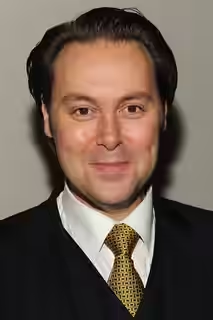
The trouble is that the film likes everyone too much to tell the truth about any of them. Agnes Stark (Nina Arianda), the brassy young wife of Phineas Stark (Stanley Townsend), laughs out loud at Florence’s first recital because it is funny, and the film treats her as a vulgarian for noticing. Earl Wilson (Christian McKay), the one critic who will not take St. Clair’s money, is the nearest thing to a villain. Martin’s script raises the question that matters, whether a kind lie is better than an unkind truth, and then leaves it to Grant’s face to answer. The second half is the first half again: another recital, another round of bribed reviewers and hand-picked audiences, another collapse at the piano. By the third aria the joke is tired and the film has no other.

Set against Frears’s own record it is a soft entry. The Queen (2006) and Philomena (2013) were both about women the public had already made up its mind on, and both left the awkward facts where they lay. This one tidies up after itself. The sadness is here, in Grant’s eyes and in a scene late on that we will not describe, but the film keeps covering it with another aria.

See it for Grant, and for Helberg’s face, and expect to laugh. Expect also to feel slightly guilty about it on the way home, which the film has arranged and then declines to take responsibility for. It carries a PG certificate and runs 110 minutes, and it goes down easily.

Critical consensus AI synthesised

66
Positive
13
Mixed
6
Negative
3

Most critics like Florence Foster Jenkins, and nearly all of them like it for the same reason: the acting. Meryl Streep is praised again and again for making Florence’s dreadful singing both funny and touching. Hugh Grant draws warm notices for an understated turn as the devoted husband, and Simon Helberg is repeatedly called a scene-stealer. The film is generally found amusing, big-hearted and easy to watch.

The disagreement is over whether it should be. A sizeable minority think Stephen Frears smooths over the awkward questions about deception and delusion, keeping things light where the story is sad. Others call it conventional and smaller than its subject, with a padded second half. The spread is wide: the Los Angeles Times finds the film’s message muddled, inviting the audience to laugh at Florence and then scolding them for it, and Den of Geek finds the comedy uncomfortably mean-spirited.

Radio Times
★★★★ · Emma Simmonds
80

The review is positive, finding Streep’s portrayal both deep and entertaining. It especially praises how she makes Florence’s painfully off-key musical performances entertaining.

Read the full review →
The Guardian
8 May 2016 · Mark Kermode
80*

Kermode finds the film very likable, frequently hilarious, and ultimately poignant. He praises Streep’s portrayal of Jenkins and Grant’s performance as her devoted manager.

Read the full review →
Time Out
2 May 2016 · ★★★★ · Cath Clarke
80

The review calls the biopic amusing and ridiculously watchable. It praises Meryl Streep’s comic portrayal of the famously awful singer.

Read the full review →
Vulture
12 August 2016 · David Edelstein
78*

Edelstein finds the film wobbly and uneven but ultimately wonderful, and ends with a heartfelt endorsement. He especially praises Hugh Grant’s understated, emotionally rich performance, while noting that Meryl Streep cannot quite sing as badly as the real Florence Foster Jenkins.

Read the full review →
Empire
6 May 2016 · Anna Smith
75*

Smith finds the film an entertaining, lighthearted period dramedy, though it takes few risks. She particularly praises Simon Helberg’s nuanced comic performance and the strong performances from Meryl Streep and Hugh Grant.

Read the full review →
Evening Standard
25 May 2016 · David Sexton
70*

Sexton finds the film an entertaining, big-hearted comedy, though its fun-first approach smooths over the story’s troubling ambiguities. He singles out Hugh Grant’s casting and Meryl Streep’s charismatic performance, which makes the film more pleasurable but less true to the case.

Read the full review →

Straight answers AI written, from our review

Is Florence Foster Jenkins worth watching?
Florence Foster Jenkins is worth watching for Hugh Grant, and we scored it 64. Grant is quietly superb as the husband who keeps the truth from her, and Streep sings badly with great control, but the film is softer than its story and repeats itself by the third aria. Suits anyone wanting a gentle, handsomely made comedy and prepared to laugh and feel slightly guilty about it.
How long is Florence Foster Jenkins, and what is it rated?
Florence Foster Jenkins runs 1h 50m and is rated 12 by the FSK in Germany. It is a comedy and drama film.
Where can I watch Florence Foster Jenkins in Germany?
Florence Foster Jenkins is available to rent from Apple TV from €3.99. Availability is checked daily; the links above go straight to each service.
How does Florence Foster Jenkins compare to Ed Wood?
Florence Foster Jenkins and Ed Wood are both affectionate comedies about cheerful incompetents, and Ed Wood is the better film. Burton loves his subject without pretending he was good, where Frears tidies up after Florence and never decides whether we may laugh. Choose Frears for Grant and a shorter, lighter evening; choose Burton for the richer portrait of failure.
What should I watch after Florence Foster Jenkins?
After Florence Foster Jenkins, try Ed Wood (1994, Fi1m 84): Another cheerful incompetent, and a film that loves him without pretending he was good. Then Philomena (2013, Fi1m 82): Frears on sharper form, with a woman the world had misjudged and a harder truth; and Topsy-Turvy (1999, Fi1m 88): Mike Leigh backstage with Gilbert and Sullivan; the hard labour behind light music, taken seriously.

Cast

Awards

Academy Awards, 2017

Nominated
Best Actress
Nominated
Best Costume Design

European Film Award for Best Actor, 2016

Nominated
European Film Award for Best Actor

If you liked this, try…

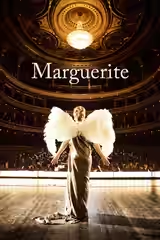
  1. Marguerite (2015) · not reviewed yetThe same true story moved to 1920s France, and far less afraid of its sadness.

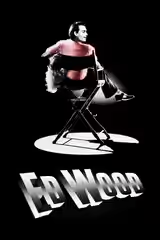
  2. Ed Wood (1994, Fi1m 84)Another cheerful incompetent, and a film that loves him without pretending he was good.

  3. Philomena (2013, Fi1m 82)Frears on sharper form, with a woman the world had misjudged and a harder truth.

  4. Topsy-Turvy (1999, Fi1m 88)Mike Leigh backstage with Gilbert and Sullivan; the hard labour behind light music, taken seriously.

  5. Sunset Boulevard (1950, Fi1m 91)The cruel version: a woman who will not be told, and a man paid to agree.