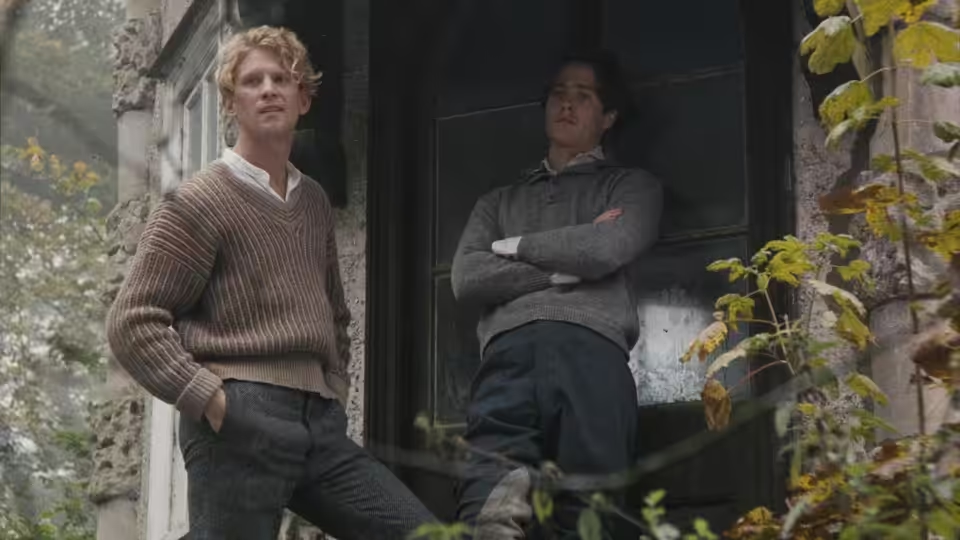
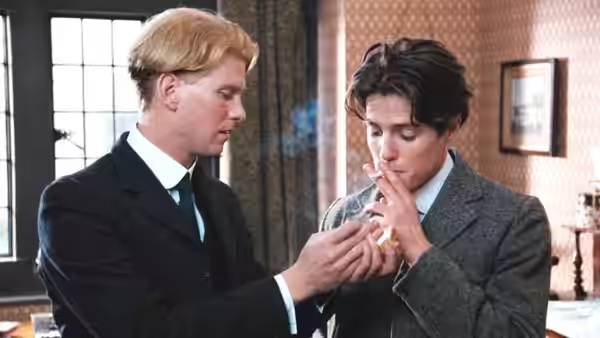
James Ivory’s Maurice is a moving romance, carried by James Wilby’s unforced performance. Its tenderness earns our attention, although the careful pacing occasionally gives us longer than we need to understand a feeling.
Maurice is a moving romance with a fine central performance and a pace that occasionally tries our patience. James Ivory, adapting E.M. Forster’s novel, takes the difficulty of understanding desire seriously enough to give it room. Maurice Hall is allowed to be confused, awkward and slow to recognise what matters to him. The screenplay, by James Ivory and Kit Hesketh-Harvey, does not demand that he become immediately eloquent about any of it. That puts considerable responsibility on James Wilby, who makes the uncertainty worth watching.
James Wilby does not make Maurice especially quick or dazzling company. That leaves the actor with less immediate charm to rely on, and makes his unforced playing especially valuable. We were moved by Maurice’s difficulty in understanding his desire, which he makes feel like hard, embarrassing work. We recognise how difficult it can be to say what we want without first finding out whether anyone will approve. The actor holds our attention without making that struggle look particularly noble.
Hugh Grant, as Clive Durham, has a polish that makes his appeal easy to understand, with enough reserve to keep us watching closely. Rupert Graves, as Alec Scudder, brings a more direct presence, and the difference gives the film a welcome change of emphasis. Neither is merely there to explain Maurice to us, and the casting keeps the attraction persuasive. The supporting cast is strong enough to tempt the film away from its lead, but we are always glad to come back to him.
Pierre Lhomme’s cinematography gives the male body an attention that the romance needs; the pleasure of looking is part of the story. This is one reason the film feels less timid than its careful manners might suggest. Brian Ackland-Snow’s production design gives the people around Maurice a reassuring appearance of order, making his uncertainty seem more exposed. Those composed settings work because the actors can seem so uncomfortable within them. The visual care helps us understand the attraction and the pressure surrounding it.
Katherine Wenning’s editing is less consistently helpful. The performances have time to establish a feeling, but some passages continue after we have understood what is being withheld, and the pauses begin to feel too long. Richard Robbins’s music gives the romance warmth, though it cannot make every hesitation equally absorbing. At 140 minutes, there is room for a firmer cut without making Maurice’s difficulties seem any simpler. The problem is repetition, particularly when a hesitation tells us something the acting has already made clear.
Literary romances can be anxious about appearing respectable, and Maurice sometimes shares that anxiety. Yet there is nothing apologetic in its attention to male desire, which makes the charge of excessive caution only partly convincing. We would ask for brisker storytelling before asking for a different emotional approach: the tenderness is one of the reasons to see it. This is a romance for people willing to watch someone take time over feelings they may recognise sooner than he does. Give it an evening when nobody is in a hurry.