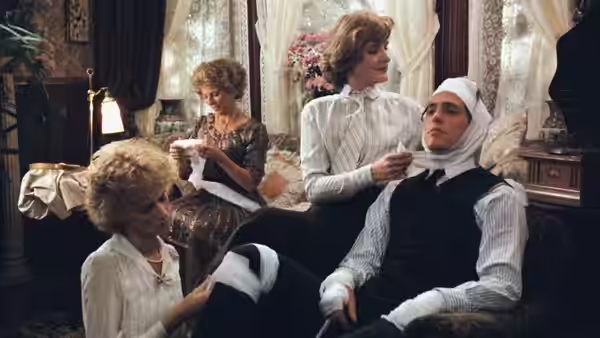
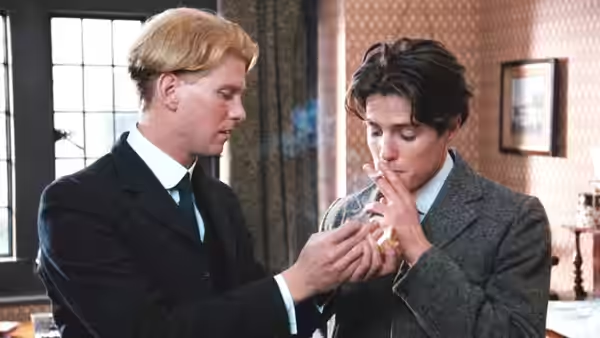
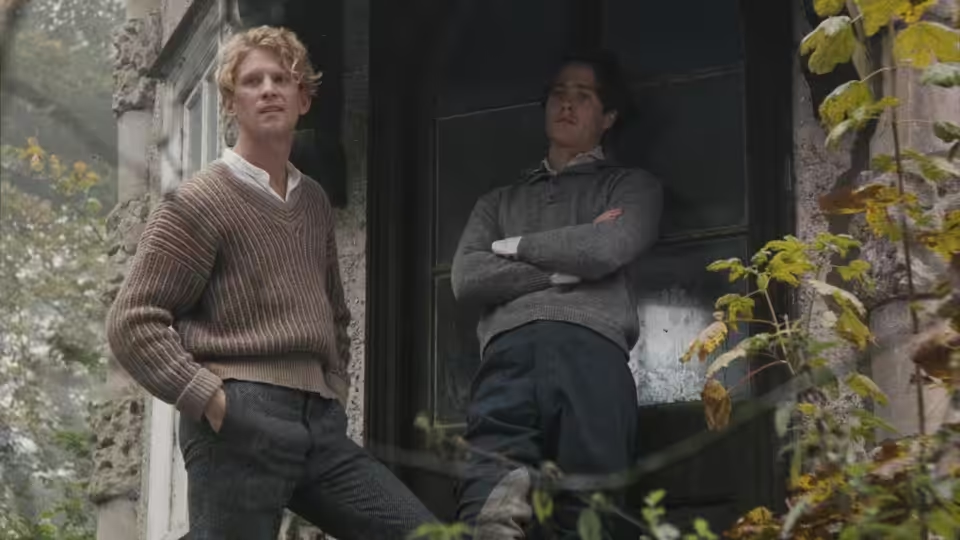
Clive Durham (Hugh Grant) and Maurice Hall (James Wilby) stand in a country house doorway
Film review

Maurice

1987 · Directed by James Ivory · 2h 20m

In a sentenceFalling in love takes time; James Ivory has made quite sure of that

Maurice Hall (James Wilby) struggles to understand his attraction to men and the expectation that he will leave those feelings unspoken. Clive Durham (Hugh Grant) and Alec Scudder (Rupert Graves) are the other central figures in his story. Wanting affection also means confronting how little Maurice understands his own desires, and how difficult it is to speak about them. James Ivory and Kit Hesketh-Harvey adapt E.M. Forster’s novel as a drama of love and repression.

Plays from YouTube when you press play; nothing loads from them until then.

Fi1m review

James Ivory’s Maurice is a moving romance, carried by James Wilby’s unforced performance. Its tenderness earns our attention, although the careful pacing occasionally gives us longer than we need to understand a feeling.

Maurice is a moving romance with a fine central performance and a pace that occasionally tries our patience. James Ivory, adapting E.M. Forster’s novel, takes the difficulty of understanding desire seriously enough to give it room. Maurice Hall is allowed to be confused, awkward and slow to recognise what matters to him. The screenplay, by James Ivory and Kit Hesketh-Harvey, does not demand that he become immediately eloquent about any of it. That puts considerable responsibility on James Wilby, who makes the uncertainty worth watching.

James Wilby does not make Maurice especially quick or dazzling company. That leaves the actor with less immediate charm to rely on, and makes his unforced playing especially valuable. We were moved by Maurice’s difficulty in understanding his desire, which he makes feel like hard, embarrassing work. We recognise how difficult it can be to say what we want without first finding out whether anyone will approve. The actor holds our attention without making that struggle look particularly noble.

Hugh Grant, as Clive Durham, has a polish that makes his appeal easy to understand, with enough reserve to keep us watching closely. Rupert Graves, as Alec Scudder, brings a more direct presence, and the difference gives the film a welcome change of emphasis. Neither is merely there to explain Maurice to us, and the casting keeps the attraction persuasive. The supporting cast is strong enough to tempt the film away from its lead, but we are always glad to come back to him.

Pierre Lhomme’s cinematography gives the male body an attention that the romance needs; the pleasure of looking is part of the story. This is one reason the film feels less timid than its careful manners might suggest. Brian Ackland-Snow’s production design gives the people around Maurice a reassuring appearance of order, making his uncertainty seem more exposed. Those composed settings work because the actors can seem so uncomfortable within them. The visual care helps us understand the attraction and the pressure surrounding it.

Katherine Wenning’s editing is less consistently helpful. The performances have time to establish a feeling, but some passages continue after we have understood what is being withheld, and the pauses begin to feel too long. Richard Robbins’s music gives the romance warmth, though it cannot make every hesitation equally absorbing. At 140 minutes, there is room for a firmer cut without making Maurice’s difficulties seem any simpler. The problem is repetition, particularly when a hesitation tells us something the acting has already made clear.

Literary romances can be anxious about appearing respectable, and Maurice sometimes shares that anxiety. Yet there is nothing apologetic in its attention to male desire, which makes the charge of excessive caution only partly convincing. We would ask for brisker storytelling before asking for a different emotional approach: the tenderness is one of the reasons to see it. This is a romance for people willing to watch someone take time over feelings they may recognise sooner than he does. Give it an evening when nobody is in a hurry.

Critical consensus AI synthesised

75
Positive
6
Mixed
5
Negative
0

The reviews lean favourable on Maurice, with praise clustering around its emotional sensitivity, performances and patient handling of repressed desire. Admirers find the adaptation intelligent and moving, attentive to the pain and pleasure of Maurice’s self-discovery. James Wilby draws repeated praise for an unaffected, convincing performance, while Hugh Grant and the supporting cast also receive favourable notice. Several critics argue that the romance retains its power, with some finding it more affecting over time.

Reservations concern the film’s caution and the strength of its central performance. Variety finds Wilby merely adequate and outshone by the supporting cast. Radio Times considers the treatment of homosexuality too gingerly, whereas Eye for Film praises the explicit portrayal of male bodies. The recorded responses range from measured approval to strong enthusiasm, with none negative, though three entries lack accessible verdicts and cannot establish the reasons behind their scores.

Los Angeles Times
1 June 2017 · Kevin Thomas
95*

Thomas calls the film well-nigh flawless and a remarkably faithful, perceptive adaptation. He especially praises James Wilby’s unaffected performance and the graceful script’s treatment of Maurice’s self-discovery.

Read the full review →
Sight and Sound
25 July 2018 · Claire Tomalin
90*

Tomalin finds the film a subtle, intelligent, moving success that would have pleased Forster. She especially praises James Wilby’s performance and the film’s fidelity to the novel’s mixture of joy and pain.

Read the full review →
The Guardian
26 July 2018 · Peter Bradshaw
90*

Bradshaw calls the film a revelation whose fascination and power have only grown over time. He praises the emotionally charged scene where Alec confronts Maurice in London and their hurt feelings emerge.

Read the full review →
Empire
1 January 2000 · empire
80*

The review calls the film one of Merchant Ivory’s finest. It praises its rich atmosphere and patient attention to repressed passions.

Read the full review →
RogerEbert.com
64*

The page could not be accessed, so the critic’s verdict cannot be established. No specific praise or complaint is available from the blocked content.

Read the full review →
The New York Times
18 September 1987 · Vincent Canby
64*

The page is inaccessible, so the critic’s verdict cannot be verified. No specific praise or complaint can be reliably identified from the available text.

Read the full review →

Straight answers AI written, from our review

Is Maurice worth watching?
Maurice is worth watching for its moving treatment of love and repression and James Wilby’s unforced central performance; we score it 83 out of 100. We recommend it to anyone drawn to patient, character-led romances, with the reservation that its 140 minutes include pauses that outlast what the acting needs.
How long is Maurice, and what is it rated?
Maurice runs 2h 20m. It is a drama and romance film.
Where can I watch Maurice in Peru?
Maurice is not on any streaming or rental service in Peru at the moment. It is available in 8 other countries; change your country at the top of the page to see where. Availability is checked daily.
How violent or frightening is Maurice, and is it suitable for children?
Maurice carries a UK 15 certificate, making it unsuitable for children under 15 and a choice for older teenagers and adults. Its focus is desire and repression, but we cannot offer specific assurances about violence or frightening material: the certificate alone does not identify which content warrants the restriction.
How does Maurice compare to My Beautiful Laundrette?
Maurice is the more measured romance, while My Beautiful Laundrette offers a sharper, scruffier treatment of desire and class that we favour for its humour and directness. We recommend Maurice for its patient attention to uncertain feelings; the alternative is funnier and more crowded, with subplots that sometimes obstruct its tender central romance.
Is Maurice based on a true story or a book?
Maurice is based on E.M. Forster’s novel, adapted for the screen by James Ivory and Kit Hesketh-Harvey, rather than presented as a true story. Knowing the book is not necessary to follow Maurice’s struggle to understand his attraction to men; we value the screenplay’s willingness to let him remain awkward and uncertain.
What should I watch after Maurice?
After Maurice, try My Beautiful Laundrette (1985, Fi1m 85): A sharper, scruffier British romance where desire and class cannot be kept apart. Then The Wedding Banquet (1993, Fi1m 81): Family expectations turn a gay man’s romantic life into an increasingly complicated negotiation; and Weekend (2011, Fi1m 86): Two men have less time together, and considerably more room to speak plainly.

Cast

Awards

Academy Awards, 1988

Nominated
Best Costume Design

If you liked this, try…

  1. My Beautiful Laundrette (1985, Fi1m 85)A sharper, scruffier British romance where desire and class cannot be kept apart.

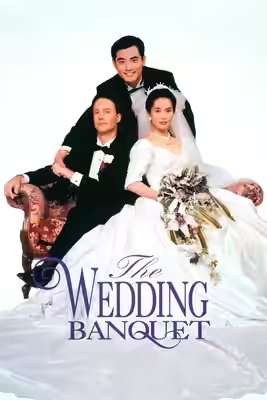
  2. The Wedding Banquet (1993, Fi1m 81)Family expectations turn a gay man’s romantic life into an increasingly complicated negotiation.

  3. Weekend (2011, Fi1m 86)Two men have less time together, and considerably more room to speak plainly.

  4. The Way He Looks (2014) · not reviewed yetA blind teenager discovers attraction in a romance that trusts small changes of feeling.

  5. Portrait of a Lady on Fire (2019, Fi1m 89)A painter’s attention turns intimate, with each look carrying more than the conversation.

Free account

Know what to watch tonight

Two lists that know where things are streaming, collections you can share, your own score beside ours, and Discover that remembers what you have seen.

  • Want to see, sorted by what is streaming now
  • Seen, with your score out of ten
  • No adverts, ever