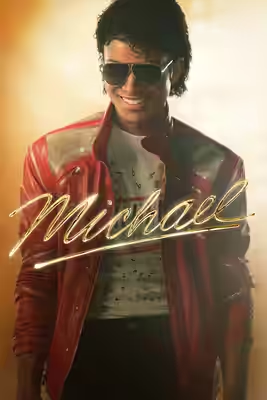
Michael poster

Michael

2026 · Directed by Antoine Fuqua
2h 08mMusicDrama12A
47
Fi1m score
40
Critics · 16
Audience · not yet

Where to watch in the UK

Checked 10 September at 22:28. Prices and availability change; the service’s page is the last word.

Plays from YouTube when you press play; nothing loads from them until then.

Synopsis

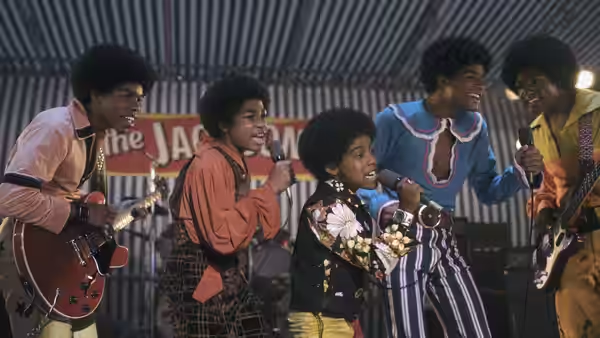
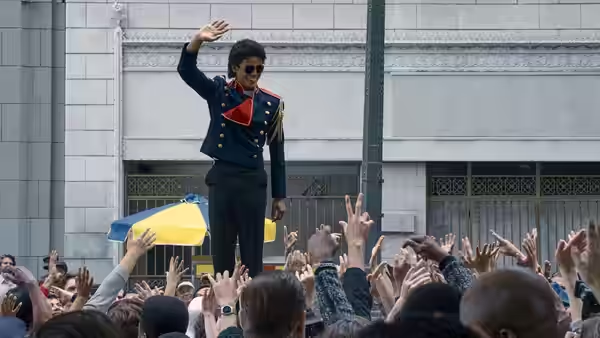
Antoine Fuqua’s film follows Michael Jackson from a childhood in Gary, Indiana, where his father Joseph (Colman Domingo) drills him and his brothers into the Jackson 5, to the years when he leaves the family act and makes records under his own name. Juliano Krue Valdi plays the boy; Jaafar Jackson, Michael’s nephew, plays him as a young man. Nia Long is his mother Katherine, Larenz Tate is Berry Gordy of Motown, Kendrick Sampson is the producer Quincy Jones and Miles Teller is the lawyer John Branca. John Logan writes. The film runs 128 minutes and stops in the early 1980s, before the parts of the life most people now argue about.

Fi1m review

In a sentenceThe dancing is his, the face is his nephew’s, and the story has been approved by his lawyer

Jaafar Jackson moves like his uncle and the stage numbers are the real thing; around them, Antoine Fuqua has made an authorised biography that stops the moment the story gets difficult. Watch it for the dancing and expect to argue about the rest.

Antoine Fuqua’s Michael covers the life of Michael Jackson from a childhood in Gary, Indiana, to the early 1980s in 128 minutes, and among its producers is John Branca, who was Jackson’s lawyer and now helps run his estate. Branca is also in the film, played by Miles Teller as the calm man who helps Michael take charge of his own affairs. We mention this early because it explains a good deal of what follows. John Logan’s script is a straightforward rise: a father drills his sons into an act, the smallest son becomes the act, the young man walks away from his father and becomes the most famous performer alive. Then the film stops, some years before the allegations of child sexual abuse that everyone watching knows are coming.

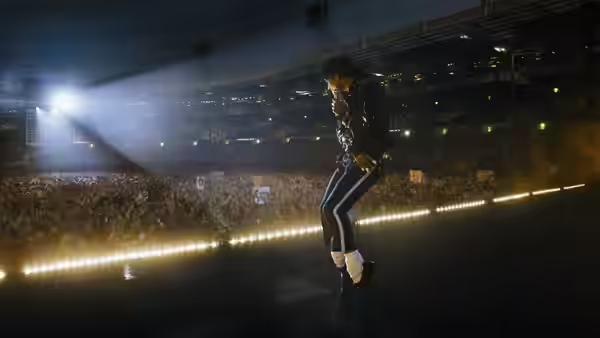
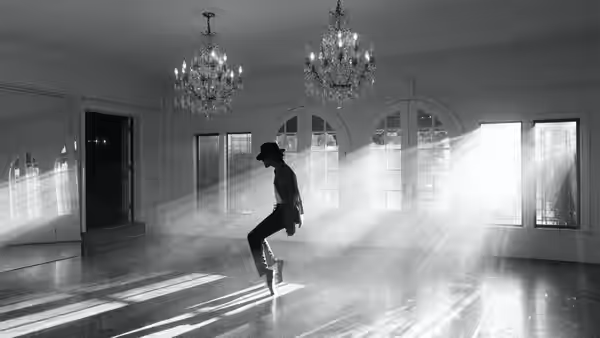
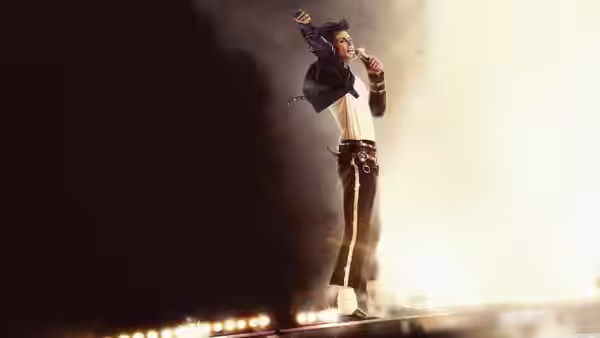
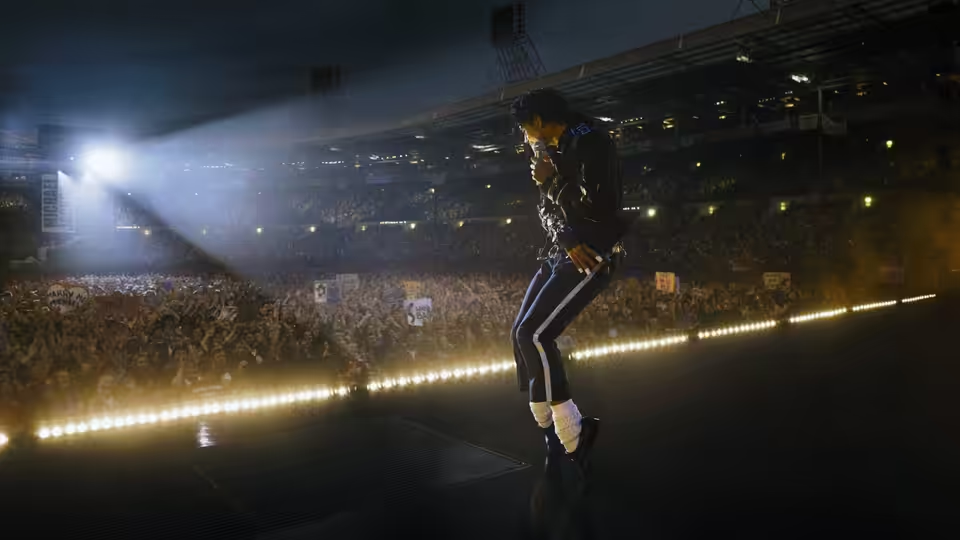
Jaafar Jackson is Michael’s nephew, and the resemblance does the first ten minutes’ work for him. What he does after that is his own. He has the soft speaking voice, the way of ducking his head when praised, the sudden stillness before a move, and when the film lets him dance he does not look like a man copying old footage. The first time the adult Michael takes a stage on his own we sat up and forgot the film around him, and that happened three or four more times before the end. He is the reason the numbers work.

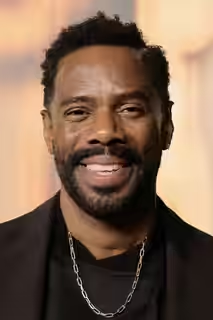
Colman Domingo plays Joseph Jackson as a large, watchful man who believes fear is a teaching method, and he is good at it, sometimes too good; the film needs a villain, hands him the job, and he plays it at a pitch that empties the rest of the house. Nia Long’s Katherine is left to look worried in doorways. Juliano Krue Valdi, as the boy Michael, is the more surprising piece of casting: small, exact and plainly lonely among his brothers. The scenes of him alone after the others have finished are the closest the film comes to saying what it costs to be this good this young.

The music is handled with care and money. Dion Beebe shoots the stage numbers from the floor and the wings, close on feet and hands, and Barbara Ling’s sets move from a small house in Gary to a Motown office to arenas without once looking like a soundstage. Marci Rodgers has put the right clothes in the right year. Four editors are credited, John Ottman, Harry Yoon, Tom Cross and Conrad Buff IV, and we could feel the seam between the numbers, which are cut to the beat and let a move finish, and the scenes between them, which are cut as if someone were checking a list. Lior Rosner’s score has little to do, because the songs are the score.

The problem is not what the film puts in but where it stops. It ends at the point of greatest triumph, and along the way there are several scenes of Michael being kind to children, which the film offers as plain evidence of a good heart. We watched those scenes with a knot in our stomach, and we do not believe that was the intention. A film that knows what its audience knows and stages this anyway is daring us to raise the subject, then leaving before we can. Logan wrote The Aviator, which admired Howard Hughes and showed him falling apart in the same scene; here there is not one line that admits a difficulty.

Fuqua made Training Day, which was about a bad man and knew it. Here he directs as if under instruction. The biopic scaffolding is all up: the record executive (Mike Myers, as Walter Yetnikoff, having a fine time), the studio scenes with Kendrick Sampson’s Quincy Jones, the montage of ascent. Oddly, the business scenes are the most detailed in the film. It is more interested in how Michael took control of his affairs than in what he was like at three in the morning.

The reviews so far are mostly cold, and ours is only a degree or two warmer. If you want to see how the songs were made and how the moves were done, the two hours will give you that, and Jaafar Jackson will give you more. If you want to know who the man was, the film has decided that is a question for a different producer.

Critical consensus AI synthesised

40
Positive
2
Mixed
4
Negative
10

Most critics agree on both what works and what does not, and the balance falls against the film. The praise clusters on Jaafar Jackson, whose likeness in voice, look and movement is repeatedly called uncanny, and on the musical sequences, which even the harshest notices find electrifying. Colman Domingo’s Joe Jackson also draws notice. The reservations are near-unanimous: the film ends before the child abuse allegations and never mentions them, and most reviews call it a sanitised, estate-approved hagiography that hits every music-biopic beat. The New York Times reports that reshoots removed material addressing the allegations. Dissent comes chiefly from the American trade press: Variety finds the father-son story surprisingly effective, and The Hollywood Reporter detects a melancholy underneath the boilerplate. The Independent and The i Paper go furthest the other way, calling it ghoulish and asking whether it should have been made at all. The scores vary widely; the complaint hardly at all.

The Telegraph
24 April 2026
50*

The review praises the captivating early rise-to-fame story, performances, music and choreography but faults the film for refusing to address later controversies, making it a structurally complete but only half-told story and a whitewash. It calls the omission a borderline-fatal flaw.

Read the full review →
Little White Lies
21 April 2026 · 1/2/1 · David Jenkins
40

The critic deems it a squeaky-clean, PR-driven hagiography that reaffirms Jackson’s genius while erasing controversies. Jaafar Jackson’s central performance and the film’s professional sheen are noted positively amid the overall dismissal.

Read the full review →
The Observer
22 April 2026 · Wendy Ide
40*

The film is criticised as an aggressively anodyne, surface-level box-ticker that sanitises the story and follows a rigid biopic formula, with the Jackson estate’s influence evident in its curated image. It succeeds mainly in capturing the electrifying stage presence and music of the performer.

Read the full review →
Empire
21 April 2026 · John Nugent
30*

The film is a generic, hagiographic biopic that ignores controversies, focuses on career milestones with impressive performances but feels like a cynical cash grab with no artistic point of view.

Read the full review →
Slant Magazine
21 April 2026
30*

The biopic is a transparent bid to redeem the King of Pop by sidestepping scandals and turning a complicated life into sanitized popcorn entertainment. The critic singles out the focus on early career and Jaafar Jackson’s embodiment of the role while criticizing the lack of impartiality and depth.

Read the full review →
The Guardian
21 April 2026 · Peter Bradshaw
30*

The critic finds the film a frustratingly shallow and inert cruise-ship entertainment that assembles every music-biopic cliché while avoiding the central issues in Jackson’s life. It offers bland smiley blandness from the lead and little depth beyond surface spectacle.

Read the full review →

Cast

Colman Domingo
Joseph Jackson
Nia Long
Katherine Jackson
Juliano Krue Valdi
Young Michael
Miles Teller
John Branca
Larenz Tate
Berry Gordy
Laura Harrier
Suzanne de Passe

Stills

If you liked this, try…

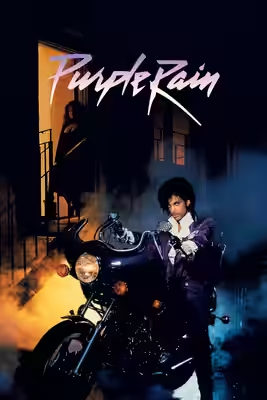
Purple Rain poster

Purple Rain

1984 · Prince plays himself and is allowed to be vain, cruel and brilliant at once.

Love & Mercy poster

Love & Mercy

2014 · A pop genius biopic that puts the breakdown on screen instead of around the corner.

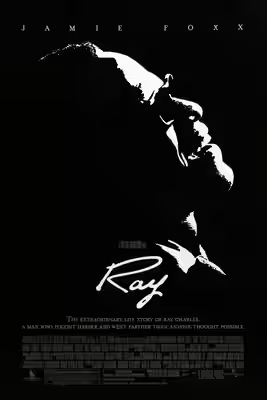
Ray poster

Ray

2004 · The same rise, told with the subject’s worst habits left in.

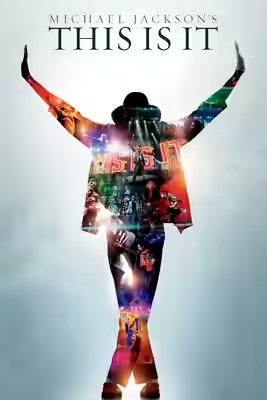
Michael Jackson's This Is It poster

Michael Jackson's This Is It

2009 · Rehearsal footage from the last months; the real dancer, unrehearsed and unhidden.

Leaving Neverland poster

Leaving Neverland

2019 · The four hours this film leaves out; watch it and make up your own mind.