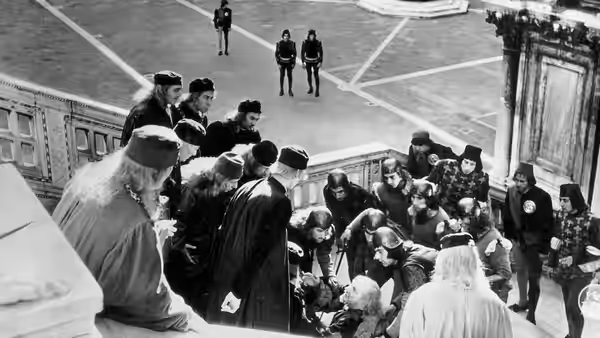
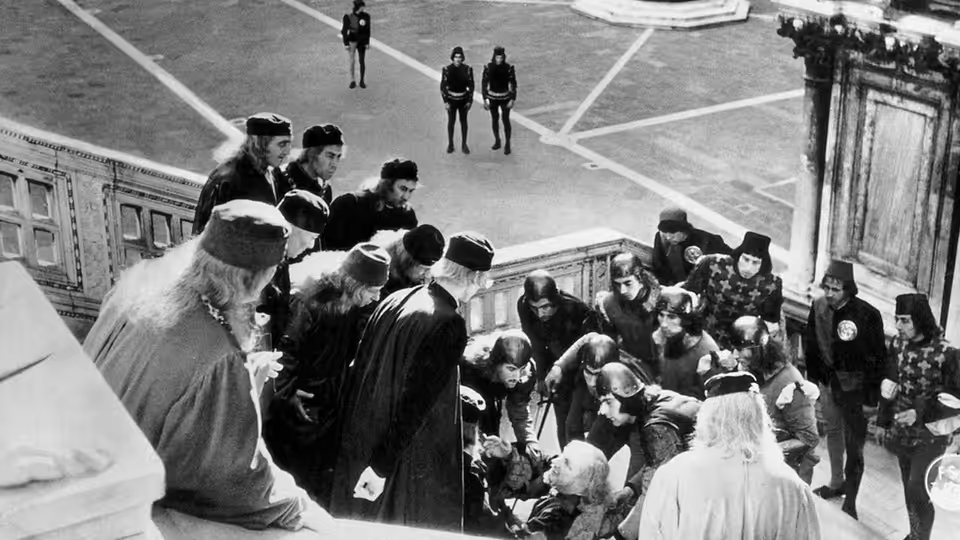
A crowd of men in robes and hats gathered on stone stairs overlooking a courtyard
Film review

Othello

1951 · Directed by Orson Welles · 1h 33m

In a sentenceNinety minutes of the best shadows in cinema, dubbed in what sounds like a neighbouring room

Venice, and then the fortress island of Cyprus, where Venice keeps a garrison against the Turks. Othello (Orson Welles), a Moorish general in the city’s service, has married Desdemona (Suzanne Cloutier) in secret. Her father, the senator Brabantio (Hilton Edwards), learns of it in the night from Iago (Micheál Mac Liammóir), Othello’s ensign, who has been passed over for promotion in favour of Michael Cassio (Michael Laurence) and has recruited the rich, lovesick Roderigo (Robert Coote) to help him make trouble. Brabantio drags the matter before the Senate; Desdemona speaks for her husband; the Turkish threat means Venice cannot spare him. Othello sails for Cyprus with his wife, his lieutenant and his ensign, and Iago begins to plan. The film opens with a funeral procession along the battlements, then goes back to the beginning.

Fi1m review

Welles shot his Othello in fits and starts wherever the money took him, and you can hear it in every dubbed line. You can also see, in every frame, a director who knew exactly where to put the camera. We recommend it, with patience.

Orson Welles’s Othello is a film that should not exist, and it looks like it. It was shot over years, in pieces, and it reached British cinemas on 24 February 1956. Welles cut Shakespeare’s play down to 93 minutes and turned it into a nightmare of walls, bars and stairs. We think it is one of the best-looking films he made, and one of the worst-sounding, and we recommend it on the first count knowing you will have to forgive the second.

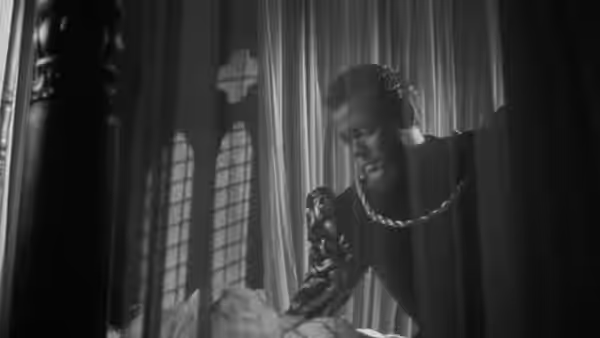
The opening is the best thing in it. A coffin is carried along the battlements against a white sky, monks in black file past, an iron cage is hauled up a wall, and Angelo Francesco Lavagnino and Alberto Barberis put drums and a chant under it that sound like something being nailed shut. Only then do we go back to Venice and the beginning. Every bright scene afterwards has a shadow already over it.

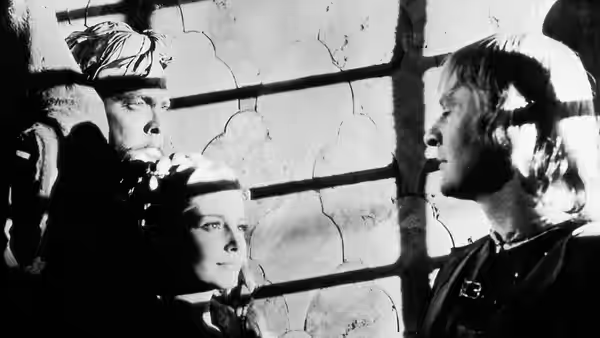
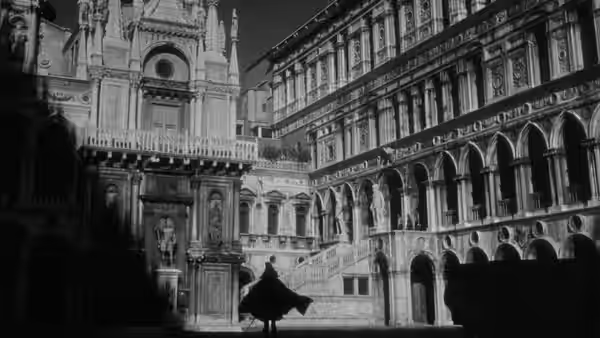
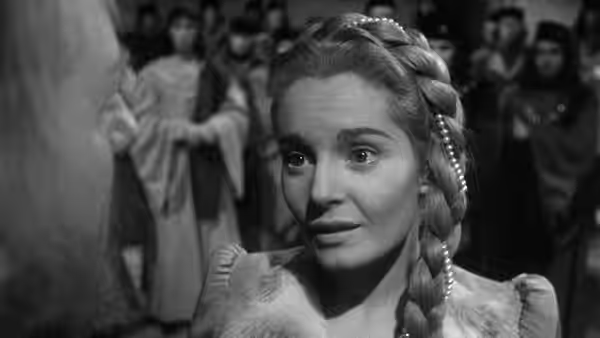
Three cinematographers are credited, G.R. Aldo, Anchise Brizzi and George Fanto, and you cannot tell where one stopped and the next began. The camera sits low and looks up at people against vaults and arches. Faces are lit from one side and cut in half. The production designers Luigi Scaccianoce and Alexandre Trauner had to make a dozen real places into one imaginary Cyprus, and the joins rarely show. Maria De Matteis dresses Othello in dark robes and everyone else in pale ones, so that he is the only black shape in a white world.

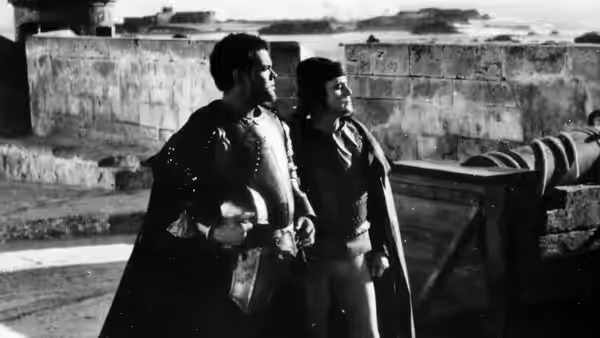
Micheál Mac Liammóir’s Iago is small, dry and unsmiling. He does not twinkle at the audience the way stage Iagos do; he looks like a clerk who has been slighted and has all afternoon. The scene where he first puts the idea into Othello’s head is played as a long walk along the ramparts, the two men side by side, the camera keeping pace, the sea below. We found it frightening, because nothing happens. Two men walk. One of them says less than he means. By the end of the wall the other one is a different person.

Welles plays Othello inward, the voice low and slow, the eyes doing most of it, and the voice is magnificent. The make-up is a problem, and it is a harder thing to look past now than the sound. Suzanne Cloutier is given little to do as Desdemona beyond be looked at and be lit, and she is lit beautifully. Fay Compton’s Emilia gets the film’s plainest, angriest lines. Robert Coote’s Roderigo is funny, a rich idiot in a feathered hat who keeps handing over money and asking why nothing has happened yet.

Then the sound. Lines arrive a fraction after lips move, or before, or from somewhere behind the actor’s head. Voices were laid on afterwards, and it shows: Nicholas Bruce’s Lodovico is credited with one face and Robert Rietti’s voice. The three editors, Renzo Lucidi, Jenö Csepreghy and William Morton, had to build scenes out of footage shot at different times, and there are moments when a character starts a sentence in one place and finishes it in another. The middle stretch, where Iago’s scheme needs its props and its witnesses, is hardest to follow. We lost the thread and resented it, because the pictures had been so clear.

Most critics have come round to the film over the years. We are close to them, a little cooler. The early complaint, that Welles cared more about staircases than about Shakespeare, is not fair; the staircases are how the film thinks. But the sound is a real failure, and it costs the actors. It is not as whole as Citizen Kane or as sure-footed as Touch of Evil, and it is more alive than either in its single shots.

Watch it at home, where you can turn the sound up and go back when a line escapes you. It is a U certificate. We would not put a child in front of it, not because of anything on screen but because the child will ask what everyone just said, and you will not be able to tell them.
Critical consensus AI synthesised

76
Positive
9
Mixed
2
Negative
1

Most critics admire this Othello, and the praise gathers almost entirely around Welles the director. The reviews return to how he turned a starved, interrupted production into a style: locations stitched together across countries, stand-ins, jump cuts and disorienting compositions that put the audience inside the Moor’s head rather than in front of the plot. Several call it the most cinematic Shakespeare on film, and the later reviews, written around restorations, treat its raggedness as part of the appeal. Welles’s voice and MacLiammoir’s Iago are noted approvingly.

The reservations sit on the same point, turned over. The dissenters, chiefly the American critics who saw it on first release in the 1950s, find the staircases, mirrors and chaotic sound a set of tricks that bury the story; The New York Times calls the result hollow. The Independent, writing at the 1992 restoration, grants the flair but finds the film tatty and the locations distracting. The spread is wide, though the rejection is old and the admiration recent.

Los Angeles Times
19 April 1992 · Kenneth Turan
90*

The critic hails the restored film as a breathtaking achievement that overcomes its troubled production history, praising its audacious visual style and stripped-down intensity.

Read the full review →
Time Out
10 September 2012 · TR
90*

Welles turned production limitations into strengths through inventive locations, stand-ins and montage in this Shakespeare adaptation shot over four years. The visual rhetoric syncs with the verbal imagery for sensory overload in a very great film noir.

Read the full review →
Empire
1 January 2000 · Alan Morrison
85*

The critic calls this the most cinematic of Shakespeare adaptations, crediting Welles' direction for suggesting characters' psychological states through inventive camera work and locations. Welles' genius behind the camera is singled out for bringing one of the Bard's darkest plays to life.

Read the full review →
Slant Magazine
15 October 2017 · Chuck Bowen
85*

The critic praises the Criterion Collection's restoration and transfer of Welles's audaciously personal Othello, highlighting its fragmented editing syntax and psychological depth achieved through jump cuts and disorienting compositions. He singles out the film's experimental style and the supplements that contextualize its chaotic production and racial themes.

Read the full review →
Evening Standard
11 April 2012 · Nina Caplan
80*

The review praises Welles as a truly gifted director in this powerful adaptation of Shakespeare's tragedy, made despite chronic funding shortages. It highlights the film's ability to overcome its difficult production history, especially in a decent print with restoration extras.

Read the full review →
Film Comment
1 May 2014 · Aaron Cutler
78*

The critic describes Welles's 1952 Othello as an inventive adaptation that prioritizes reflection on the protagonist's self-deception over suspense, using motifs of imprisonment, mirrors, and fragmented imagery to convey the Moor's internal conflict and tragic isolation. It notes the film's stylistic coherence despite its piecemeal production and positions Othello among Welles's other isolated protagonists.

Read the full review →

Straight answers AI written, from our review

Is Othello worth watching?
Othello (1951) is worth watching for anyone who can forgive a badly dubbed soundtrack in exchange for some of the best black-and-white images Orson Welles ever shot, and we scored it 80. Watch it at home, where you can turn the sound up and go back when a line escapes you; the middle stretch, where Iago's scheme needs its props and witnesses, is the hardest to follow.
How long is Othello, and what is it rated?
Othello runs 1h 33m. It is a drama film.
Where can I watch Othello in Indonesia?
Othello is not on any streaming or rental service in Indonesia at the moment. It is available in 8 other countries; change your country at the top of the page to see where. Availability is checked daily.
How does Othello compare to Hamlet?
Othello (1951) is the rougher and stranger of the two, and Olivier's Hamlet the better spoken and more whole. Both are black-and-white films of castles, stairs and shadows, but Olivier's lines arrive clearly from the actors' mouths, while Welles's were laid on afterwards and often land a beat off. Choose Hamlet for the play and Othello for the pictures.
What should I watch after Othello?
After Othello, try Hamlet (1948, Fi1m 84): Olivier’s black-and-white castle of stairs, the other great Shakespeare of its decade. Then Ran (1985, Fi1m 92): Lear as a Japanese warlord, with colour doing what Welles’s shadows do here.

Cast

Awards

Cannes Film Festival, 1952

Won
Palme d'Or

If you liked this, try…

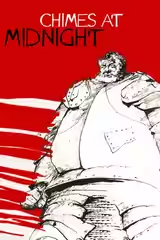
  1. Chimes at Midnight (1965) · not on Fi1m yetWelles’s Falstaff, made the same hand-to-mouth way, and his warmest film by a distance.

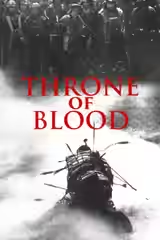
  2. Throne of Blood (1957) · not on Fi1m yetKurosawa’s Macbeth in fog and armour; the play rebuilt from the ground up.

  3. Hamlet (1948, Fi1m 84)Olivier’s black-and-white castle of stairs, the other great Shakespeare of its decade.

  4. Ran (1985, Fi1m 92)Lear as a Japanese warlord, with colour doing what Welles’s shadows do here.

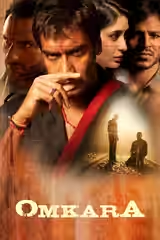
  5. Omkara (2006) · not on Fi1m yetOthello moved to rural Uttar Pradesh, with gangsters, songs and the same handkerchief.

Othello (1951) review: Welles’s ragged Shakespeare, superbly shot (Indonesia) | Fi1m