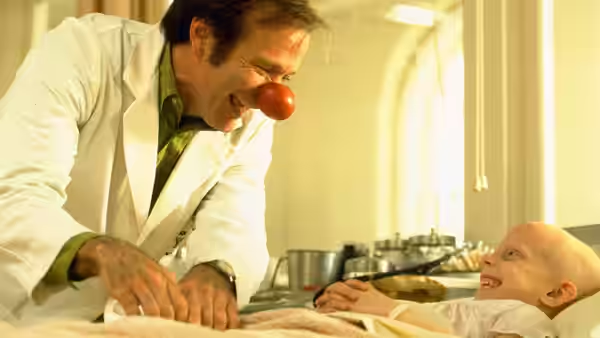
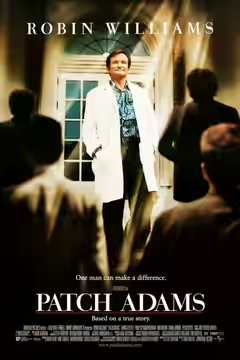
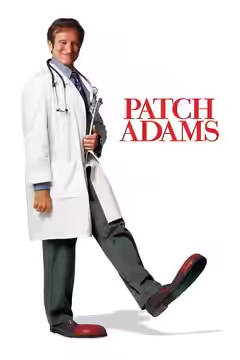
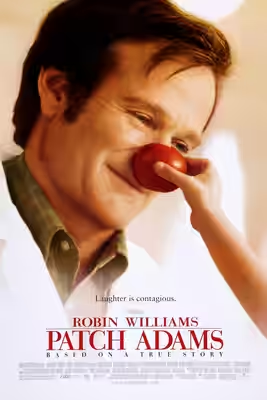
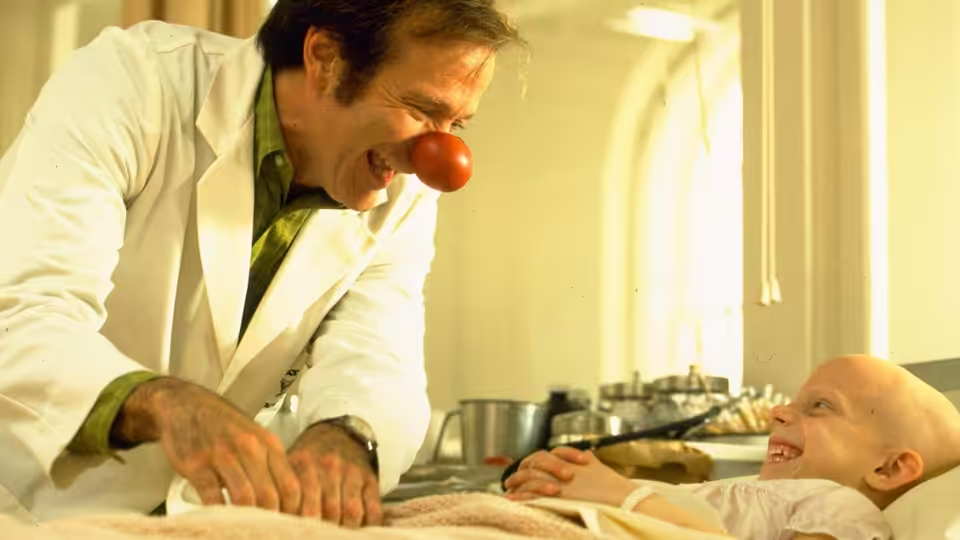
Patch Adams (Robin Williams) wears a clown nose and leans over a smiling child in a hospital bed
Film review

Patch Adams

1998 · Directed by Tom Shadyac · 1h 55m · FSK 6

In a sentenceA doctor who prescribes red noses, in a film that prescribes violins

Patch Adams (Robin Williams) commits himself to a psychiatric hospital after trying to take his own life. The doctors there will not look at him, but a fellow patient will, and Patch finds that making the man laugh does more for both of them than anything the staff have tried. He signs himself out and enrols at medical school, determined to become a doctor who treats people rather than charts. His roommate Mitch (Philip Seymour Hoffman) is top of the class and wants him gone. Truman (Daniel London) becomes an ally; Carin (Monica Potter) keeps her distance. Dean Walcott (Bob Gunton) runs a school where students do not meet a patient until their third year, so Patch sneaks onto the children’s ward with a red enema bulb on his nose.

Fi1m review

Robin Williams is likeable and often funny as the clown who wants to be a doctor, and Tom Shadyac trusts none of it, so every scene arrives with strings attached. Some of it lands. Most is a lecture wearing a red nose.

Tom Shadyac’s film, from a screenplay by Steve Oedekerk and the book by the real Patch Adams, has one idea and holds it up to the light for 115 minutes: a doctor should treat the person in the bed, not the chart at the end of it. It is a decent idea. Plenty of people who have sat in a hospital corridor will nod at it. The trouble is that Patch Adams does not argue the idea or test it; it announces it, scores it, and then has a character say it again in case the strings were not clear.

Williams is the reason to be here, and for stretches he is enough. Judy Ruskin Howell puts him in shirts you could see from the car park, and he moves through the wards like a man who has never once been told to sit down. The enema bulb on the nose is a good gag. So is the bedpan footwear, and the way he talks to a dying man about what he had for breakfast. We laughed, properly, more than once. Then we noticed that every laugh was followed by a close-up of a child’s face and a swell from the orchestra, and that the film did not believe we would get the point unless it was underlined, and we started to resent being managed.

The cast around him is better than the parts. Philip Seymour Hoffman plays Mitch, the roommate who has worked all his life for this and cannot stand to watch someone treat it as a party, and in two or three scenes he makes a real case against Patch that the script then forgets to answer. Daniel London is a warm, easy presence as Truman. Monica Potter is given very little as Carin beyond a reluctance that melts on schedule, and she does what she can with it. Bob Gunton’s Dean Walcott is the villain, and the film never once allows him a sentence a sane person might agree with, which is a pity, because the questions he raises about who is allowed to touch a sick child are not stupid ones.

The craft is handsome and it works against the material. Phedon Papamichael shoots everything in a soft, late-afternoon light, so that even the asylum looks like somewhere you might book a weekend. Linda DeScenna’s wards are bright and uncluttered, and the ramshackle house Patch wants to turn into a free clinic is the only room in the film that looks lived in. Marc Shaiman’s score is the problem. It tells you what to feel before the actors have finished, and Don Zimmerman cuts to its rhythm, so that scenes which might have breathed are chopped into reaction shots and swells. A quieter film would have let Williams sit with a patient for a minute in silence. This one cannot wait that long.

There is one scene that got past our guard. Peter Coyote plays Bill Davis, a man dying slowly and furiously, who wants nothing from anyone and least of all from a medical student in a clown nose. What Patch eventually does for him we will not describe, but Coyote plays the shift from rage to something else without a word, and for about two minutes the film stops explaining itself and simply watches. We were moved, and we were slightly annoyed about it, because it showed what the rest of the picture could have been.

The second half takes a turn we will not reveal. We will say that the film uses it to hand Patch a speech, and that the speech is the moment our patience ran out.

Shadyac made Liar Liar the year before, a comedy built entirely on a star’s body and face, and it worked because it knew that was all it was. Here he has the same instinct and a subject that asks for more. Williams had already played the inspiring teacher in Dead Poets Society and the wounded healer in Good Will Hunting, and this is both of those again, with the hard edges filed off. Most critics landed where we have, somewhere between a shrug and a sigh, and we think they were right.

If you want Williams being kind to sick people for two hours, you will get exactly that, and you may have a good cry. Go in knowing the film will not trust you to find the feeling on your own, and keep an eye on Coyote, who found it anyway.
Critical consensus AI synthesised

46
Positive
2
Mixed
2
Negative
4

The consensus leans negative, and nearly every critic, admirer or not, reaches for the same word: sentimental. Most reviews agree the film is built to work on the tear ducts, and the quarrel is over whether that matters. Where praise lands, it lands on Robin Williams, whom several critics find well cast and credit with joining physical comedy to real compassion. Variety looks past him and singles out Philip Seymour Hoffman for giving depth to a thinly written part.

The spread is wide. Empire and Eye for Film find the film heartfelt despite the syrup and are moved enough to forgive it. Radio Times sits in the middle, allowing that Williams suits the role but saying the film overindulges his clowning. Total Film faults Tom Shadyac’s slack direction and sees Williams repeating earlier roles. The sharpest dissent is Philip French in The Guardian, who calls the film preachy and self-righteous and objects both to its insensitivity and to Williams’s portrait of Adams.

Empire
1 January 2000 · Darren Bignell
70*

Bignell finds the film generally positive and emotionally engaging, though overly sentimental and manipulative at times. He praises Robin Williams’s memorable performance and his ability to combine physical comedy with compassion.

Read the full review →
The New York Times
24 December 1998
64*

The article appears to review Patch Adams, but its verdict and specific praise or criticism cannot be determined from the accessible page. The article text was inaccessible.

Read the full review →
Radio Times
★★★ · Angie Errigo
60

Errigo finds Williams well cast, but says the film overindulges his clowning and relies on saccharine emotional manipulation. She praises Williams’s portrayal of Patch’s idealism and suggests viewers frustrated by impersonal medical care will enjoy his rule-breaking approach.

Read the full review →
Total Film
12 February 1999 · ★★ · Total Film
40

The review finds the film emotionally manipulative but ultimately bad, with Robin Williams repeating familiar territory. It criticizes Tom Shadyac’s slack direction and the story’s resemblance to Williams’s earlier roles.

Read the full review →
Time Out
· DA
30*

The description characterizes the film as a slushy comedy drama, suggesting a negative verdict. It singles out the film’s sentimental tone as a complaint.

Read the full review →
Variety
14 December 1998 · Joe Leydon
30*

Leydon finds the film shamelessly sentimental and emotionally manipulative, though he notes its potential crowd-pleasing appeal. He praises Philip Seymour Hoffman’s performance for giving depth to a thinly written character.

Read the full review →

Straight answers AI written, from our review

Is Patch Adams worth watching?
Patch Adams is a mixed bag that we scored 47: Robin Williams is likeable and often funny as the clown who wants to be a doctor, but Tom Shadyac underlines every feeling with strings and close-ups until it becomes a lecture. It suits anyone who wants Williams being kind to sick people for two hours and does not mind being told when to cry.
How long is Patch Adams, and what is it rated?
Patch Adams runs 1h 55m and is rated 6 by the FSK in Germany. It is a comedy and drama film.
Where can I watch Patch Adams in Germany?
Patch Adams is available to rent from Apple TV from €3.99. Availability is checked daily; the links above go straight to each service.
How violent or frightening is Patch Adams, and is it suitable for children?
Patch Adams carries a UK 12 certificate and contains no real violence or frights; the adult material is a suicide attempt that opens the film, a stay in a psychiatric hospital and several scenes with dying patients. Teenagers and older children should be fine with it, though the hospital deaths and the opening may upset younger viewers.
How does Patch Adams compare to Awakenings?
Patch Adams is the louder and weaker of the two films, and Awakenings is the one we would reach for first. Both cast Robin Williams as a doctor who cares about the person in the bed, but Penny Marshall’s film trusts its actors and its silences, where Shadyac’s cannot let a scene breathe before the orchestra tells you what it meant.
Is Patch Adams based on a true story or a book?
Patch Adams is based on a book by the real Patch Adams, so it draws on a real doctor’s life, though the film shapes it into a conventional inspirational drama rather than a documentary record. Knowing the source does not matter; the film announces its one idea plainly enough that no background reading is needed.
What should I watch after Patch Adams?
After Patch Adams, try Awakenings (1990, Fi1m 73): Williams as a doctor again, this time quiet, and the film trusts the silence. Then MASH (1970, Fi1m 72): Surgeons who clown because the alternative is screaming; the jokes have blood on them.

Cast

Awards

Academy Awards, 1999

Nominated
Best Original Musical or Comedy Score

If you liked this, try…

  1. Awakenings (1990, Fi1m 73)Williams as a doctor again, this time quiet, and the film trusts the silence.

  2. MASH (1970, Fi1m 72)Surgeons who clown because the alternative is screaming; the jokes have blood on them.

  3. Wit (2001) · not reviewed yetEmma Thompson on a cancer ward, and nobody reaches for a red nose.

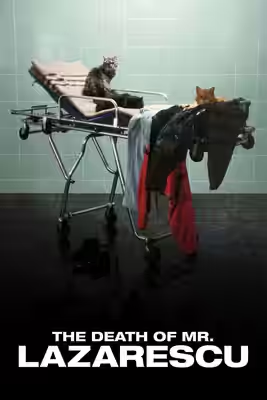
  4. The Death of Mr. Lazarescu (2005) · not reviewed yetOne sick man, one long night, four hospitals; the indifference Patch rails against, shown plainly.

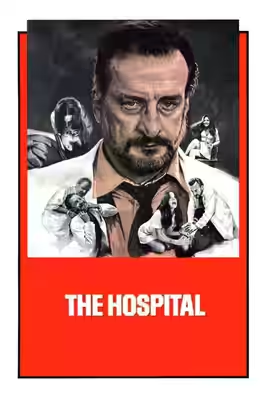
  5. The Hospital (1971) · not reviewed yetPaddy Chayefsky’s furious comedy about a hospital where everything is going wrong.

Free account

Know what to watch tonight

Two lists that know where things are streaming, collections you can share, your own score beside ours, and Discover that remembers what you have seen.

  • Want to see, sorted by what is streaming now
  • Seen, with your score out of ten
  • No adverts, ever