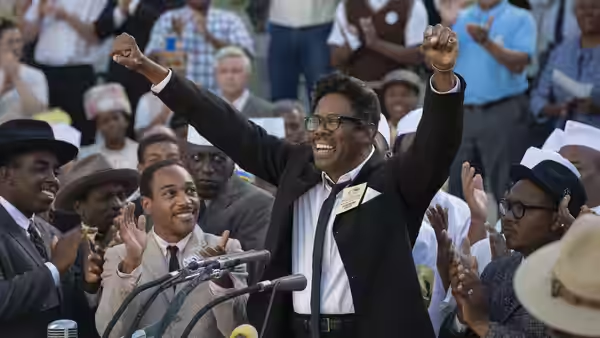
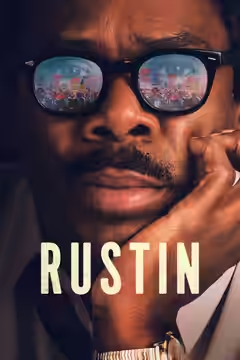
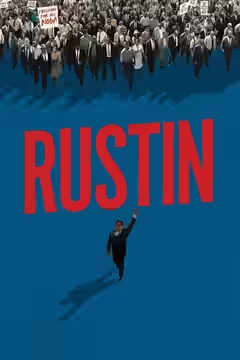
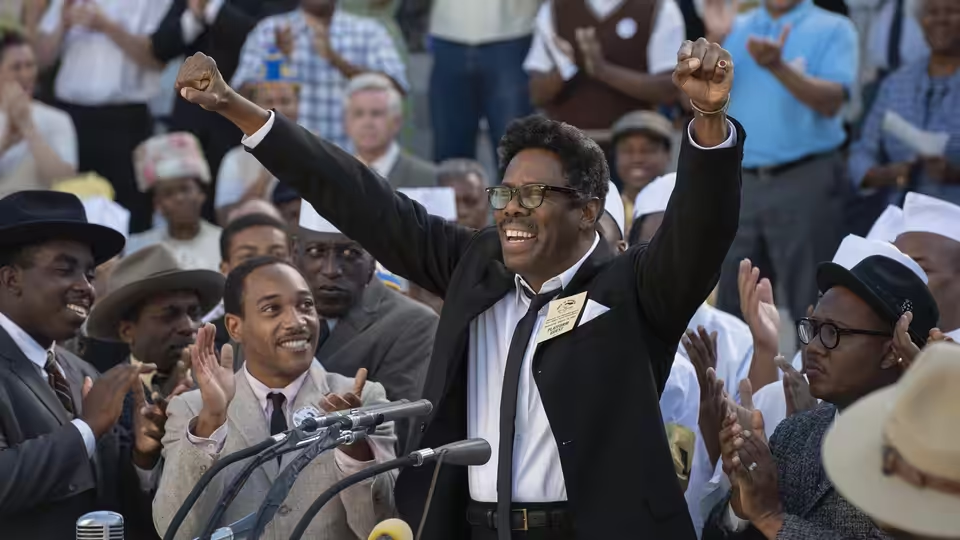
Bayard Rustin (Colman Domingo) raises his arms at a crowded rally as people applaud
Film review

Rustin

2023 · Directed by George C. Wolfe · 1h 48m

In a sentenceColman Domingo could talk us into a committee meeting, and we do not offer that compliment lightly

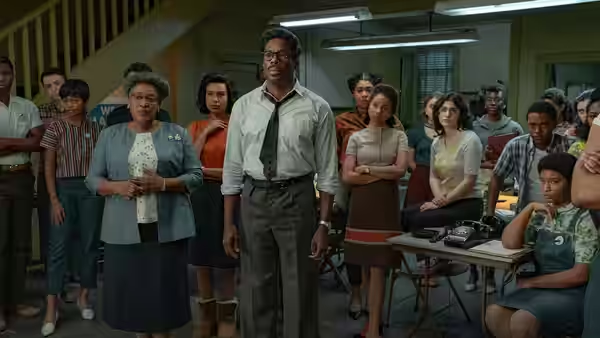
Bayard Rustin (Colman Domingo) is trying to organise the March on Washington, bringing people together across the American civil-rights movement. Martin Luther King, Jr. (Aml Ameen), A. Philip Randolph (Glynn Turman) and Roy Wilkins (Chris Rock) are among the figures involved in the movement’s debates. Being gay gives Rustin’s opponents a reason to keep him on the sidelines, even as the march needs his ability to mobilise people. Getting the event moving means winning support, sharing out the work and negotiating disagreements among people committed to the same cause. Rustin must secure his own place in that effort while persuading others to join it.

Plays from YouTube when you press play; nothing loads from them until then.

Fi1m review

Colman Domingo gives Rustin the warmth and impatience its subject deserves. George C. Wolfe’s biography is worth seeing for him, but its orderly account of political organising leaves too little room for a complicated private life.

George C. Wolfe’s Rustin is at its most engaging when it watches people work out how to organise the March on Washington. Making that labour dramatic is a worthwhile ambition, and the film often succeeds because Colman Domingo makes persuasion look like something requiring patience, nerve and considerable energy. We recommend it for his performance, with reservations about how neatly the biography arranges the man around it. The writing is much more comfortable explaining his importance than exploring his private life.

Colman Domingo gives Bayard Rustin a warmth that makes the organising feel personal: getting people to join the effort matters to him, and their reluctance matters too. We were stirred by the coalition-building scenes, because he makes the effort of bringing people together feel urgent and worth the trouble. His theatrical force suits a man trying to mobilise others. There is enough pleasure in watching him persuade people that the film can sustain a stretch of political discussion without losing its pace.

The screenplay by Dustin Lance Black and Julian Breece gives the movement’s debates enough space to establish that agreement takes work. The discussions involving Aml Ameen’s Martin Luther King, Jr. and Glynn Turman’s A. Philip Randolph help prevent the organising from looking like one man’s achievement. Yet the dialogue can sound like information being delivered for our benefit, rather than people finding the next thing to say. The director’s willingness to give the performances some theatrical breadth brings welcome energy to these exchanges.

Tobias A. Schliessler’s cinematography keeps the group scenes readable, though the images can feel static beside the leading performance. Mark Ricker’s production design provides credible settings for the planning without making those surroundings particularly memorable. The direction finds more excitement in the arrangement of performers than in the camera. That approach works when we can follow one person trying to convince another; during the more explanatory passages, there is little else to hold our attention.

Andrew Mondshein’s editing gives the preparations a briskness that helps the film across its more dutiful passages. Branford Marsalis’s music keeps the mood buoyant, sometimes more insistently than the conversations need. At 108 minutes, the film does not linger unnecessarily over its explanations. Even so, the pace cannot quite disguise how seldom the writing allows uncertainty to last long enough to trouble us.

The greater disappointment is how cautiously the film approaches Bayard Rustin’s inner life as a gay man. It acknowledges that his sexuality contributes to his exclusion, but gives insufficient attention to what that costs him away from the work. Colman Domingo makes that limited attention frustrating, since his performance suggests feelings the script could have explored at greater length. The writers are so concerned to make the case for his importance that they keep returning to the achievements, leaving his private life underdeveloped.

For a biography seeking to restore attention to someone who has been sidelined, that caution is understandable, and still disappointing. Too many scenes have the reassuring shape of a lesson whose conclusion was settled before anyone entered. Yet the practical work of organising gives Rustin a worthwhile subject beyond the familiar celebration of an exceptional individual. Give it an evening if political organising interests you, or if the prospect of Colman Domingo commanding a conversation is enough.
Critical consensus AI synthesised

64
Positive
6
Mixed
9
Negative
2

The reviews are mixed, with admiration for Colman Domingo considerably stronger than enthusiasm for the film around him. Critics repeatedly praise his charisma, energy and warmth as Bayard Rustin, finding a layered performance even where they find the biographical drama conventional. The other recurring strength is the attention to organising the March on Washington: several reviews welcome the practical work of building coalitions and the sense of collective effort.

Reservations centre on familiar biopic habits, dutiful exposition and a shortage of dramatic tension. Some critics also find Rustin’s inner life less fully explored than his public achievements. The spread is wide: Deadline finds the film exhilarating and praises its lively handling of civil-rights debates, while Vulture finds it dull and visually static despite Domingo’s forceful performance. The central divide is over whether the energetic organising scenes and lead performance compensate for the cautious storytelling.

The Hollywood Reporter
1 September 2023 · festival review · Sheri Linden
85*

Linden calls the film an overdue, admiring, and nuanced tribute to Bayard Rustin. She particularly praises Colman Domingo’s vibrant performance and the film’s portrayal of the organizers’ collective effort.

Read the full review →
Variety
3 September 2023 · Critics Pick · Peter Debruge
85*

Debruge finds the film compelling and sees Domingo’s performance as career-defining. He especially praises the script’s nuanced portrayal of Rustin, while noting that the march’s scale is underwhelming on screen.

Read the full review →
Los Angeles Times
2 November 2023 · Glenn Whipp
70*

Whipp finds the film an optimistic, worthwhile portrait, though its biopic conventions and restraint sometimes limit its impact. He praises Colman Domingo’s charismatic performance and the film’s nimble account of organizing the March on Washington.

Read the full review →
The AV Club
2 November 2023 · B- · Leigh Monson
70

The review finds that the film honors Rustin’s accomplishments but offers a weaker portrait of his inner life, particularly as a gay man. It praises Colman Domingo’s commanding performance and the energetic depiction of organizing the March on Washington.

Read the full review →
Screen Daily
11 September 2023 · festival review · Tim Grierson
65*

The available page identifies this as a Toronto review but does not reveal the critic’s verdict. Its standfirst singles out Rustin’s role behind the March on Washington and his sidelining because he was gay.

Read the full review →
The New York Times
65*

The URL identifies this as a review of Rustin, but the page content is inaccessible. Its verdict and any specific praise or complaint cannot be determined.

Read the full review →

Straight answers AI written, from our review

Is Rustin worth watching?
Rustin is worth watching for Colman Domingo’s performance and its account of political organising, though its tidy biography has limits; we score it 68 out of 100. We find the coalition-building stirring, but the writing explains Rustin’s importance more fully than it explores his private life, making this chiefly a recommendation for those interested in the man or the movement.
How long is Rustin, and what is it rated?
Rustin runs 1h 48m. It is a drama and history film.
Where can I watch Rustin in Denmark?
Rustin is streaming on Netflix in Denmark. Availability is checked daily; the links above go straight to each service.
How violent or frightening is Rustin, and is it suitable for children?
Rustin carries a UK 15 certificate, so it is not suitable for children under 15. That certificate signals material intended for older teenagers and adults, but we cannot give a specific violence or fright warning from the details available; the drama centres on political disagreements and the exclusion Rustin faces as a gay man.
How does Rustin compare to Selma?
Rustin offers an engaging account of civil-rights organising, but we recommend Selma more strongly for making strategy tense and giving greater room to personal strain. Both sometimes let dialogue sound prepared for our benefit; Rustin is worth considering for Domingo’s warmth and persuasive energy, while Selma gives disagreement and exhaustion more dramatic force.
What should I watch after Rustin?
After Rustin, try Selma (2014, Fi1m 84): Civil-rights strategy becomes tense drama, with room for disagreement and exhaustion. Then Pride (2014, Fi1m 82): Another coalition built through practical solidarity, with humour that earns its warmth; and Milk (2008, Fi1m 83): A gay organiser’s public work and personal life share the same urgency.

Cast

If you liked this, try…

  1. Selma (2014, Fi1m 84)Civil-rights strategy becomes tense drama, with room for disagreement and exhaustion.

  2. Pride (2014, Fi1m 82)Another coalition built through practical solidarity, with humour that earns its warmth.

  3. The Organiser (1963) · not reviewed yetCollective action, awkward compromises and the difficulty of getting everyone to agree.

  4. BPM (Beats per Minute) (2017) · not reviewed yetActivist meetings and private desire receive equal attention, with much less reassurance.

  5. Milk (2008, Fi1m 83)A gay organiser’s public work and personal life share the same urgency.