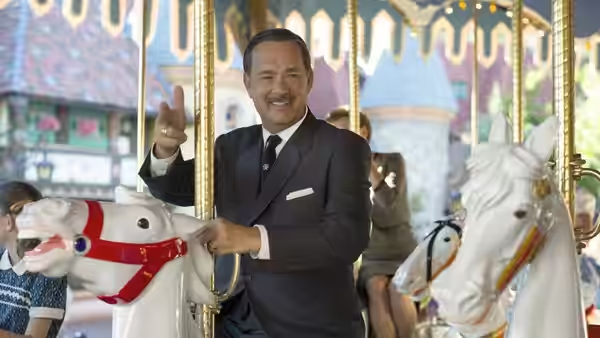
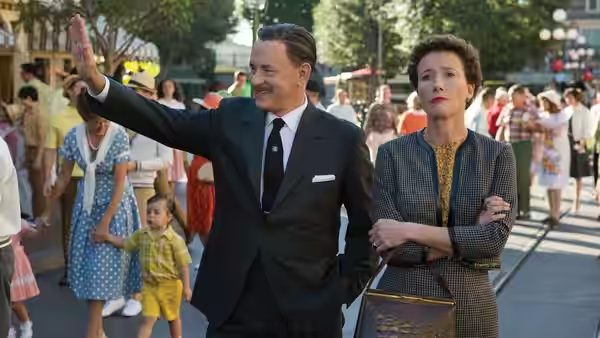
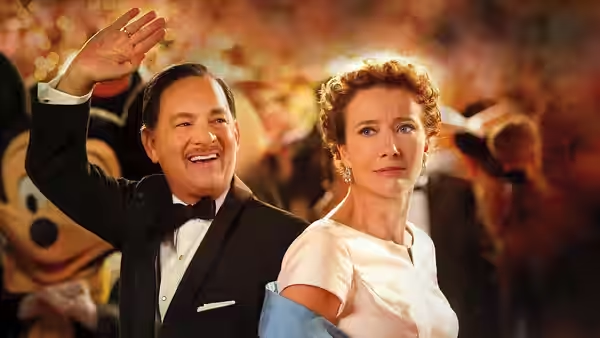
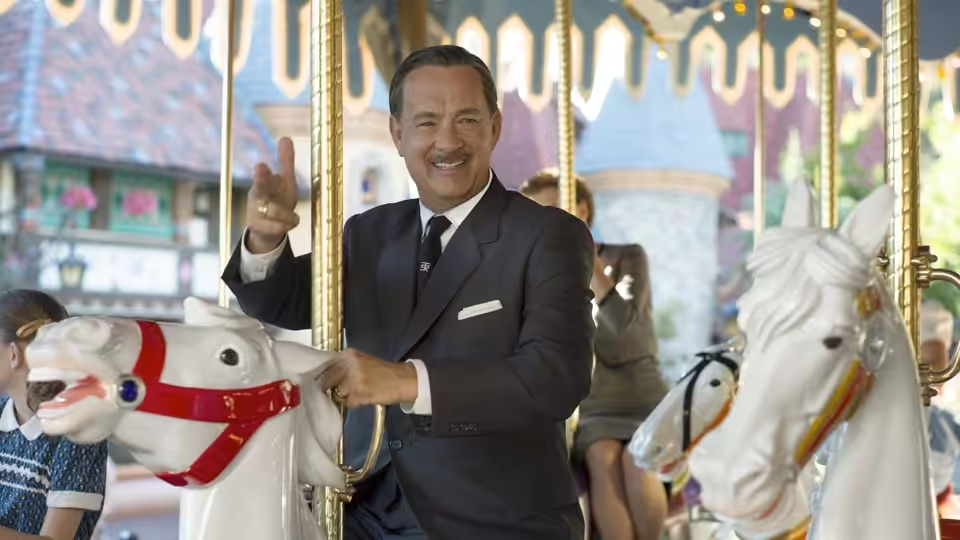
Walt Disney (Tom Hanks) smiles and waves while riding a carousel horse
Film review

Saving Mr. Banks

2013 · Directed by John Lee Hancock · 2h 06m · ICAA 7

In a sentenceWe could have managed fewer childhood memories and another hour of Emma Thompson objecting to things

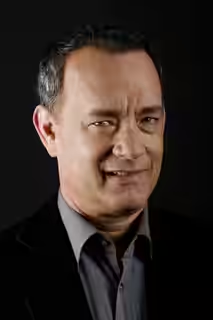
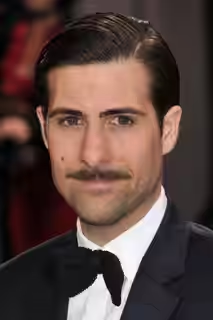
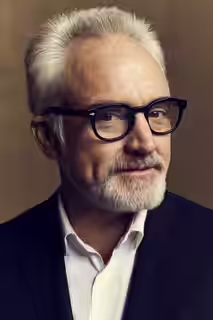
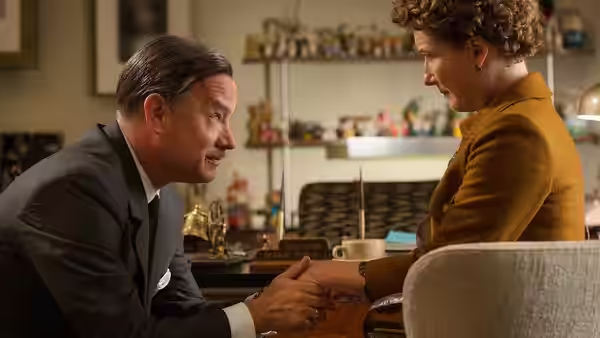
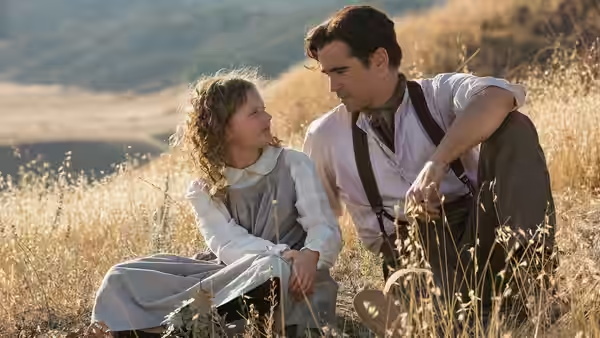
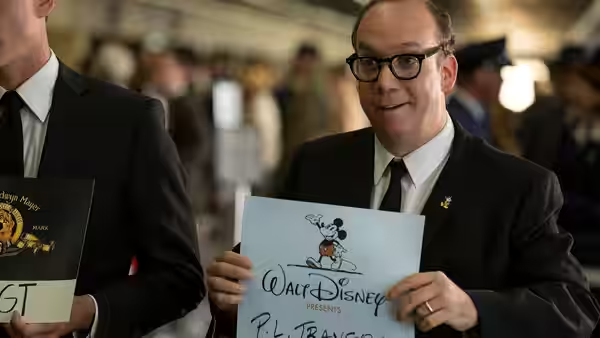
P.L. Travers (Emma Thompson) faces Walt Disney (Tom Hanks) over a screen version of Mary Poppins. She wants a say in what happens to her work; he wants to win her over. In the writers’ room, Richard Sherman (Jason Schwartzman) and Robert Sherman (B.J. Novak) work on the songs as creative decisions become arguments. The author’s resistance puts her at odds with the enthusiasm around her. Alongside these discussions, the film returns to her childhood and to Travers Robert Goff (Colin Farrell), linking the proposed adaptation with family memories she cannot easily put aside.

Fi1m review

Emma Thompson gives Saving Mr. Banks enough bite to make its comedy worth watching. John Lee Hancock’s drama is less persuasive, repeatedly turning an author’s objections into feelings that other people know how to fix.

John Lee Hancock’s Saving Mr. Banks is an entertaining comedy about people trying to work together, interrupted by a drama that explains them too readily. P.L. Travers and Walt Disney have competing ideas about what should happen to Mary Poppins, and that disagreement is enough to hold our attention. The film keeps reaching back into the author’s childhood to tell us why she resists. We wanted it to let her objections stand a little longer before explaining them away.

Emma Thompson gives the author enough sharpness to make those objections worth hearing. They are funny because she plays them seriously, rather than asking us to enjoy an eccentric having a tantrum. We laughed at her severity in the writers’ room, then felt uneasy about how readily everyone else treats it as something to be overcome. There is hurt in the performance, but she does not let it account for everything. Her character can be lonely and still have a point.

Tom Hanks makes Walt Disney’s affability feel effortless, and the comic exchanges benefit from his willingness to absorb a rebuff without losing his welcome. There is a reason the scenes of creative negotiation are the easiest to enjoy: both leads can make a disagreement entertaining without settling it. The Sherman brothers’ songs add some welcome energy, too. The difficulty comes when the screenplay by Sue Smith and Kelly Marcel treats the genial man’s confidence as proof that he knows what is best for the author.

Colin Farrell brings enough tenderness to Travers Robert Goff to keep the childhood passages from becoming mere explanations. We were moved by the sadness he brings to those scenes, even while resenting how insistently the film uses them. Mark Livolsi’s editing keeps breaking up the livelier working scenes with returns to the past. The repeated interruption starts to feel like an instruction to stop questioning the story and feel sorry for its heroine.

John Schwartzman’s cinematography favours a reassuring prettiness which suits the comedy and feels too gentle for the childhood passages. Michael Corenblith’s production design works better in the writers’ room, where the surroundings never compete with the sparring actors. Thomas Newman’s music is less helpful when its warmth presses us towards sympathy that the performances are already earning. The combined effect is too comfortable for a story asking us to take its unhappy memories seriously.

A film about adapting a book ought to have room for the possibility that its author has sound reasons to be unhappy. Here, the lively resistance is repeatedly explained through childhood pain, until artistic disagreement begins to look like a condition needing treatment. That limits the drama more seriously than the obvious sentimentality. The film can make us understand a lonely person, but it seems less interested in understanding her work. At 126 minutes, there is time for both.

Those interested in the performers will find enough here to justify an evening, particularly in the prickly exchanges that the film keeps interrupting. We would be more cautious about recommending it as an account of artistic collaboration, given how readily it dismisses one participant’s concerns. Watch it for Emma Thompson, and allow her a little more authority than the film does.

Critical consensus AI synthesised

59
Positive
8
Mixed
7
Negative
6

The reviews are mixed, with praise clustering most consistently around Emma Thompson’s sharp, funny and sometimes affecting portrayal of P. L. Travers. Even several detractors admire her performance, while Tom Hanks earns credit for his affability as Walt Disney and the lively sparring between the leads. Supporters find an entertaining, moving account of their cultural clash, with the comedy often surviving reservations about the film’s sentimentality.

The main divide is over how much that sentimentality costs the story: some critics accept the emotional pressure, while others see a simplified account that flatters Disney and diminishes Travers. Childhood flashbacks draw repeated complaints for interrupting the livelier scenes and explaining her past too bluntly. The spread is wide: Radio Times finds the film hugely entertaining and moving, whereas Vulture finds it interminable and emotionally unconvincing, welcoming the Sherman brothers’ songs as a source of energy.

Radio Times
★★★★★ · Alan Jones
100

The critic calls the film hugely entertaining, informative and ultimately moving. They single out the sharply witty cultural clash between Walt Disney and P. L. Travers.

Read the full review →
Time Out
26 November 2013 · ★★★★ · Cath Clarke
80

The review is positive, praising Emma Thompson’s performance as Pamela Travers. It singles out her sharply entertaining portrayal of the author as a battleaxe.

Read the full review →
Empire
25 July 2013 · Helen O'Hara
78*

O'Hara finds the film a delicate, brilliantly acted story, with Emma Thompson especially magnetic. She praises Colin Farrell’s pathos but faults the overused childhood flashbacks.

Read the full review →
IndieWire
8 November 2013 · Matt Mueller
75*

Mueller finds the film robustly entertaining, though softened and Disneyfied in its treatment of events. He especially praises Emma Thompson’s prickly, comic portrayal of P.L. Travers.

Read the full review →
Variety
20 October 2013 · festival review · Scott Foundas
75*

Foundas finds the film a warmly entertaining, old-fashioned Disney valentine, though its storytelling can be too on-the-nose and eager to tug at heartstrings. He especially praises Emma Thompson’s performance and Tom Hanks’s capture of Disney’s folksy charisma.

Read the full review →
Los Angeles Times
12 December 2013 · Kenneth Turan
70*

Turan finds the film engaging, though its direction is overly soft and its past-set scenes push emotion too insistently. He singles out Emma Thompson’s gleefully sharp performance as the film’s chief strength.

Read the full review →

Straight answers AI written, from our review

How long is Saving Mr. Banks, and what is it rated?
Saving Mr. Banks runs 2h 06m and is rated 7 by the ICAA in Spain. It is a comedy and drama film.
Where can I watch Saving Mr. Banks in Spain?
Saving Mr. Banks is streaming on Disney+ in Spain, and it is also available to rent from Apple TV from €3.99. Availability is checked daily; the links above go straight to each service.
What should I watch after Saving Mr. Banks?
After Saving Mr. Banks, try Finding Neverland (2004, Fi1m 64): Another author’s private grief meets a public fantasy, with similarly generous performances. Then The Straight Story (1999, Fi1m 88): For patient family drama that earns its feeling without explaining every silence; and The Remains of the Day (1993, Fi1m 88): For restraint, regret and performances that trust us to notice what goes unsaid.

Cast

Awards

Academy Awards, 2014

Nominated
Best Original Score

If you liked this, try…

  1. Finding Neverland (2004, Fi1m 64)Another author’s private grief meets a public fantasy, with similarly generous performances.

  2. Day for Night (1973) · not on Fi1m yetFor livelier filmmaking friction, with affection distributed more fairly among the participants.

  3. The Straight Story (1999, Fi1m 88)For patient family drama that earns its feeling without explaining every silence.

  4. The King of Masks (1996) · not on Fi1m yetA performer guards a tradition while an unexpected attachment tests his stubbornness.

  5. The Remains of the Day (1993, Fi1m 88)For restraint, regret and performances that trust us to notice what goes unsaid.