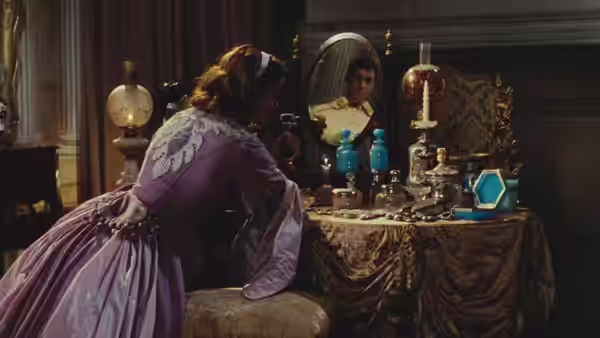
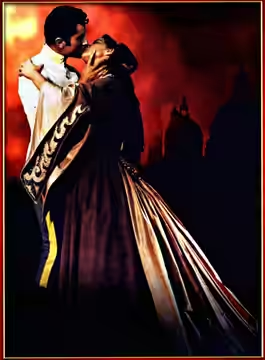
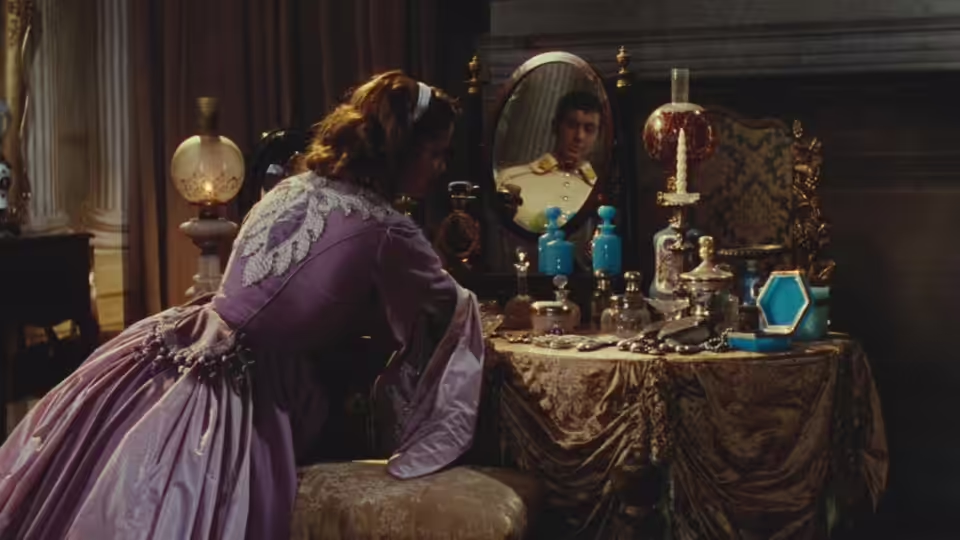
A woman in a lavender gown sits at a dressing table, studying her reflection
Film review

Senso

1954 · Directed by Luchino Visconti · 2h 03m · Kijkwijzer 9

In a sentenceThe countess has terrible judgement, but we cannot fault her surroundings

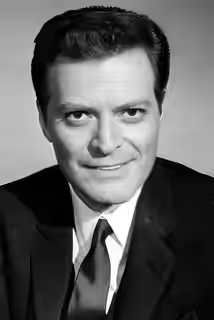
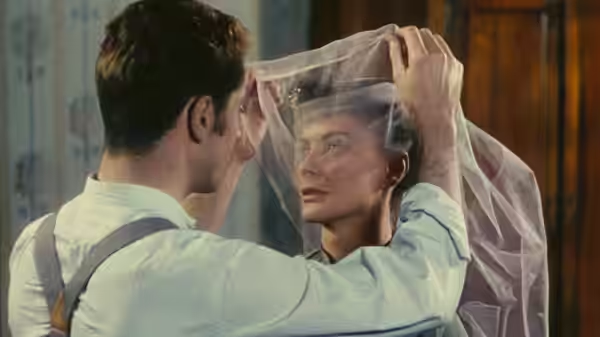
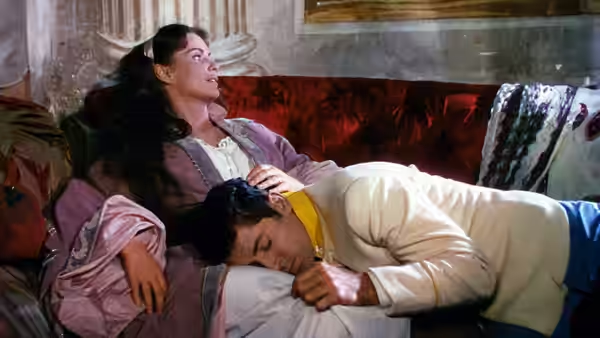
In Venice, an opera-house gathering brings aristocratic society and military life into the same public space. La Contessa Livia Serpieri (Alida Valli) becomes drawn to Il Tenente Franz Mahler (Farley Granger). Her social circle includes Il Marchese Roberto Ussoni (Massimo Girotti) and Il Conte Serpieri (Heinz Moog), each with a position to maintain. The countess wants to pursue her attraction to the lieutenant, but her rank brings expectations that complicate any private choice. Their affair takes shape amid the formalities of aristocratic life and the presence of the military.

Plays from YouTube when you press play; nothing loads from them until then.

Fi1m review

Luchino Visconti’s romantic tragedy is worth the patience for Alida Valli and the exacting visual craft. The central attraction remains underexplained, but the film understands how seriously people take desires they ought to question.

Senso is a moving romantic tragedy, though it leaves the attraction between its lovers underexplained. Luchino Visconti follows an aristocratic affair closely enough to make the lovers’ vanity troubling without dismissing their passion. The splendour is part of the pleasure, and he does not pretend otherwise. We recommend it to anyone with patience for period romance, with a reservation about how much of the central relationship we are asked to take on trust.

The opera-house opening establishes a society accustomed to putting itself on display. We felt uneasy watching it: the careful arrangement of people in that grand public space makes their private conduct seem open to inspection. It is an effective way of making social rank matter before the love story has much work to do. The film begins with people watching a performance, and the sense that appearances are being managed never quite goes away.

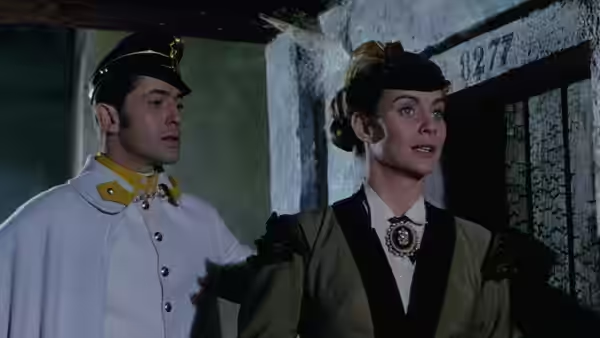
Alida Valli gives the countess’s desire a seriousness that keeps the film from becoming an exercise in looking down on foolish people. She makes the emotional risk credible even when the relationship itself is not. Farley Granger is effective as an object of fascination, but the film gives us too little sense of why this particular lieutenant should command such devotion. Attraction can happen at a glance; the weight placed on it here needs more preparation. The screenplay by Suso Cecchi d’Amico and Luchino Visconti does not quite supply it.

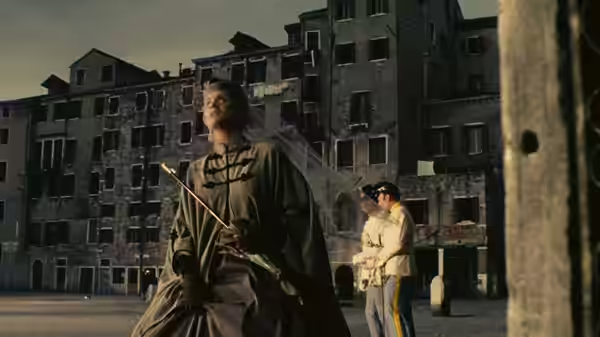
Cinematographers G.R. Aldo and Robert Krasker give Venice a physical presence that helps compensate. Their carefully ordered compositions make us notice where people stand in relation to their surroundings, and how much those surroundings dominate them. The military panoramas widen the film without making the private affair seem trivial. Their scale makes the lovers’ preoccupation with each other look increasingly selfish, although there are moments when the arrangement of figures across the image is more absorbing than either lover.

Ottavio Scotti’s production design gives the aristocratic world enough weight to make its hold on the characters understandable. The spaces suggest lives accustomed to being accommodated, an impression reinforced by Marcel Escoffier and Piero Tosi’s costumes. Clothes establish standing before anyone needs to explain it. This is where the film gets beyond the usual handsome period romance: appearances exert pressure on behaviour, and the care spent on them contributes to the drama.

Mario Serandrei’s editing allows that visual detail time to register, but it also exposes the weakness in the lovers’ bond. When the story lingers over their fascination, we have time to wonder about what has not been established. Anton Bruckner’s music supplies an emotional gravity the relationship sometimes struggles to justify. We would not want the film hurried, yet at 123 minutes it asks for a degree of absorption that the writing cannot always sustain.

Even so, the film’s unwillingness to excuse selfishness gives it an edge that many costume romances lack. Alida Valli keeps the countess sufficiently human for that scrutiny to hurt. Give Senso an evening when there is time for a romance that makes room for discomfort. Expect to believe the countess’s suffering more readily than her choice of man.

Critical consensus AI synthesised

76
Positive
6
Mixed
3
Negative
0

Most critics respond warmly to Senso, with praise clustering around Visconti’s use of colour, framing and period detail. The reviews repeatedly single out the painterly staging and cinematography, from the opera house opening to the military panoramas, as central to its emotional force. Several also admire its treatment of destructive passion, finding a romantic tragedy that both celebrates love and exposes the lovers’ moral decline.

Reservations centre on how convincingly the central attachment develops, rather than on the film’s visual craft. Variety finds the love story shaky while crediting the direction, lighting and production detail with keeping it compelling; The AV Club is much more enthusiastic but also questions how fully the lovers’ bond is established. The available verdicts range from qualified admiration to strong praise, with no outright rejection, though the limited accessible material for several entries leaves parts of that spread unexplained.

The AV Club
9 March 2011 · A- · Scott Tobias
90

Tobias praises the film’s lush, operatic style and its emotionally powerful portrayal of destructive passion. He notes that Visconti does not fully establish how the lovers’ magnetic bond forms, but singles out the beautifully rendered Venice as a strength.

Read the full review →
The New Yorker
1 May 2011 · Richard Brody
85*

Brody presents the film as an evocative, emotionally charged work rooted in Italian history. He especially praises Visconti’s exacting use of color, detail, and framing.

Read the full review →
Slant Magazine
23 February 2011 · ★★★★ · Bill Weber
80

Weber regards the film as a near-definitive work of cunning artifice. He particularly praises the painterly staging and the subtle, splendid Technicolor visuals.

Read the full review →
RogerEbert.com
79*

The inaccessible page does not reveal the critic’s verdict or what they single out. Its URL identifies it as a Great Movies piece about the requested film.

Read the full review →
Los Angeles Times
29 November 2018 · Kenneth Turan
75*

Turan finds the film a distinctive, enduring celebration and mockery of romantic love. He especially praises its lush cinematography, from the opera house opening to the military panoramas.

Read the full review →
Time Out
· TR
66*

The available metadata describes the film as sumptuous but does not reveal the review’s overall verdict. It singles out the Technicolor expressionism and the perspective on heterosexual love.

Read the full review →

Straight answers AI written, from our review

Is Senso worth watching?
Senso is worth watching if patient period romance appeals, and we score it 79 out of 100. Alida Valli makes the countess’s suffering credible, while the carefully composed images give aristocratic life real weight; our reservation is that the lovers’ attraction never quite justifies the devotion it demands.
How long is Senso, and what is it rated?
Senso runs 2h 03m and is rated 9 by the Kijkwijzer in the Netherlands. It is a romance and drama film.
Where can I watch Senso in the Netherlands?
Senso is not on any streaming or rental service in the Netherlands at the moment. It is available in 5 other countries; change your country at the top of the page to see where. Availability is checked daily.
How violent or frightening is Senso, and is it suitable for children?
Senso has no UK or US certificate supplied, so we cannot give an age-rating-based recommendation for children or a firm warning about violence or frightening content. Its adult romantic concerns, emotional discomfort and measured pace make it a more natural choice for adults interested in period drama than for a family evening.
How does Senso compare to The Earrings of Madame de...?
Senso is our choice for exacting visual craft, while we favour The Earrings of Madame de... for a warmer, more persuasive romance. Both make aristocratic manners and romantic self-deception painful to watch, but Valli must compensate for an underexplained attraction in Senso, whereas Darrieux gives the comparison film much of its emotional warmth.
Is Senso based on a true story or a book?
Senso is adapted from a novel by Camillo Boito, rather than presented as a true story. We cannot establish how faithfully it follows the book from the information available, but its aristocratic affair is approachable on its own: the film establishes the social expectations that complicate the countess’s private desires.
What should I watch after Senso?
After Senso, try The Earrings of Madame de... (1953, Fi1m 87): Aristocratic manners make romantic self-deception both pleasurable to watch and painful. Then The Heiress (1949, Fi1m 90): Another uncertain courtship where social position complicates every apparent declaration of love; and The Music Room (1958, Fi1m 88): Music and aristocratic pride sustain a man reluctant to recognise his decline.

Cast

If you liked this, try…

  1. The Earrings of Madame de... (1953, Fi1m 87)Aristocratic manners make romantic self-deception both pleasurable to watch and painful.

  2. The Heiress (1949, Fi1m 90)Another uncertain courtship where social position complicates every apparent declaration of love.

  3. The Music Room (1958, Fi1m 88)Music and aristocratic pride sustain a man reluctant to recognise his decline.

  4. In the Mood for Love (2000, Fi1m 91)Restrained performances and exact framing give forbidden attraction an almost physical pressure.

  5. The Age of Innocence (1993, Fi1m 86)A more tightly buttoned account of desire struggling against expensive social rules.

Senso (1954) review: lavish craft and a less convincing romance (the Netherlands) | Fi1m