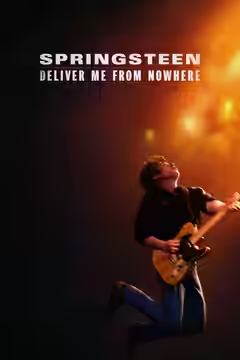
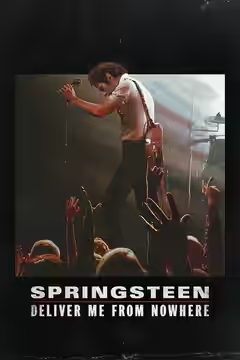
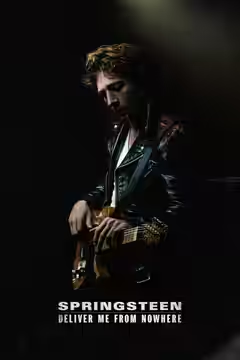
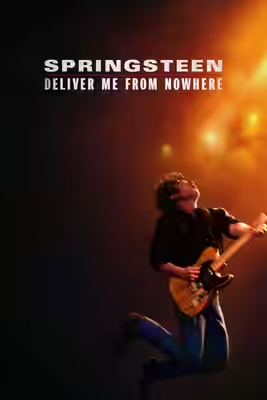
Scott Cooper shrinks the Springsteen story to one year and one cassette recorder, which is the right idea. Jeremy Allen White is quietly good and the recording scenes are the best thing here; the rest is a biopic being careful with a living man.
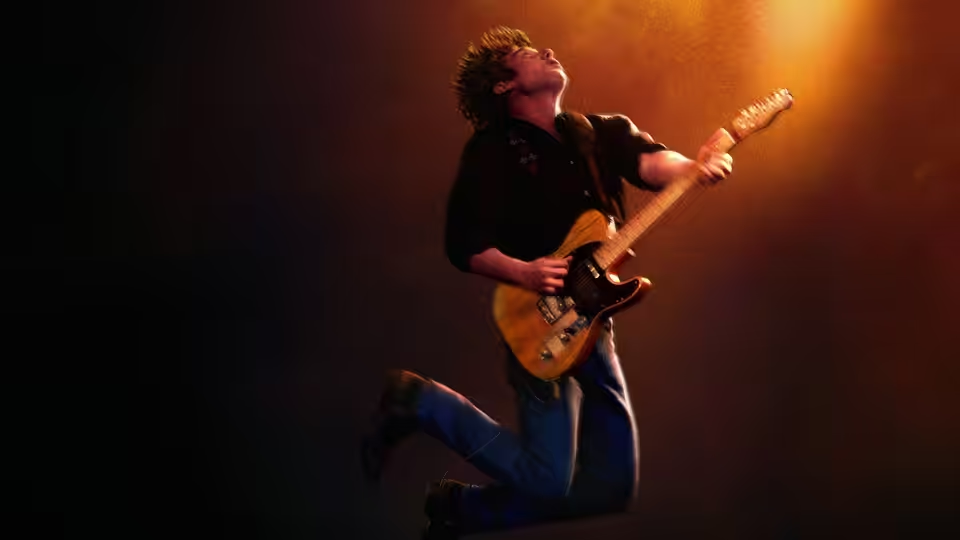
Scott Cooper, who wrote and directed, has picked the part of Bruce Springsteen’s story a studio would normally leave out. There are no stadiums and almost no band. In the early 1980s, off the road and alone in a rented house in New Jersey, Springsteen (Jeremy Allen White) borrows a four-track cassette recorder, sits on a bed and sings about murderers, laid-off men and his father. The result was Nebraska, and the film covers the months in which he made it and then refused to let anyone improve it. That is a good idea for a film. Cooper has made about two thirds of it.
White does not do the voice. He plays Springsteen as a man who has gone quiet, shoulders up round his ears, talking to his manager the way a patient talks to a doctor he does not want to worry. He sings the songs himself and he sings them small, which is right, because the record is small. The scene in which he first gets a song onto tape, the machine on the bedspread and the window black behind him, is the best in the film, because nobody speaks and Pamela Martin, editing, lets the take run to the end.
Jeremy Strong plays Jon Landau as a man who has decided his job is to stand between his friend and the world. The scenes between the two of them, in cars and on the phone, are the only relationship in the film that feels lived in. Paul Walter Hauser gives Mike Batlan, the guitar tech who wires up the recorder, an easy warmth the film could have used more of. Marc Maron’s Chuck Plotkin is handed a cassette and told to turn it into a record, and the sequences in which the full band tries the songs and flattens them make the film’s point better than any line does.
Masanobu Takayanagi shoots the childhood in black and white and the present in browns and ambers, rooms lit by one lamp. Stefania Cella furnishes the rented house with almost nothing, a mattress, a chair, the recorder, so the empty space around White does some of the acting. Kasia Walicka Maimone keeps him in the same denim and flannel and puts Landau in blazers bought to meet lawyers. Jeremiah Fraites keeps his score to a few guitar figures and mostly stays out of the songs’ way; when it comes in under the father scenes it tells us what to feel a beat before we would have felt it anyway.
The trouble is everything Cooper adds to the record. Odessa Young’s Faye is an invention, and her scenes exist to show us he is kind; we believed it the first time. The depression is handled with a doctor’s office and lines that say exactly what the character is feeling, in a film whose subject wrote ten songs because he could not say it. And Cooper goes back to the childhood too often. Every cut to the boy stops the man, and by the fourth or fifth we were restless, watching the film assemble a case for its hero rather than watching him work.
Then one late scene between Stephen Graham and White, which we will not describe, caught us off guard. We had sat through the doctor’s office with our arms folded, and then Graham, who barely speaks in it, did something with his hands and his breathing, and we were moved, more than we thought this film had in it. He does it in about six minutes.
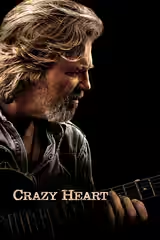
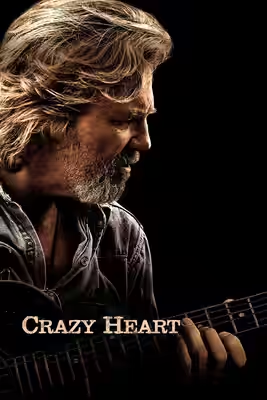
Cooper made Crazy Heart (2009), about a country singer it allowed to be a drunk and a bore before it allowed him to be good. This one has a living subject and it shows. Springsteen is permitted only the flaws the songs already admit to.
If you own the record, this is worth an evening, and the recording scenes will send you back to it. If you do not, it will explain the songs to you and then, gently, get in their way. It runs 120 minutes and carries a 12A, and the loudest thing in it is a cassette.