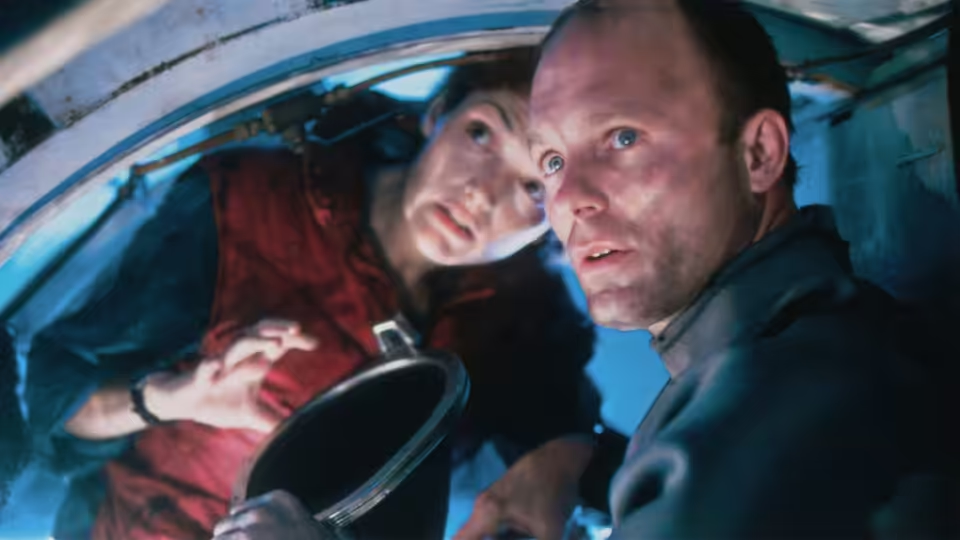
For two hours this is the tensest, best-made thing James Cameron has put underwater, and Harris and Mastrantonio give it a marriage worth the trouble. The last twenty minutes go soft. Most critics hold that against the whole film; we do not.
James Cameron writes and directs a 140-minute film set almost entirely at the bottom of the sea, and for two of its hours it is the most disciplined thing he has made. A United States submarine, the USS Montana, goes down near the Cayman Trough. The nearest people who can reach it are the crew of an experimental drilling rig, so the Navy hires them, sends a SEAL team down with them, and a hurricane closes the surface behind everyone. The trouble arrives late, and we will come to it.
Leslie Dilley’s rig, Deepcore, is a ring of steel modules around a flooded pool, with pipes at head height and hatches you go through sideways. Mikael Salomon lights the inside in orange and green, and outside the ports there is nothing but black water and whatever the floodlamps catch. The diving helmets have small lights inside them, so we see the actors’ faces behind the glass, and much of the film’s grip comes from that. Four editors, Steven Quale, Howard E. Smith, Joel Goodman and Conrad Buff IV, cut the Montana’s last minutes as a model of panic: a sonar contact, a lurching control room, water through a hatch, all over before anyone has explained anything.
Two scenes in the first hour got at us. In one, a SEAL drops Hippy’s pet rat into a bucket of pink fluid and holds it under until it stops fighting and starts breathing. We were appalled and then could not look away, which is what the scene is for. In the other, the divers go into the wreck and their torches find the drowned crew drifting in the compartments, and a crab climbs out of a helmet. Cameron holds the shot, and we sat rigid.
Ed Harris plays Bud Brigman, the rig’s foreman, as a man who has learned that the loudest voice on a rig is usually wrong. Mary Elizabeth Mastrantonio’s Lindsey designed the rig, is divorcing Bud, and is disliked by everyone on board; she plays it without once asking to be liked. The marriage is the film’s spine, two people who cannot stand each other and cannot stop watching each other. Michael Biehn, the decent soldier of Aliens, is the frightened one here: Lieutenant Coffey’s hands begin to shake before anyone on the rig notices, and Biehn lets the tremor do the work his lines do not. Leo Burmester’s Catfish, Todd Graff’s Hippy and Kimberly Scott’s One Night have jobs and opinions rather than quirks, and Chris Elliott, on the surface ship, is left holding the weather.
Alan Silvestri scores the first two hours with low synthesisers and the occasional voice, and keeps out of the way. Then the last twenty minutes arrive. We will not describe them, except to say that a story about pressure, cold and bad decisions turns gentle, the music swells, and a film that has trusted us to read faces starts telling us what to feel. The tagline promises that when you get there, you will understand. We got there, we understood, and we would rather have worked it out for ourselves.
Most critics disagree with us. The reviews split almost evenly between people who admire the first two hours and people who cannot forgive the last twenty minutes. A film is what it spends most of its time doing, and this one spends most of its time being a first-rate thriller about tired people in a metal box; the ending costs it, but not the whole evening. There is a longer cut in circulation, and the critics who have seen it are no more agreed than those who have not.
Cameron’s earlier films, The Terminator and Aliens, were chases. This is the first in which he wanted to say something as well; he says it clumsily, but everything before that is his most careful work with actors. See it on the largest, darkest screen you can arrange; at home the black water goes grey and the rig shrinks to a corridor. The 15 certificate is for the drowning. If you are tempted to leave before the end, you will know the moment.