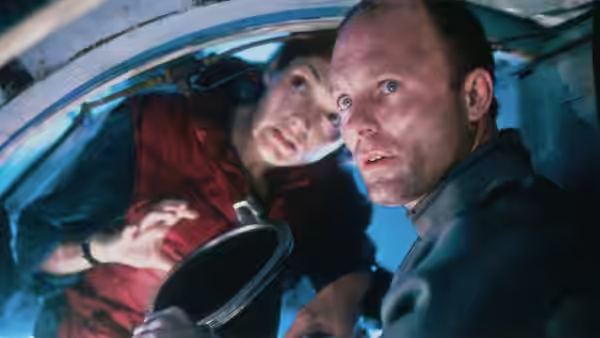
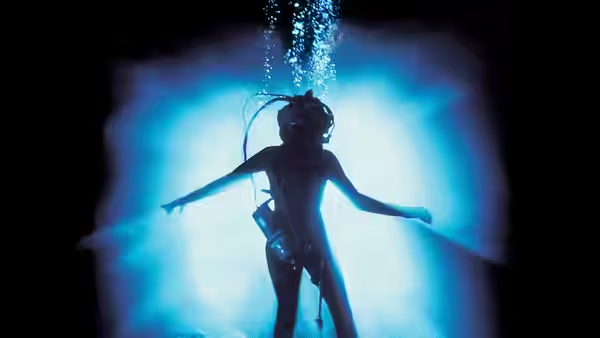
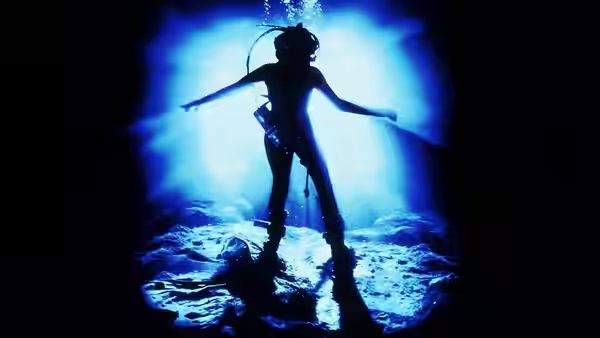
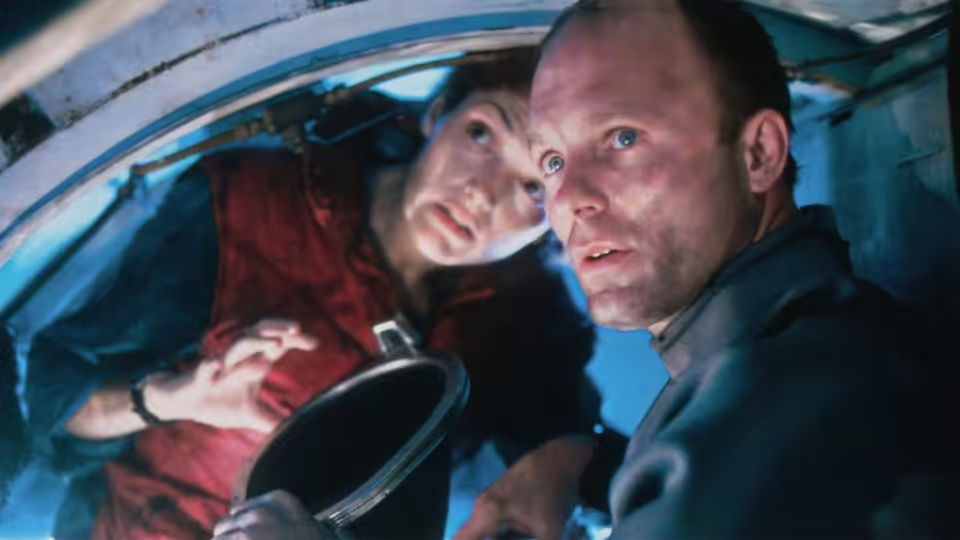
Bud Brigman (Ed Harris) and Lindsey Brigman (Mary Elizabeth Mastrantonio) inside the underwater habitat
Film review

The Abyss

1989 · Directed by James Cameron · 2h 20m · NMHH 12

In a sentenceJames Cameron holds his breath for two hours and then, at the worst possible moment, lets it out

A United States nuclear submarine, the USS Montana, is running deep near the Cayman Trough when its sonar picks up something moving faster than any submarine should, and it goes down. The Navy needs divers on the wreck fast, and the nearest are the crew of Deepcore, an experimental drilling rig run by foreman Virgil ‘Bud’ Brigman (Ed Harris). Sent down with a team of Navy SEALs under Lieutenant Coffey (Michael Biehn) is Lindsey Brigman (Mary Elizabeth Mastrantonio), who designed the rig and is in the middle of divorcing Bud. A hurricane is bearing down on the support ship above. Bud’s crew, among them Catfish (Leo Burmester), Hippy (Todd Graff) and his pet rat, and One Night (Kimberly Scott), have hours to reach the Montana before the storm cuts them off.

Plays from YouTube when you press play; nothing loads from them until then.

Fi1m review

For two hours this is the tensest, best-made thing James Cameron has put underwater, and Harris and Mastrantonio give it a marriage worth the trouble. The last twenty minutes go soft. Most critics hold that against the whole film; we do not.

James Cameron writes and directs a 140-minute film set almost entirely at the bottom of the sea, and for two of its hours it is the most disciplined thing he has made. A United States submarine, the USS Montana, goes down near the Cayman Trough. The nearest people who can reach it are the crew of an experimental drilling rig, so the Navy hires them, sends a SEAL team down with them, and a hurricane closes the surface behind everyone. The trouble arrives late, and we will come to it.

Leslie Dilley’s rig, Deepcore, is a ring of steel modules around a flooded pool, with pipes at head height and hatches you go through sideways. Mikael Salomon lights the inside in orange and green, and outside the ports there is nothing but black water and whatever the floodlamps catch. The diving helmets have small lights inside them, so we see the actors’ faces behind the glass, and much of the film’s grip comes from that. Four editors, Steven Quale, Howard E. Smith, Joel Goodman and Conrad Buff IV, cut the Montana’s last minutes as a model of panic: a sonar contact, a lurching control room, water through a hatch, all over before anyone has explained anything.

Two scenes in the first hour got at us. In one, a SEAL drops Hippy’s pet rat into a bucket of pink fluid and holds it under until it stops fighting and starts breathing. We were appalled and then could not look away, which is what the scene is for. In the other, the divers go into the wreck and their torches find the drowned crew drifting in the compartments, and a crab climbs out of a helmet. Cameron holds the shot, and we sat rigid.

Ed Harris plays Bud Brigman, the rig’s foreman, as a man who has learned that the loudest voice on a rig is usually wrong. Mary Elizabeth Mastrantonio’s Lindsey designed the rig, is divorcing Bud, and is disliked by everyone on board; she plays it without once asking to be liked. The marriage is the film’s spine, two people who cannot stand each other and cannot stop watching each other. Michael Biehn, the decent soldier of Aliens, is the frightened one here: Lieutenant Coffey’s hands begin to shake before anyone on the rig notices, and Biehn lets the tremor do the work his lines do not. Leo Burmester’s Catfish, Todd Graff’s Hippy and Kimberly Scott’s One Night have jobs and opinions rather than quirks, and Chris Elliott, on the surface ship, is left holding the weather.

Alan Silvestri scores the first two hours with low synthesisers and the occasional voice, and keeps out of the way. Then the last twenty minutes arrive. We will not describe them, except to say that a story about pressure, cold and bad decisions turns gentle, the music swells, and a film that has trusted us to read faces starts telling us what to feel. The tagline promises that when you get there, you will understand. We got there, we understood, and we would rather have worked it out for ourselves.

Most critics disagree with us. The reviews split almost evenly between people who admire the first two hours and people who cannot forgive the last twenty minutes. A film is what it spends most of its time doing, and this one spends most of its time being a first-rate thriller about tired people in a metal box; the ending costs it, but not the whole evening. There is a longer cut in circulation, and the critics who have seen it are no more agreed than those who have not.

Cameron’s earlier films, The Terminator and Aliens, were chases. This is the first in which he wanted to say something as well; he says it clumsily, but everything before that is his most careful work with actors. See it on the largest, darkest screen you can arrange; at home the black water goes grey and the rig shrinks to a corridor. The 15 certificate is for the drowning. If you are tempted to leave before the end, you will know the moment.

Critical consensus AI synthesised

52
Positive
5
Mixed
2
Negative
4

The reviews are divided on The Abyss, but praise consistently gathers around its underwater photography, practical effects and claustrophobic suspense. Even several detractors admire the technical work and the grip of the early action. The central relationship also earns support, with Ed Harris and Mary Elizabeth Mastrantonio singled out for strong performances. The Guardian places the romance above the spectacle, treating the film’s emotional generosity as a strength.

The main disagreement is over how much that craft compensates for a crowded plot and an increasingly sentimental later stretch. Several favourable reviews acknowledge problems with the ending, while the harsher assessments find the dialogue, characterisation and cosmic themes difficult to tolerate. Time Out rejects the performances and dialogue that other reviews praise. Different cuts also complicate the picture: The Independent finds that the special edition’s additions worsen the sentimentality. The spread is wide, despite substantial agreement about what works underwater.

The Guardian
9 August 2019
80*

The critic views The Abyss as a technically ambitious sci-fi epic that underperformed on release but has gained appreciation through later cuts, highlighting its big-hearted story of human-alien contact. They single out the central romantic relationship between the leads as the film's strongest element, forged under gruelling production conditions.

Read the full review →
Empire
1 January 2000 · Kim Newman
70*

The critic praises the film's tension, claustrophobia, special effects and action for most of its runtime but criticizes the soppy, optimistic ending that undermines Cameron's usual style. The first two hours deliver top-notch entertainment.

Read the full review →
The Hollywood Reporter
9 November 2014 · THR Staff (original by Duane Byrge)
70*

The critic calls the film colossally ambitious and a visual tour de force with the greatest underwater sequences ever seen, praising its technical brilliance and controlled direction while noting the plot's many elements and a potentially numbing ending for some viewers.

Read the full review →
Variety
31 December 1988 · Variety Staff
50*

The review calls it a firstrate underwater suspenser with an otherworldly twist that suffers from a payoff unworthy of its buildup, as the aliens turn out friendly and the action gets soggy. Strong performances by Ed Harris and Mary Elizabeth Mastrantonio stand out alongside the elaborate technical achievements.

Read the full review →
Slant Magazine
14 August 2014 · Tim Peters
45*

The critic finds the plot convoluted and over-the-top with too many elements forced in, complaining it lacks minimalism or irony, while noting that the money shots and visual effects have held up well over time.

Read the full review →
The Independent
20 May 1993 · Kevin Jackson
40*

The critic praises the tension, action and wit in the first part of the special edition but criticizes the added footage for worsening the cosmic and sentimental elements, leading to bathos. The early sections grip but the later additions undermine the film.

Read the full review →

Straight answers AI written, from our review

Is The Abyss worth watching?
The Abyss is worth watching for its tense underwater rescue story and convincing troubled marriage, and we score it 71 out of 100. We recommend it to anyone who enjoys confined-space thrillers and actors who make technical work feel urgent, though the last twenty minutes turn soft and tell us too firmly what to feel.
How long is The Abyss, and what is it rated?
The Abyss runs 2h 20m and is rated 12 by the NMHH in Hungary. It is an adventure and thriller film.
Where can I watch The Abyss in Hungary?
The Abyss is streaming on Disney+ in Hungary. Availability is checked daily; the links above go straight to each service.
How violent or frightening is The Abyss, and is it suitable for children?
The Abyss carries a UK 15 certificate and is not suitable for children, with drowning and underwater panic central to its scares. The divers encounter drowned bodies, and a rat is held under liquid in a distressing demonstration; we would be cautious even with older teenagers who find suffocation or animal distress hard to watch.
How does The Abyss compare to Das Boot?
The Abyss is the more uneven of these confined-space thrillers; we give Das Boot the edge for its gripping, humane submarine drama. Both make cramped quarters and danger outside the hull frightening, but Cameron adds science fiction and a troubled marriage worth caring about. Choose Das Boot for wartime strain, or The Abyss for underwater adventure with a softer finish.

Cast

Awards

Academy Awards, 1990

Nominated
Best Cinematography
Nominated
Best Production Design
Nominated
Best Sound
Won
Best Visual Effects

If you liked this, try…

The Abyss (1989) review: two superb hours and a soft ending (Hungary) | Fi1m