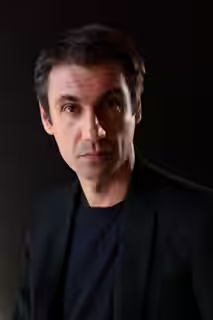
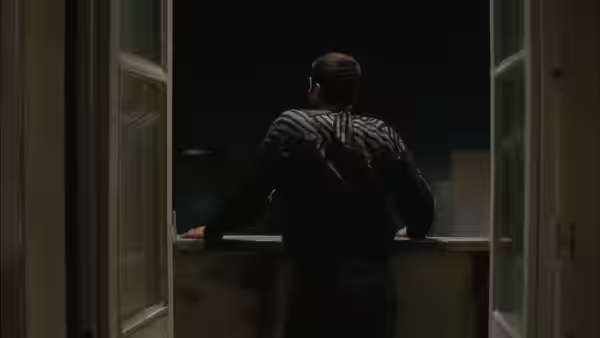
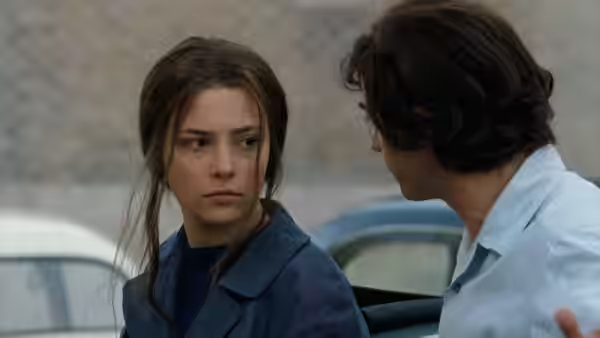
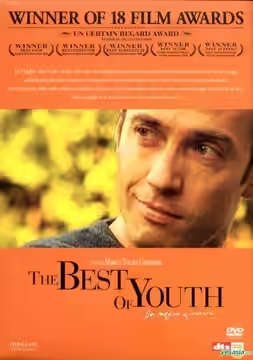
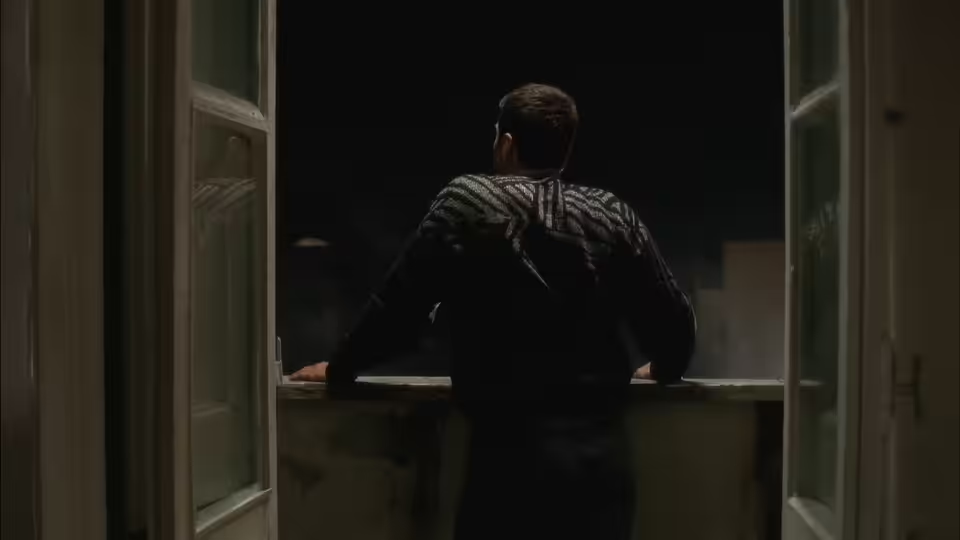
A man leans on a windowsill, looking out into the darkness
Film review

The Best of Youth

2003 · Directed by Marco Tullio Giordana · 6h 07m

In a sentenceSix hours with someone else’s family, without once pretending we need to catch a train

In Italy, Nicola Carati (Luigi Lo Cascio), Matteo Carati (Alessio Boni) and Adriana Carati (Adriana Asti) form part of a family whose story stretches across several decades. Political questions run alongside family conflicts, placing their private lives against the country’s changing history. The people around them include Giulia Monfalco (Sonia Bergamasco), Carlo Tommasi (Fabrizio Gifuni) and Giorgia Esposti (Jasmine Trinca). The drama follows personal relationships over time, moving between the concerns of the family and the wider historical circumstances in which they live.

Fi1m review

Marco Tullio Giordana’s long family drama earns its time through patient direction and Luigi Lo Cascio’s unforced performance. We recommend it warmly, though its occasional sentimentality presses harder than it needs to.

The Best of Youth asks for 367 minutes, and we think it earns them. Marco Tullio Giordana follows a family across decades of Italian history with enough patience to let their domestic difficulties command our attention. The occasional push towards sentimentality is the caveat; for most of its length, this is engrossing, carefully acted drama. Its confidence in the people on screen makes the running time seem a reasonable request, though we would understand anyone wanting to put the kettle on before agreeing.

Luigi Lo Cascio, playing Nicola Carati, gives the film the unforced human presence it needs. His performance has none of the conspicuous effort that can make a long character study feel longer, and he leaves us room to decide what we think of the person. We were moved by the close-ups: his face holds our attention without seeming to demand our sympathy. The director gives that quiet acting enough space to register, trusting a response to interest us without having to underline it.

Roberto Forza’s photography is most persuasive at this close distance, where the historical setting briefly matters less than the person occupying the frame. The restraint works because the film has already given us reason to look carefully. Franco Ceraolo’s production design keeps the period surroundings present without making them the chief subject of our attention. We never feel obliged to stop caring about the people in order to appreciate the setting, a small mercy that becomes a substantial one over six hours.

Roberto Missiroli’s editing also deserves credit for how lightly that time passes. The family scenes have room to develop, yet the film rarely feels as though it is waiting for another historical event to provide something to do. Stefano Rulli and Sandro Petraglia give the political questions space in their screenplay without continually requiring the characters to explain them. Their strongest writing allows family disagreements to remain awkward, with enough competing feeling that we can understand why a conversation matters without needing it to settle anything.

The weakness comes when that confidence falters and the drama presses an emotion the actors have already made clear. Its sentimental passages feel unnecessarily insistent beside the quieter work, and we occasionally wanted it to leave a feeling alone. The political thinking is also less searching than the breadth of the story might suggest. Bringing family experience into contact with national history creates plenty of interest, but some of those connections deserve more examination than the screenplay gives them; the affection for the characters can make the film too forgiving.

Those reservations matter, though they did not make us wish for a substantially shorter film. Long family dramas can become dutiful exercises in keeping track of people, and the vivid ensemble here largely prevents that: attention remains a pleasure rather than an administrative task. The length gives the performances time to become familiar without exhausting our curiosity about them. Make time for it, and take a break if needed; there is no special virtue in watching the last stretch while thinking about supper.

Critical consensus AI synthesised

84
Positive
7
Mixed
1
Negative
0

Most critics find The Best of Youth absorbing and moving, with its long span sustained by close attention to family life. Praise centres on the ensemble, particularly Luigi Lo Cascio’s naturalistic performance, and on Giordana’s restrained direction. The reviews repeatedly describe a drama that remains intimate while connecting private lives to Italian history. Its length is generally treated as time well spent, with the screenplay drawing praise for handling politics and family conflict without forcing melodrama.

The reservations are limited rather than widespread. The AV Club notes sentimental missteps and modest thematic reach, while still finding the film satisfying. Time Out’s praise applies only to the first instalment, which limits its assessment of the whole. The recorded scores lean strongly positive, with one mixed response, but The New York Times review text is inaccessible, so its reasons for dissent cannot be established.

Slant Magazine
13 June 2004 · ★★★★/4 · Ed Gonzalez
100

Gonzalez regards the film as a riveting, deeply human epic. He praises Giordana’s close-ups and the way historical settings connect the characters’ personal lives to Italy’s past.

Read the full review →
Empire
1 January 2000 · David Parkinson
90*

Parkinson finds the sprawling drama a monumental, moving achievement that remains intimate and involving. He especially praises its measured screenplay, which handles political themes and family conflicts without forcing them into melodrama.

Read the full review →
Los Angeles Times
18 March 2005 · Kenneth Turan
90*

Turan calls the film an exceptional, engrossing epic and urges readers to make time for it. He praises its strong performances and Giordana’s restrained, respectful direction, which make its decades-spanning family story feel real.

Read the full review →
Variety
10 June 2003 · festival review · Scott Foundas
90*

Foundas praises the film as an emotionally absorbing epic that sustains its long span without overstaying its welcome. He singles out Luigi Lo Cascio’s richly textured, naturalistic performance as a particular strength.

Read the full review →
The AV Club
22 March 2005 · Scott Tobias
80*

The critic finds the sprawling film engrossing and ultimately satisfying, despite some sentimental missteps and modest thematic reach. He particularly praises its vivid ensemble and its intimate portrait of a family across decades.

Read the full review →
The Guardian
2 July 2004 · Peter Bradshaw
80*

Bradshaw finds the six-hour epic satisfying, heartfelt and surprisingly brisk. He especially praises Luigi Lo Cascio’s intimate performance and the film’s generous scope.

Read the full review →

Straight answers AI written, from our review

Is The Best of Youth worth watching?
The Best of Youth is worth watching for patient viewers who enjoy family dramas, and we score it 86 out of 100. Its 367 minutes earn their place through carefully developed relationships and Luigi Lo Cascio’s unforced performance, though we find the occasional sentimentality too insistent and the political questions less thoroughly explored than they deserve.
How long is The Best of Youth, and what is it rated?
The Best of Youth runs 6h 07m. It is a drama and history film.
Where can I watch The Best of Youth in Germany?
The Best of Youth is not on any streaming or rental service in Germany at the moment. It is available in 4 other countries; change your country at the top of the page to see where. Availability is checked daily.
How violent or frightening is The Best of Youth, and is it suitable for children?
The Best of Youth carries a US R certificate, so we would not recommend it as a children’s choice. That certificate indicates material requiring parental caution for younger viewers, but does not establish how violent or frightening the film is; we cannot give a specific warning about gore, scares or sexual content.
How does The Best of Youth compare to Fanny and Alexander?
The Best of Youth shares the expansive family storytelling of Fanny and Alexander, though we recommend Bergman’s film more strongly. Giordana follows family relationships across decades of Italian history, while Bergman gives childhood a watchful presence in a drama that is warm, funny and frightening. Both reward settling in; choose Giordana for the broader connection between domestic life and national history.
What should I watch after The Best of Youth?
After The Best of Youth, try Fanny and Alexander (1982, Fi1m 92): Another expansive family drama that rewards settling in rather than hurrying through. Then Another Year (2010, Fi1m 87): Patient ensemble acting, with rather less reassurance about the people involved; and The Leopard (1963, Fi1m 88): For another Italian family watching history interfere with its expectations.

Cast

Awards

European Film Award for Best Actor, 2003

Nominated
European Film Award for Best Actor

European Film Award for Best Director, 2003

Nominated
European Film Award for Best Director

European Film Award for Best Screenwriter, 2003

Nominated
European Film Award for Best Screenwriter

If you liked this, try…

  1. Fanny and Alexander (1982, Fi1m 92)Another expansive family drama that rewards settling in rather than hurrying through.

  2. A City of Sadness (1989) · not on Fi1m yetFor a more demanding encounter between family loyalties and national upheaval.

  3. Still Walking (2008) · not on Fi1m yetA shorter family visit, with disagreements observed just as patiently.

  4. Another Year (2010, Fi1m 87)Patient ensemble acting, with rather less reassurance about the people involved.

  5. The Leopard (1963, Fi1m 88)For another Italian family watching history interfere with its expectations.