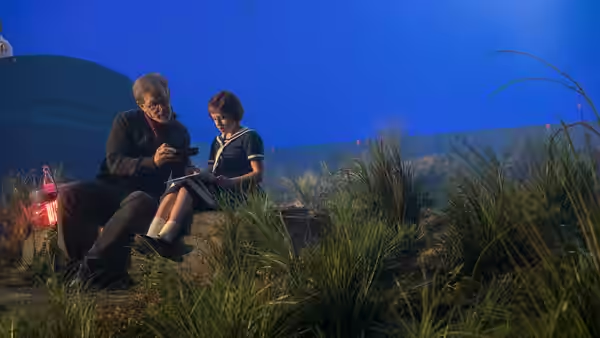
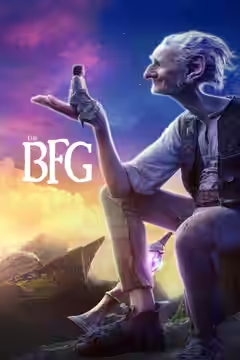
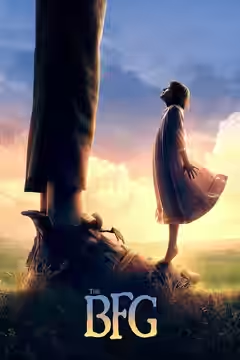
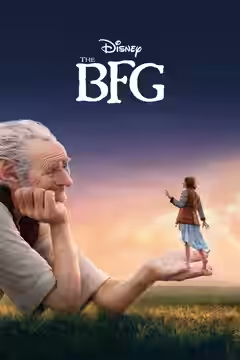
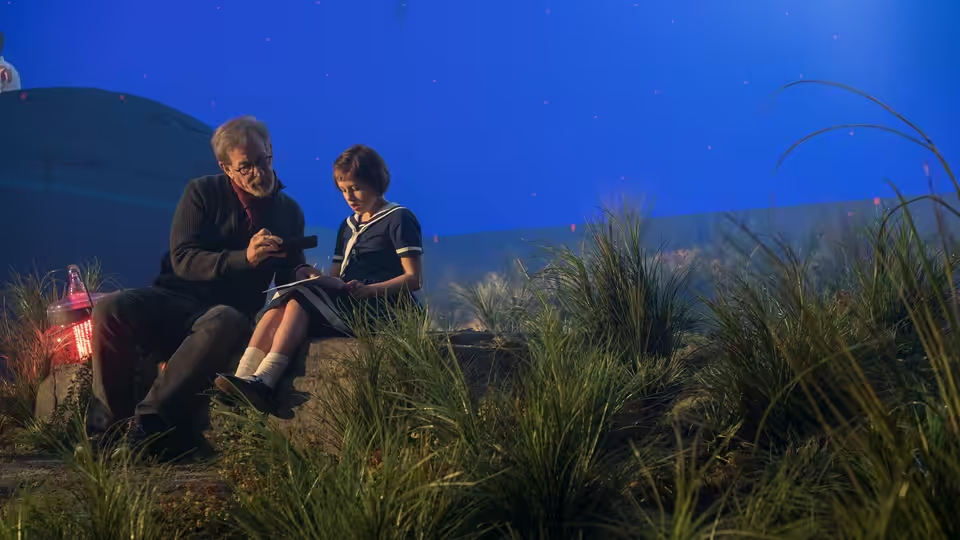
The BFG (Mark Rylance) sits beside Sophie (Ruby Barnhill) among tall grass beneath a blue sky
Film review

The BFG

2016 · Directed by Steven Spielberg · 1h 57m · MPA PG

In a sentenceThe gentlest giant in cinema, gently apologising, in a film with an hour in the middle where nothing much happens

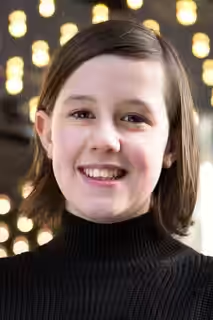
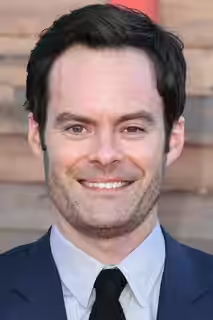
London, at night, in an orphanage. Sophie (Ruby Barnhill), ten years old and unable to sleep, gets out of bed at the witching hour, looks through the window and sees a giant in the street below. He sees her too. A hand comes through the window, and she is carried across the sea to Giant Country, because a child who has seen a giant cannot be left behind to tell. He is the Big Friendly Giant (Mark Rylance), who eats only foul snozzcumbers, drinks frobscottle and spends his nights blowing dreams into children’s bedrooms. His neighbours are not friendly: Fleshlumpeater (Jemaine Clement) and Bloodbottler (Bill Hader) are twice his size, eat what they call human beans, and would like to know what he is hiding in his cave.

Plays from YouTube when you press play; nothing loads from them until then.

Fi1m review

Steven Spielberg’s Roald Dahl film is beautifully lit, tenderly played by Mark Rylance and Ruby Barnhill, and short of anything to do between its lovely opening and its lively last act. Children under ten will be enchanted; the adults beside them may drift.

Steven Spielberg has filmed Roald Dahl’s The BFG with a script by Melissa Mathison, who wrote E.T. the Extra-Terrestrial for him in 1982, the same year Dahl’s book came out. It is a soft, patient, handsome 117 minutes about an orphan and a giant who collects dreams, and it has two great assets, Mark Rylance’s face and Rylance’s voice. It also has an hour in the middle where the story stops and the film simply potters. We liked it, in the way one likes a kind relative who talks too long.

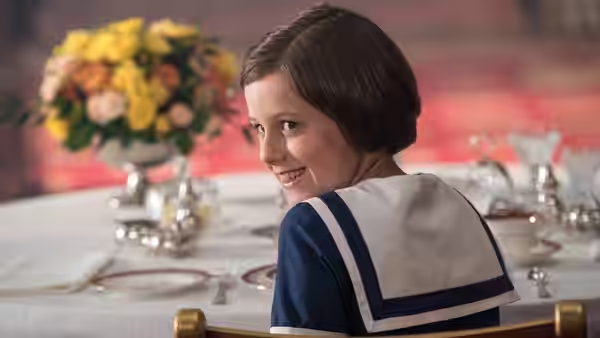
Rylance plays the giant through motion capture, and the technology, for once, has given rather than taken. The eyes are his, wet and anxious, and the enormous ears move a fraction before he speaks, as if they had heard the thought coming. He does Dahl’s mangled English, human beans and snozzcumbers and whizzpopping, without ever winking at it, in the tone of a man who has never had anyone to correct him. Ruby Barnhill’s Sophie is small, bespectacled and bossy, and she is not cute, which is the right choice; she tells a giant off for his grammar. When the two of them are alone in his cave, the film is at its best.

The opening is the other high point. Janusz Kamiński shoots London in blue-black with pools of yellow lamplight, and the giant flattens himself into a shadow or stands still against a wall while a drunk staggers past, and for ten minutes we were entirely happy. Rick Carter and Robert Stromberg’s Giant Country is green hills and a cave lined with hundreds of glass jars, each holding a dream that flickers and hums. Dream Country, where the giant goes fishing with a net, is lit from underneath, a dark lake with coloured lights moving in it like fish. We sat forward for that sequence and said nothing, and the child two seats along did the same. John Williams’s score hovers rather than swells there, and it is the right decision.

Then the film has to find something to happen, and it does not. Jemaine Clement and Bill Hader give the big giants loud, lumpen voices, and they are louts rather than monsters. Dahl’s giants ate children, and the reader knew it in the stomach; Spielberg’s giants are said to eat children, and we never once believed a child was in danger. So Sophie hides under things, the giants sniff about, she hides under something else, and Michael Kahn cuts it all at the pace of a bedtime story being read to someone already asleep. Somewhere in that stretch we looked at our watch, and were surprised and a little sad to be doing so in a Spielberg film about a child and a creature.

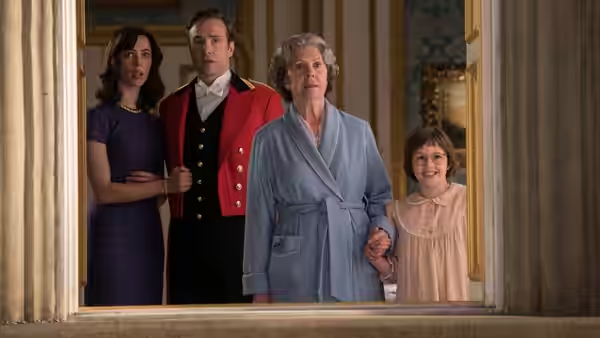
The last act moves somewhere grand, and we will leave it there. It brings in Penelope Wilton as the Queen, Rebecca Hall as her maid Mary and Rafe Spall as Mr. Tibbs, and it wakes the film up. Wilton plays the monarch as a sensible woman coping with an implausible morning, and gets the biggest laughs in the picture without appearing to try. Joanna Johnston’s costumes do a quiet joke here, the giant’s leather waistcoat and long coat against a room of gilt and braid. There is also a joke about digestion that runs for a good deal longer than it needs to, and the children in the audience loved every second of it.

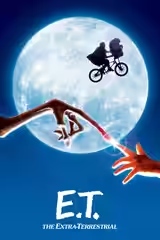
The comparison with E.T. is unavoidable and unkind. Mathison gave Elliott a divorced mother, a school, a brother who teased him and a house full of noise, so that a boy hiding an alien had a whole life to lose. Sophie has an orphanage, dispatched in five minutes, and nothing waiting at home; the film has taken the stakes away before it starts. Dahl’s cruelty has been sanded down too, as several critics noticed, and what is left is sweetness, which is pleasant and does not carry a middle hour.

See it with a child, if you have one to hand, because it was made for them and they will not notice the slack. Watch it at home, where the dream lake still glows and the long stretch in the cave can be forgiven with a cup of tea. Rylance is worth the evening on his own. He plays an enormous, lonely, courteous person, and we believed in him more than in anything he was asked to do.
Critical consensus AI synthesised

66
Positive
14
Mixed
12
Negative
3

Most critics like The BFG without loving it. The praise gathers almost entirely around Mark Rylance, whose gentle voice and motion-capture performance are credited with giving the digital giant his soul, and around the dream-gathering sequences in Dream Country, which several reviews call the most magical thing in the film. Spielberg’s effects work and the warmth of the bond between Sophie and the giant are noted approvingly throughout.

The reservations are about story rather than craft. Many reviews find the middle section slow and repetitive, the plot skimpy, and the whole slighter than Spielberg’s earlier children’s fantasies, with E.T. the comparison most often made and rarely won. Several think it will please small children more than adults. The spread is wide: a handful of raves sit alongside a few dismissals, with The New Yorker finding it forced and overmanaged and Den of Geek calling it dreary and boring. Even the harshest reviews tend to spare Rylance.

Variety
14 May 2016 · festival review · Peter Debruge
82*

Debruge finds the adaptation splendid and charming, with the makings of a family classic. He especially praises Mark Rylance’s nuanced performance and the hypnotic dream-gathering sequence.

Read the full review →
Little White Lies
festival review · Sophie Monks Kaufman
80*

The critic finds it a delightful Spielberg film, though not a great adaptation of Roald Dahl. She praises its moments of wonder, spectacle and joy, especially the scene in which the BFG catches Sophie as she falls.

Read the full review →
Time Out
13 May 2016 · ★★★★ · Dave Calhoun
80

The review presents the film as a magical adaptation of Roald Dahl’s children’s story. It singles out Spielberg’s reunion with Mark Rylance as a strength.

Read the full review →
Total Film
18 July 2016 · ★★★★ · Jamie Graham
80

The review finds the film a soulful, imaginative delight, though not one of Spielberg’s definitive works. It especially praises Mark Rylance’s performance and the dreamlike visuals of Dream Country.

Read the full review →
RogerEbert.com
30 June 2016 · ★★★/4 · Matt Zoller Seitz
75

The review finds the film charming but uneven. It praises the warmth of Sophie and the BFG’s bond, brought to life through Spielberg’s visual craft.

Read the full review →
Slant Magazine
26 June 2016 · ★★★/4 · Christopher Gray
75

Gray finds the film mild and emotionally slight, but says its visual wonders make it worthwhile. He especially praises its quietly inventive dream imagery and photorealistic visual magic.

Read the full review →

Straight answers AI written, from our review

Is The BFG worth watching?
The BFG is worth watching for families with children under ten, and we scored it 64. Mark Rylance's motion-capture giant and Ruby Barnhill's bossy Sophie are tenderly played, and the London opening and the dream lake are lovely to look at. Adults may drift through the hour in the middle where the story stops and the film potters.
How long is The BFG, and what is it rated?
The BFG runs 1h 57m and is rated PG by the MPA in the US. It is an adventure and family film.
Where can I watch The BFG in the US?
The BFG is streaming on Disney+ in the US, and it is also available to rent from Amazon Prime Video and Apple TV from $3.99. Availability is checked daily; the links above go straight to each service.
How does The BFG compare to E.T. the Extra-Terrestrial?
The BFG is the softer and slacker of the two Spielberg films written by Melissa Mathison, and E.T. the Extra-Terrestrial is the better one. Elliott had a mother, a school and a house full of noise to lose; Sophie has an orphanage dispatched in five minutes, so the stakes are gone before the story starts. Choose The BFG for Rylance and small children, E.T. for everyone else.
What should I watch after The BFG?
After The BFG, try E.T. the Extra-Terrestrial (1982, Fi1m 91): The same writer and director, with a home life the child could actually lose. Then My Neighbour Totoro (1988, Fi1m 89): A large gentle creature, two sisters and no villain; patience rewarded properly; and The Iron Giant (1999, Fi1m 88): A boy hides a giant from the grown-ups, and the ending earns its tears.

Cast

If you liked this, try…

  1. E.T. the Extra-Terrestrial (1982, Fi1m 91)The same writer and director, with a home life the child could actually lose.

  2. Matilda (1996) · not on Fi1m yetDanny DeVito keeps Dahl’s cruelty in and the film is funnier for it.

  3. My Neighbour Totoro (1988, Fi1m 89)A large gentle creature, two sisters and no villain; patience rewarded properly.

  4. The Iron Giant (1999, Fi1m 88)A boy hides a giant from the grown-ups, and the ending earns its tears.

  5. Paddington 2 (2017, Fi1m 91)British, kind, tightly plotted and never slack for a minute of its running time.