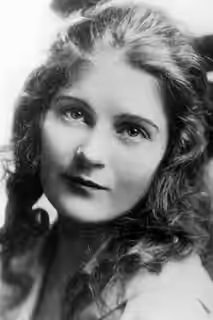
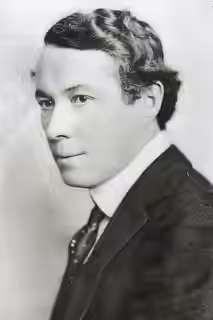
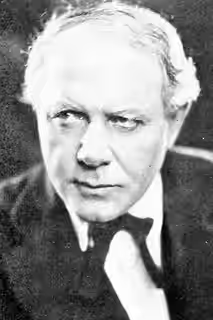
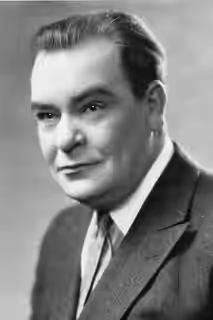
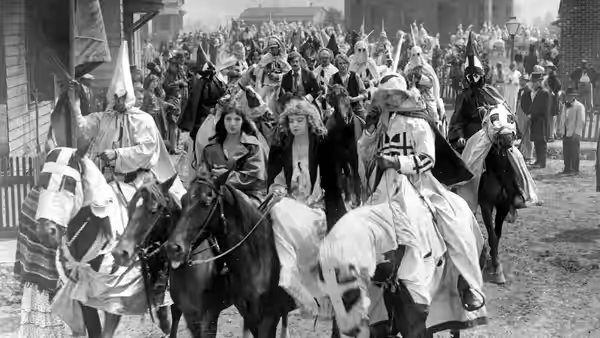
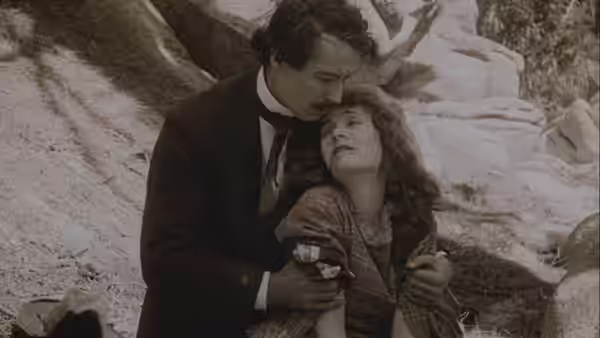
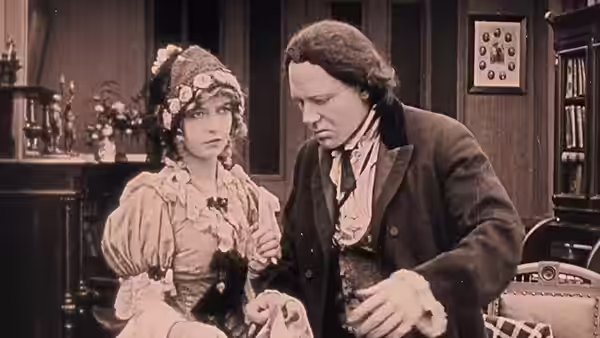
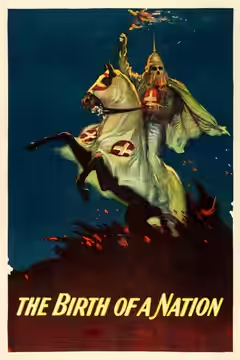
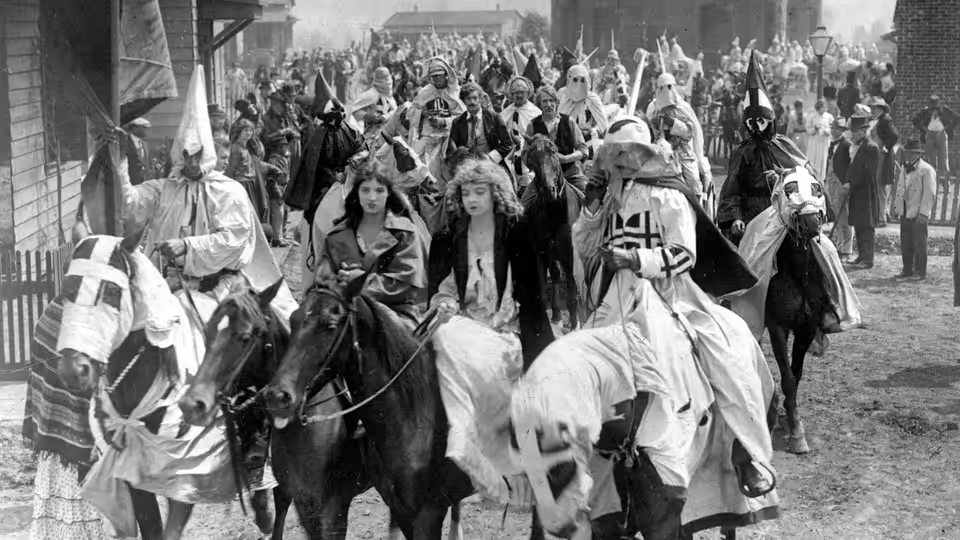
Elsie Stoneman and Margaret Cameron ride through town amid a Ku Klux Klan procession
Film review

The Birth of a Nation

1915 · Directed by D.W. Griffith · 3h 15m

In a sentenceIt taught the cinema how to cut and used the lesson to make a lynch mob look like the cavalry

A Southern town on the eve of the American Civil War. Austin Stoneman (Ralph Lewis), leader of the House of Representatives, has two sons, Phil (Elmer Clifton) and Tod (Robert Harron), and a daughter, Elsie (Lillian Gish). Their friend Ben Cameron (Henry B. Walthall) is a Southern planter’s son, with sisters Margaret (Miriam Cooper) and Flora (Mae Marsh). The Stoneman boys visit the Camerons; Phil falls for Margaret, and Ben for a photograph of Elsie, whom he has never met. Then war is declared and the friends enlist on opposite sides. Ben is wounded leading a charge and wakes in a hospital where Elsie is a nurse, while Abraham Lincoln (Joseph Henabery) argues with Stoneman over how the beaten South should be treated.

Fi1m review

D.W. Griffith’s three-hour epic built much of the grammar films still use, and spent it arguing that the Ku Klux Klan saved America. The craft is real and so is the lie, and we cannot pull them apart. We do not recommend it for an evening.

D.W. Griffith’s The Birth of a Nation runs 195 minutes, follows two families through the American Civil War and Reconstruction, and ends with the Ku Klux Klan riding to the rescue. It is taken from Thomas F. Dixon Jr.’s novel The Clansman, with a screenplay by Frank E. Woods, and it was sold under a tagline about the fiery cross of the Ku Klux Klan, so nobody involved was hiding what it was for. It is among the most important films ever made. We cannot recommend it as a way to spend tonight, and the rest of this review is about why both of those sentences are true.

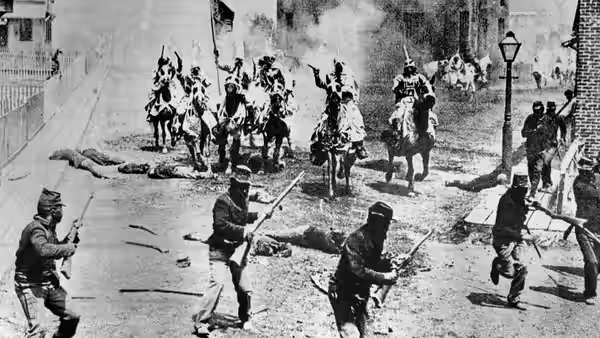
The first half is the war, and much of it is superb. Billy Bitzer puts his camera high on a hill above the battlefield so that two lines of men advance through smoke across the whole width of the frame, then drops down close for Henry B. Walthall’s Ben Cameron ramming a flag into the mouth of a cannon. A mother and her children huddle on a hillside in a tight circle of light; the circle opens and Sherman’s army is crawling across the valley beneath them. Griffith irises in on a detail, holds, and cuts to the thing it explains. Films had done pieces of this before. Nobody had done all of it at once, at this length, and made it hold.

The cutting is the heart of it. Five editors are credited, Griffith among them, alongside Raoul Walsh, Joseph Henabery, James Smith and Rose Smith, and what they worked out here is parallel action: two places, shown in turn, faster and faster, until the audience is in a third place that is pure feeling. Joseph Carl Breil’s score is built to drive that rhythm, and it does.

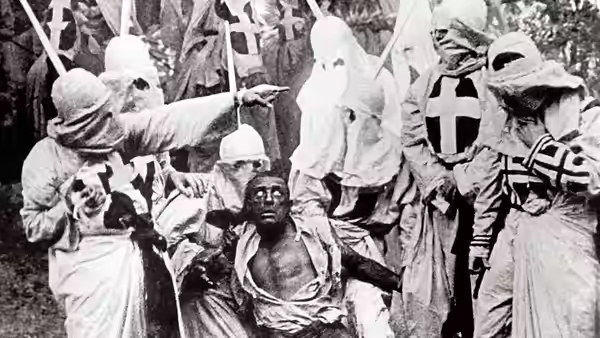
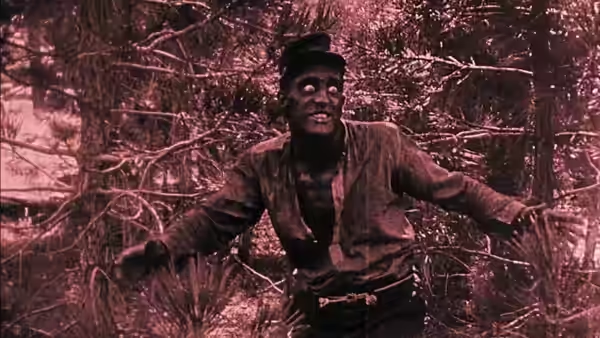
Then comes Reconstruction, and the film tells us what it thinks. Ralph Lewis’s Stoneman fusses with his wig and takes counsel from his housekeeper Lydia (Mary Alden). Silas Lynch (George Siegmann) is installed as Lieutenant Governor and the new legislature is shown eating chicken with its feet on the desks. Gus (Walter Long) is played as an animal. Nearly every black character who matters to the plot is a white actor in make-up, and the black characters who are not villains are servants glad of the old days. We were horrified, and we want to be exact about the cause. It was not the age of the ideas. It was the skill. When the hooded riders gather and the film cuts between them and the people they are riding to save, our pulse went up. We were being made to cheer for the Klan, and the film knew precisely how to do it.

The actors are mostly better than the parts. Mae Marsh gives the one performance that still feels alive, all nerves and sudden bolts of movement, a girl who cannot keep still. Lillian Gish has less to do than her billing suggests and does it beautifully. Walthall plays Ben small and inward, a man who has decided things before he speaks, and it is a relief among so much arm-waving. Miriam Cooper is dignified and underused. Robert Goldstein and Clare West sewed the robes and hoods for the camera, and the film shoots them as a uniform, in ranks.

The reviews so far average out somewhere near the middle, and they get there by marking the craft and the politics on separate sheets and splitting the difference. We do not think that can be done. The editing is not beside the argument; the editing is how the argument is made. Every cut in the last forty minutes exists to make men in hoods feel like a rescue party, and if the cutting were worse the film would be less dangerous and less good in the same measure.

Griffith made Intolerance the following year, longer and stranger and about mercy, and it is the film we would send you to if you want to see what he could do. This one we would send you to only if you study cinema, in which case see it, all 195 minutes with the intertitles, not a reel of famous shots, because the lie lives in the shape of the whole. It carries a U certificate, which tells you something about certificates.

Critical consensus AI synthesised

55
Positive
2
Mixed
1
Negative
2
Radio Times
★★★★ · Tony Sloman
80

The critic praises the film as a groundbreaking, successful epic, while noting a serious caveat in its source material. The elaborate Civil War battlefield recreations are singled out for praise.

Read the full review →
Slant Magazine
8 March 2012 · ★★★★ · Budd Wilkins
80

Wilkins regards the film as both a major formal achievement and a deeply harmful distortion of history. He praises its forceful editing and the Blu-ray’s improved clarity and contrast, while condemning its racist depiction of Reconstruction.

Read the full review →
Variety
31 December 1929 · Variety Staff
60*

The review is mixed, finding the reissue’s music too shallow and lacking the film’s sweeping spectacle. It praises the clear print and says the Klan ride remains a major thrill.

Read the full review →
Empire
1 January 2000 · David Parkinson
35*

Parkinson recognizes the film’s ambition but judges its weaknesses and intellectual poverty more significant. He praises the coherent tableaux and battle sequences while condemning its racist rhetoric.

Read the full review →
Time Out
· MSu
20*

The review presents Griffith’s film as a melodramatic adaptation of a profoundly racist novel. It singles out the source material’s racism as a defining concern.

Read the full review →

Straight answers AI written, from our review

Is The Birth of a Nation worth watching?
The Birth of a Nation is not worth watching for an evening's entertainment, and we scored it 32. D.W. Griffith's 195-minute film built much of the grammar cinema still uses, and used it to make the Ku Klux Klan look like a rescue party. We would send only students of film to it, and they should see the whole thing, not a reel of famous shots.
How long is The Birth of a Nation, and what is it rated?
The Birth of a Nation runs 3h 15m. It is a drama and history film.
Where can I watch The Birth of a Nation in Poland?
The Birth of a Nation is not on any streaming or rental service in Poland at the moment. It is available in 3 other countries; change your country at the top of the page to see where. Availability is checked daily.
How violent or frightening is The Birth of a Nation, and is it suitable for children?
The Birth of a Nation carries a U certificate in the UK, so its battle scenes are large in scale but not graphic, and nothing in it is frightening in the horror sense. The problem is what it argues: black characters are played by white actors in make-up as villains or grateful servants, and the film asks you to cheer for men in hoods. We would not put it in front of children.
How does The Birth of a Nation compare to Battleship Potemkin?
The Birth of a Nation and Battleship Potemkin are both landmarks of editing, and Eisenstein's film is the one we recommend. Griffith worked out parallel cutting and spent it making the Klan feel heroic; Eisenstein took the same technique and turned it on a different set of villains, with blunt politics but real urgency. Potemkin is the tighter, angrier film and far easier to sit through in good conscience.
Is The Birth of a Nation based on a true story or a book?
The Birth of a Nation is based on a novel, Thomas F. Dixon Jr.'s The Clansman, adapted for the screen by Frank E. Woods. It is set against real events, the American Civil War and Reconstruction, and Abraham Lincoln appears as a character, but the story of the Stoneman and Cameron families is fiction and its account of the Klan is a lie. You need not know the book; the film states its case plainly enough.
What should I watch after The Birth of a Nation?
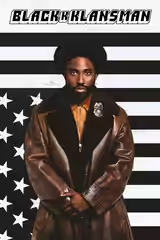
After The Birth of a Nation, try Intolerance (1916, Fi1m 83): Griffith the year after, same scale, four stories, and this time the subject is mercy. Then Battleship Potemkin (1925, Fi1m 88): Eisenstein takes Griffith’s cross-cutting and turns it on a different set of villains; and BlacKkKlansman (2018, Fi1m 78): Spike Lee screens Griffith’s film to a room of Klansmen and lets you watch them watch.

Cast

If you liked this, try…

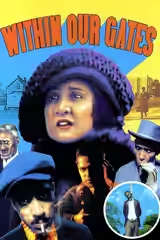
  1. Within Our Gates (1920) · not on Fi1m yetOscar Micheaux’s direct reply: a Black director answers Griffith with a lynching shown as one.

  2. Intolerance (1916, Fi1m 83)Griffith the year after, same scale, four stories, and this time the subject is mercy.

  3. Battleship Potemkin (1925, Fi1m 88)Eisenstein takes Griffith’s cross-cutting and turns it on a different set of villains.

  4. BlacKkKlansman (2018, Fi1m 78)Spike Lee screens Griffith’s film to a room of Klansmen and lets you watch them watch.

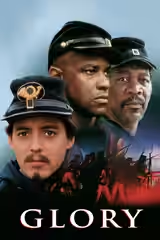
  5. Glory (1989, Fi1m 82)The Civil War from the regiment Griffith left out, with Denzel Washington and Morgan Freeman.