Film review

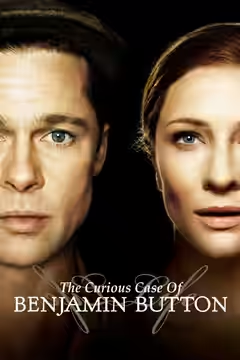
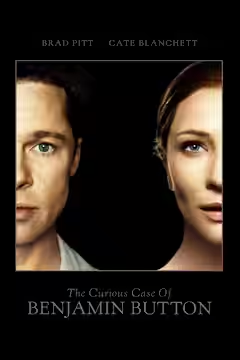
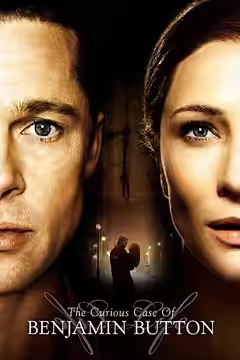
The Curious Case of Benjamin Button

2008 · Directed by David Fincher · 2h 46m · MPA PG-13

In a sentenceA man ages backwards for 166 minutes and greets each decade with the same polite nod

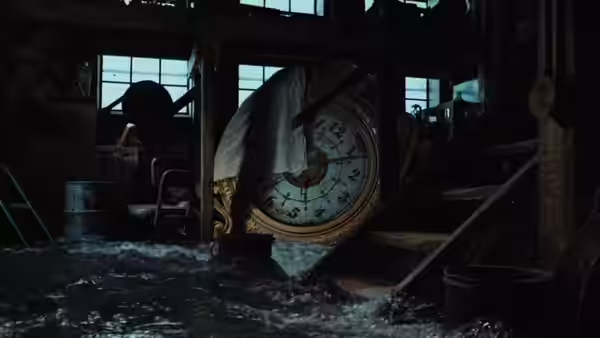
New Orleans, 2005. In a hospital room, with a hurricane on its way, Caroline Fuller (Julia Ormond) reads a diary aloud to her dying mother, Daisy (Cate Blanchett). It belongs to Benjamin Button (Brad Pitt), born on the night the First World War ends with the wrinkled, arthritic body of a man in his eighties. His father, Thomas Button (Jason Flemyng), abandons him on the steps of an old people’s home, where Queenie (Taraji P. Henson) takes him in and raises him among residents who assume he is one of them. As the years pass he grows younger. A small girl called Daisy visits her grandmother there and a friendship begins. Across town a blind clockmaker (Elias Koteas) has built a station clock that runs backwards.

Fi1m review

David Fincher’s adaptation of Fitzgerald’s story is made with enormous care and for long stretches it is beautiful. It is also 166 minutes in the company of a man to whom life mostly happens, and the hospital framing tests our patience.

F. Scott Fitzgerald’s 1922 short story about a man born old is a joke told over a few pages. Eric Roth’s screenplay tells it over 166 minutes, moves it from Baltimore to New Orleans and adds a love story, a war, a tugboat and a hurricane. David Fincher, who had until then made films about killers and the men who hunt them, directs it as a slow, respectful romance. The result is handsome and careful and, for long stretches, cold. We admired a great deal and were moved by rather less.

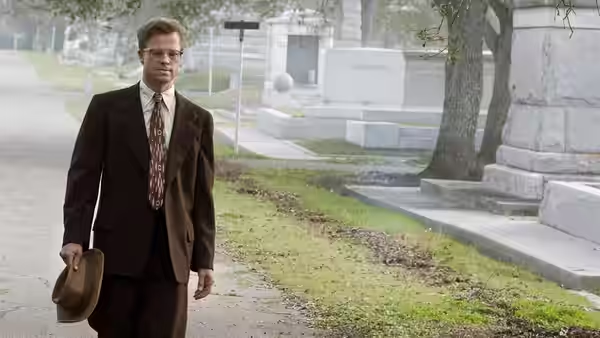
It is superbly made. Claudio Miranda photographs the early decades in lamplight, the colour of old varnish, and lets the palette cool as the century wears on. Donald Graham Burt’s old people’s home is a tall New Orleans house where the residents sit in the same chairs every day and a wrinkled boy fits in without remark. Jacqueline West dresses forty years of Americans without once drawing attention to it. The effects, which put Brad Pitt’s face, aged by decades, on the body of a much smaller man, are disconcerting for about a minute and then simply accepted. Alexandre Desplat’s score, mostly piano, is patient and does not push.

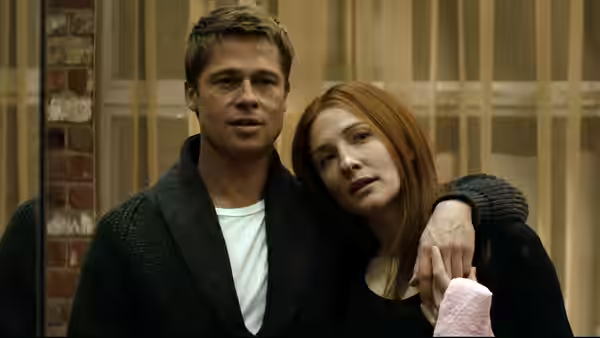
Taraji P. Henson is the warmest thing in it. Queenie finds the baby on the steps, decides on the spot that he is a miracle and hers, and Henson plays her as a practical woman with a house to run rather than a saint. Jason Flemyng gives Thomas Button, the father who left the child, a guilt that sits on him for years. Jared Harris enjoys himself as Captain Mike, a tugboat skipper who considers himself an artist and has the tattoos to prove it. Pitt is watchful and decent and still, and the stillness is the problem: Benjamin is written as a man things happen to, and he takes them politely. Cate Blanchett has more to play as Daisy, a dancer with ambitions, and the film wakes up when she is angry.

And then there is a stretch in a hotel in the far north, where Benjamin, now at sea, meets Elizabeth Abbott (Tilda Swinton), the wife of a British official, over tea in an empty lobby at three in the morning. Nothing much happens. Two people who cannot sleep talk about caviar and the things they meant to do. It moved us more than anything else in the film, and more than we expected, because for twenty minutes the script stops announcing its themes and lets two lonely adults be careful with each other. Swinton does it with almost no gestures. When the film leaves her we felt the loss, and we were not sure the film did.

The framing is the worst of it. The whole story is read from Benjamin’s diary by Caroline Fuller (Julia Ormond) at the bedside of the dying Daisy in a New Orleans hospital in 2005, with a hurricane coming in. The film returns to that room repeatedly, Blanchett rasping under prosthetics, Ormond turning pages, the wind picking up, and each return stops the story so that it can tell us how to feel about it. The hurricane is meant as a large symbol and lands as an interruption. Roth’s dialogue does not help; people speak in the film’s tagline, and the script has the shape of his Forrest Gump (1994), a mild Southern man drifting through the century towards a woman who is not ready for him. Angus Wall and Kirk Baxter cut the decades as tidy montage, but the middle hour goes round the same track twice, and past the two-hour mark we were checking how much was left. That is not a good sign in a love story.

Fincher’s Zodiac (2007) was also long and also patient, and it never dragged, because its people wanted something and could not have it. Benjamin wants little. Fincher’s reserve stops Roth’s script from turning to syrup, but it also stops us getting close to anyone.

It is worth an evening for anyone fond of Fincher, of Swinton, or of a period rebuilt to the last brass fitting, and it is better at home, where the hospital scenes can be got through with a cup of tea and the long middle becomes a matter of your own patience. It carries a 12A and runs 166 minutes, of which perhaps two hours are needed.

Critical consensus AI synthesised

66
Positive
10
Mixed
2
Negative
3

Most critics come down in favour, though few are warm about it. The praise gathers around David Fincher’s direction and the technical work: the effects and make-up that carry Brad Pitt backwards through the ages are singled out almost everywhere, and several reviews note that they serve the story rather than show off. Pitt’s performance is admired, Tilda Swinton’s supporting turn is mentioned more than once, and many are relieved that a premise begging for sentiment is handled with restraint.

The reservations are about temperature. Even the admirers find the film cool and remote, with a passive hero who watches life rather than lives it; the comparison to Forrest Gump recurs, and rarely as a compliment. Eric Roth’s script and the running time draw complaints too. The spread is wide. The Guardian and NME dismiss it as twee and tedious, Screen Daily thinks it never coheres as the tragedy it wants to be, and Den of Geek asks whether the mauling is deserved.

Empire
· Ian Freer
90*

Fincher delivers a cool, non-mawkish love story that avoids easy sentiment while capturing the melancholy of time as the nemesis of love. The critic singles out the film's grace notes, technical effects, and emotional depth as making it a film for the ages.

Read the full review →
The Hollywood Reporter
24 November 2008 · Kirk Honeycutt
80*

The critic finds the film a superbly made epic that transforms Fitzgerald’s gimmick into a contemplative tale of life, death, and love. Fincher’s assured direction and Pitt’s touching performance stand out.

Read the full review →
Time Out
3 February 2009 · ★★★★ · Tom Huddleston
80

The film works only sporadically as an epic melancholic romance thanks to Fincher’s storytelling skill and visual spectacle, despite hokey scripting from Eric Roth. It is praised for transcending its flaws through craft and standout performances, especially Tilda Swinton’s poignant turn.

Read the full review →
Slant Magazine
20 December 2008 · ★★★/4 · Nick Schager
75

The critic notes Fincher’s measured approach prevents the material from becoming mawkish and creates a reserved portrait of love, though the script occasionally falters. Technical deftness and visual framing are singled out for praise amid mixed feelings about emotional distance.

Read the full review →
The Independent
8 February 2009
70*

The critic praises Fincher's visual bravura and narrative gusto in adapting the reverse-aging premise into a poetic, virtuoso feat that is eloquent and rapturous. The film is seen as extravagant with imperfections but ultimately a serious, sober Hollywood exploration of death and mortality.

Read the full review →
The New York Times
24 December 2008 · NYT Critic’s Pick · A.O. Scott
70*

Fincher and screenwriter Eric Roth have turned Fitzgerald’s slight fantasy into a lush romantic film that investigates the philosophical paradoxes of its protagonist’s condition in a spirit owing more to Borges. The puzzles about time, experience and love are deep and imposing, explored in consistently interesting if not always dramatically satisfying ways.

Read the full review →

Cast

Awards

Academy Awards, 2009

Nominated
Best Actor
Nominated
Best Cinematography
Nominated
Best Costume Design
Nominated
Best Director
Nominated
Best Film Editing
Nominated
Best Original Score
Nominated
Best Picture
Nominated
Best Sound
Nominated
Best Supporting Actress
Nominated
Best Writing, Adapted Screenplay
Won
Best Makeup and Hairstyling
Won
Best Production Design
Won
Best Visual Effects

If you liked this, try…