John Madden’s remake of an Israeli thriller is at its best in a cold Berlin flat in 1965, where Jessica Chastain and Jesper Christensen face each other across an examination table. The 1997 half, for all Helen Mirren’s work, lets it down.
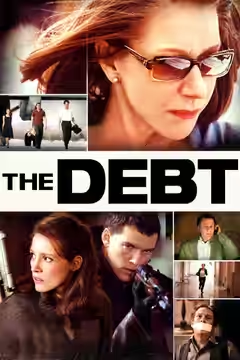
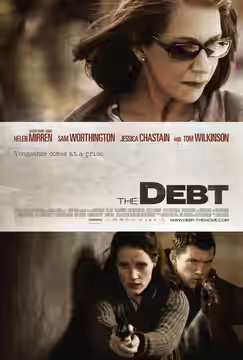
John Madden’s The Debt is a remake of an Israeli thriller, and it is really two films. The first is set in East Berlin in 1965 and follows three young Mossad agents sent to catch a Nazi doctor and bring him to trial. The second is set in 1997 and asks what thirty years of living with that mission have done to them. The first is a tight, cold, well-made thriller. The second is slacker, warmer and finally silly, and it is the one the film has to end on.
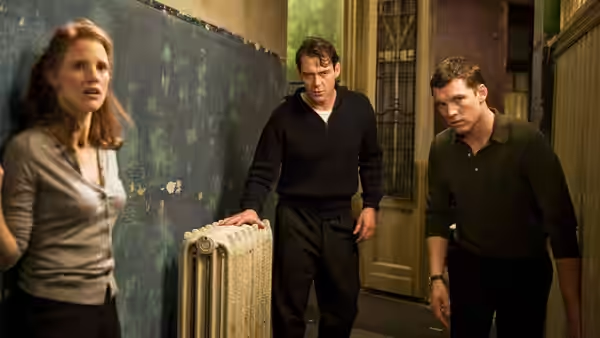
The Berlin section begins with Rachel (Jessica Chastain) crossing into the East to join David (Sam Worthington) and Stefan (Marton Csokas) in a flat with a view of nothing. Their target, Dieter Vogel (Jesper Christensen), is practising as a gynaecologist under another name, and the only way to get close is for Rachel to book an appointment. Christensen plays him as a pleasant, attentive doctor who asks after her husband and warms his hands before he touches her. We were rigid in our seats through every one of her visits, and not because anything happens; it is that his hands are in the frame and her face is above them, and Ben Davis’s camera keeps both in view and does not cut away.
Davis shoots East Berlin in greys and a thin, dirty green, with the agents’ flat lit by one lamp and the clinic in a flat white that is somehow worse. Jim Clay’s safe house is two rooms, a bath and peeling paper, and the film spends long enough in it that we come to know where the chair is. Natalie Ward puts Rachel in a coat too thin for the weather and Stefan in one too good for his cover. Thomas Newman’s score is sparer than usual for him, a low string pulse and a few plucked notes, and it stays out of the way until the attempt to get Vogel out through a railway station, which Alexander Berner cuts to the rhythm of a timetable and which is the best five minutes in the film.
What follows in the flat, with Vogel tied up and the three agents waiting for new orders, is nearly as good. Christensen barely raises his voice, and he does more damage talking than most screen villains do with a weapon. Csokas gives Stefan a swagger that curdles into something meaner under pressure. Worthington plays David as the quiet one, which suits him, though his accent goes on its own travels. The love triangle the script threads between the three has been much complained of, and it is slight, but it is also the only thing in the flat besides Vogel, and we did not mind it.
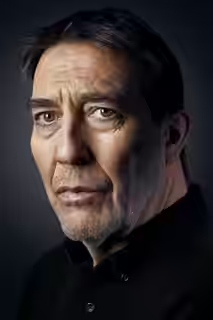
Then the film goes back to 1997, and the trouble starts. Helen Mirren, Tom Wilkinson and Ciarán Hinds are all good, and Mirren in particular makes Rachel’s public face look like a thing that costs her to hold. But the matching is odd: Chastain into Mirren we can believe, Worthington into Hinds we cannot, and the film asks us to several times. The screenplay, by Matthew Vaughn, Jane Goldman and Peter Straughan, then takes a turn we will not describe. What we can say is that the last half hour swaps the questions the Berlin scenes raised, about what a country owes its heroes and what the heroes owe the truth, for the business of an ordinary thriller, with a corridor and a weapon and a clock. We felt the film shrinking as we watched it.
Madden made Shakespeare in Love (1998), and he is at his best here as there, with actors in a room and a scene that turns on a look. Against Spielberg’s Munich (2005), which covers some of the same ground, The Debt is tidier and far less troubled by what its agents do. Munich made us uneasy; this asks us to be uneasy and then reassures us.
See it for Chastain and Christensen and the hour in Berlin, which would have made a good film on its own. Stay for Mirren. Expect the ending to let you down, and decide in advance that you do not mind. It runs 113 minutes and carries a 15 certificate.