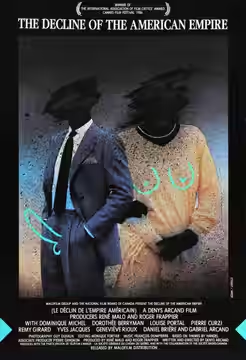
Denys Arcand’s comedy of manners is almost all talk, and the talk is sharper than it first sounds. The first hour flatters its academics and lets them run on; the dinner takes most of it back. Stay for the dinner.
Denys Arcand puts eight people from a Quebec university history department in one house for one dinner and lets them talk. That is the whole film. For most of its 101 minutes the men are in the kitchen and the women are at a gym, and both groups discuss sex with the confidence of people who have read a great deal about it. The Decline of the American Empire is a comedy of manners in the old sense: the manners are the subject, and the joke is the distance between what these people say and what they do. It is stagey, and it is good, and the second is not in spite of the first.
The title comes from Dominique (Dominique Michel), who has written a book arguing that when a society starts to put private happiness above everything else, it is on its way down. Michel plays her dry and amused, the only one at the table who seems to have heard herself talk. Rémy Girard’s Rémy is the opposite: a cheerful, tireless adulterer who narrates his affairs to the other men as if reading out a recipe. Pierre Curzi’s Pierre has left his marriage for Danielle (Geneviève Rioux), a student young enough to make the others uneasy. Yves Jacques, as Claude, is the only gay man among them and gets the best lines, because he is the only one who is not boasting.
The women are given the harder material and play it better. Louise Portal’s Diane describes being tied up and hit by her lover Mario (Gabriel Arcand) with a frankness the film is careful not to laugh at. Dorothée Berryman’s Louise, married to Rémy, believes her marriage has an understanding, and Berryman lets us see how much work it takes to keep believing it. Danielle mentions, early and without fuss, that she pays for her studies working in a massage parlour, and the gym goes quiet for a moment. Arcand’s screenplay is at its best in these silences, when someone has said a true thing and nobody knows where to put it.
Guy Dufaux shoots the house in warm lamplight and the lake outside in the flat gold of late autumn, and he keeps the camera at the table, low, so that we are a guest and not an observer. Gaudeline Sauriol gives the house big windows and wooden walls and the look of money that does not want to be noticed. Denis Sperdouklis dresses the women in gym leotards and the men in aprons, and both groups look faintly ridiculous, which is the point. Monique Fortier cuts between kitchen and gym so that a claim made in one room is answered in the other a minute later, and the film’s argument is carried almost entirely by that cutting. François Dompierre’s score stays out of the way of the talk and comes in over the lake exteriors, where it can do no harm.
What does not work is the first hour’s fondness for its own cleverness. Rémy’s monologues go on past the point where they tell us anything, and Arcand seems to enjoy them more than he should. The men are written; the women are observed, and the difference shows. Mario’s arrival, in leather and contempt, is the one clumsy stroke, the working man brought in to make the academics look soft, and Gabriel Arcand is given little to do beyond glower. Some of the sexual bragging has dated hard, though the film knew it was bragging even then.
We laughed at Rémy for an hour, easily, the way one laughs at a friend’s stories at a party. Then, at the table, there is an exchange involving Louise that we will not describe, and we stopped laughing and felt caught out, because we had been enjoying exactly the thing the film was about to punish. The second half takes a turn, and having taken it Arcand does not soften it. That is the film’s real subject: not sex, but the cost of the talk, and who pays it.
Arcand went back to these people in The Barbarian Invasions (2003), older and sadder, and that film is the better one. This is the sharper. Watch it with someone you have been with long enough to argue afterwards, and expect to.