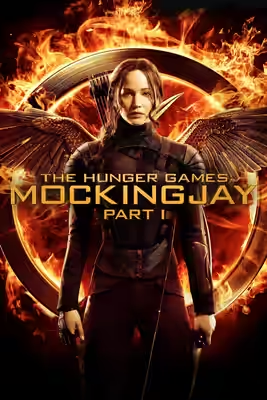
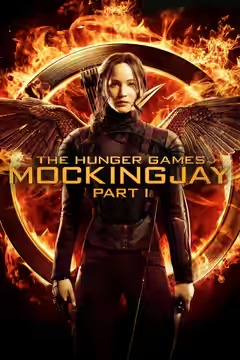
The third Hunger Games film has no games in it, an interesting idea for an hour and a stalling tactic for the second. Jennifer Lawrence and Philip Seymour Hoffman keep it alive; cutting one book in two nearly kills it.
Suzanne Collins’s third book has been cut in two, and this is the half without the ending. Peter Craig and Danny Strong’s screenplay takes Katniss Everdeen out of the arena for good and puts her in a bunker, where the war is fought mainly with cameras: the rebels need a face for their broadcasts, and the Capitol already has one in Peeta. For an hour that is the sharpest idea the series has had. Then the film runs out of book, and it knows it.
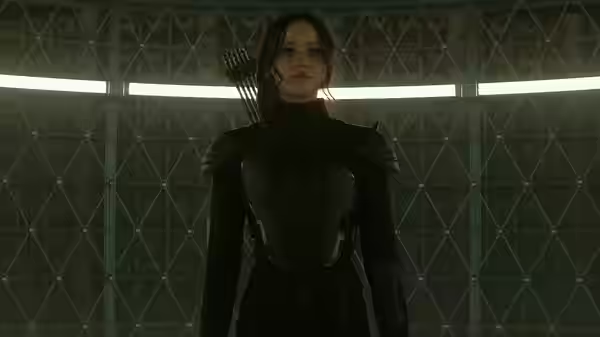
Francis Lawrence directs the bunker with care. Philip Messina designs District 13 as a place with no colour in it, concrete corridors, stencilled numbers, a canteen where everyone eats the same grey food at the same hour, and Jo Willems lights it with the flat overhead glare of a hospital at night. Bart Mueller and Kurt Swanson put the whole population in identical boiler suits, which leaves Elizabeth Banks’s Effie Trinket, down to one headscarf, with the film’s only running joke. Above ground, Willems shoots the ash of District 12 in a weak white daylight that makes it look as if it were still cooling.
Philip Seymour Hoffman is the best thing in it. Plutarch Heavensbee, the Capitol’s old gamesmaker now running the rebels’ propaganda, is played as a television producer who has changed networks and is delighted by a good shot whichever side it serves. He gives Julianne Moore’s President Coin, pale and exact, somebody to be amused by. The first attempt to film Katniss as a revolutionary, on a studio floor with a green screen, a smoke machine and a script, is funny and then quietly damning: the series has at last admitted that its heroine was always a product. Woody Harrelson’s Haymitch, drying out in a district with nothing to drink, turns up to say so out loud.
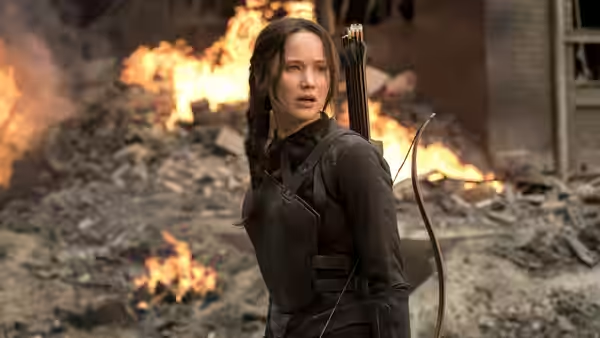
Jennifer Lawrence plays the reluctance as something close to illness. Katniss does not want the job, cannot act, and goes grey and sick each time Peeta appears on Capitol television, and Lawrence lets the camera sit on all of it without asking for sympathy. Then, by the water in the ruins, she sings a folk song almost under her breath, and the film cuts to crowds of workers taking it up as they march on a dam. We did not expect to be moved by that and we were, badly. James Newton Howard keeps his orchestra out until the crowd has the tune, and Alan Edward Bell and Mark Yoshikawa cut the song against the march so that each carries the other.
The hospital in District 8 is the other sequence that stays. Katniss walks among the wounded, is recognised, and steps outside in time to watch the Capitol’s planes flatten the building, and we were horrified, hand over mouth. We were then a little ashamed, because the film has timed the horror to produce the speech she makes into the camera straight afterwards, and it worked on us exactly as it works on the districts. That is the film being honest about what it is. Nothing after it is as good.
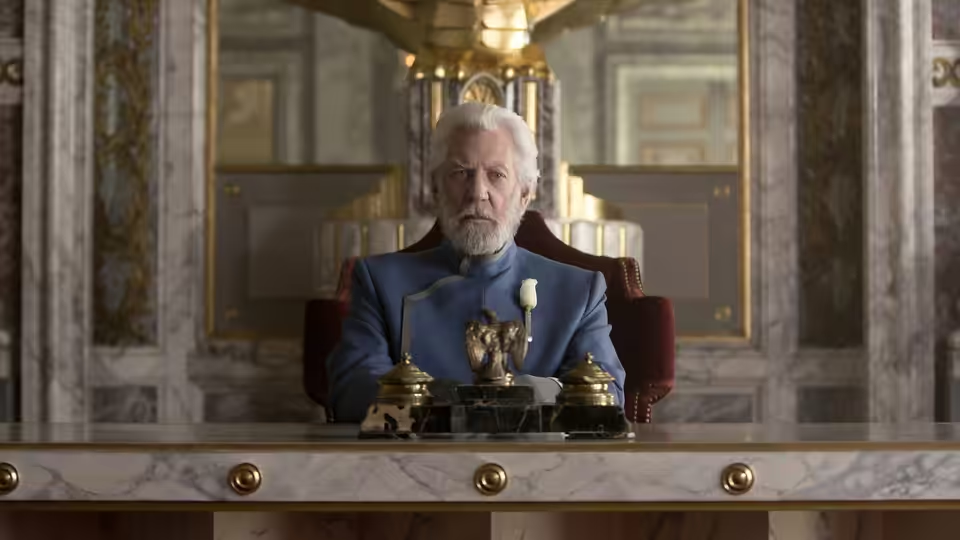
The second hour is a holding pattern. Liam Hemsworth’s Gale is given more to do and there turns out to be less in him than the script needs. Josh Hutcherson spends the film on monitors, thinner each time, which is effective and gives him nothing to play. Donald Sutherland’s President Snow smiles and sends roses, and the final stretch is a rescue mission that the heroes, and we, watch on screens from the bunker. We will not describe how it ends, except to say that it does not. We were bored by the last forty minutes and then annoyed at being bored, because the first hour had earned better.
Catching Fire (2013) had an arena to deliver and delivered it. This one has none and for a while is the better film for it. Taken on its own, it is a well-made case against cutting books in two. It runs 123 minutes and carries a 12A, and it is best watched with the next part to hand, as the first half of one long evening.