Francesco Rosi sends three brothers home to bury their mother and asks each of them to stand for a piece of Italy. The kitchen-table arguments are the weakest thing here; the old man and the small girl around them are worth the evening on their own.
Francesco Rosi spent the best part of twenty years making films about how Italy is run and who gets hurt by it: Salvatore Giuliano, Hands over the City, Illustrious Corpses. Three Brothers takes the same country and shrinks it to one farmhouse and one funeral. Taken from Andrey Platonov and written by Rosi with Tonino Guerra, it is a serious, handsome film that is worth your evening, and it is at its weakest exactly where it works hardest. The brothers stand for things, and they know it, and so do we.
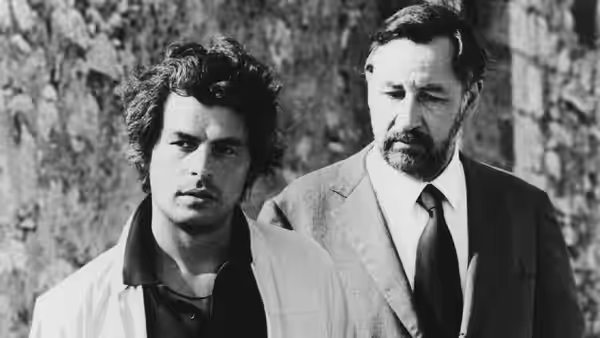
The setup is simple and Rosi keeps it so. A telegram goes to Rome, where Raffaele (Philippe Noiret) is a judge preparing a terrorism trial and opening letters that tell him he will be shot. One goes to Naples, where Rocco (Vittorio Mezzogiorno) looks after boys at a reform school. One goes to Turin, where Nicola (Michele Placido) works on the factory floor and has walked out on his wife. Three cities, three trades, and by the time they are all in the same kitchen the film has set out its pieces: the law, good works, the union. They sit up the night before the burial and argue about whether the state deserves defending and whether a bullet is ever an answer. Every line is intelligent. Almost none of it sounds like something a tired man would say to his brother at two in the morning.
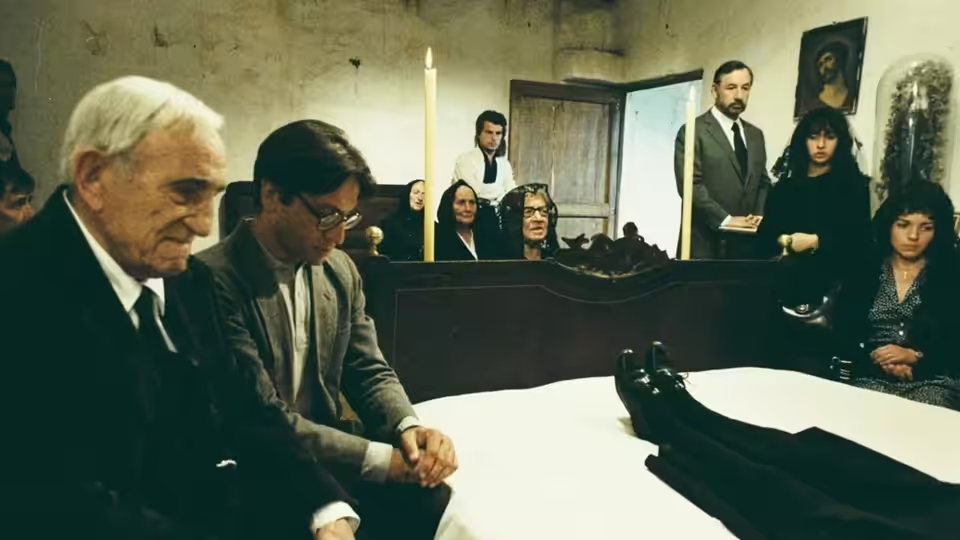
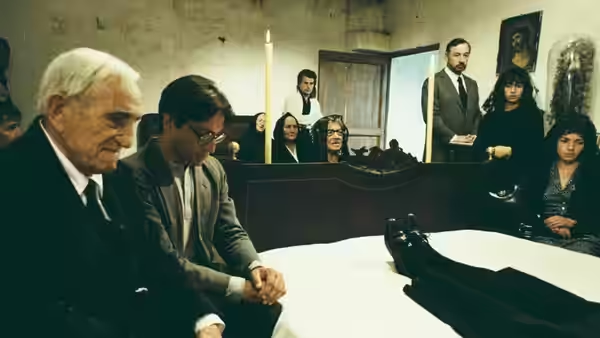
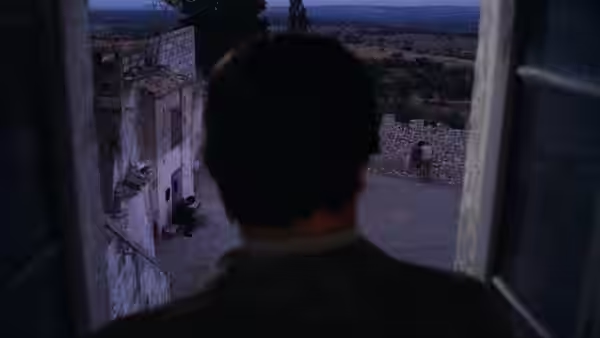
What saves it is everything around the table. Pasqualino De Santis shoots the farm in flat early light and the rooms in the half-dark of shuttered windows, so that the dead woman on her bed is a shape under a sheet and the brothers arriving from their cities look overdressed for the place they were born. Andrea Crisanti’s farmhouse is whitewash, a stone floor and a cart in the yard, and the film keeps coming back to the same doorway as the day moves across it. Gabriella Pescucci puts Raffaele in a grey suit he never takes off, even here, and Nicola in the jacket he wore on the shop floor, which explains them better than the speeches do.
And then there is the old man. Charles Vanel was well into his eighties when he played Donato, and Rosi lets him move at his own pace: across the yard, through the stable, out to the well with his granddaughter Marta (Marta Zoffoli) trailing after him and asking where her grandmother has gone. Nothing much happens in these scenes. He shows her the animals; she opens drawers; they sit. We were moved by them far more than we expected to be, and far more than by anything the brothers say, because Vanel does not act grief so much as carry it about the farm like something he has been asked to hold. There is a flashback to his wedding day on a beach, with Mezzogiorno as the young Donato and Simonetta Stefanelli as his bride, and a ring dropped in the sand, and it is the best five minutes in the film.
Noiret is the film’s weight, a large tired man who has decided to keep going to work, and he is best when saying nothing and looking at the fields. Placido plays Nicola’s anger as something he is slightly bored by himself, which is truer than the script’s version of it. Mezzogiorno has the harder job, a good man written as goodness, and he plays Rocco and the young Donato as two men who might have got on. Maddalena Crippa, as Giovanna, has little screen time and makes the failure of the marriage specific in all of it.
Christ Stopped at Eboli (1979), Rosi’s previous film, also sent a northerner into the south and let the place do the talking. Here the men talk for the place, at length, and the film is smaller for it. It is still a proper film about a country at the end of a bad decade, made by someone who loved the country and trusted nobody running it. See it for Vanel, the girl and De Santis’s light, and sit through the seminar, which is shorter than it feels. It runs 113 minutes.