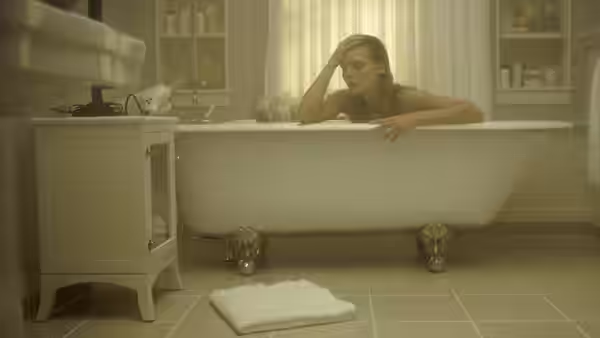
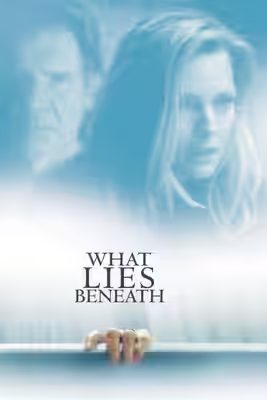
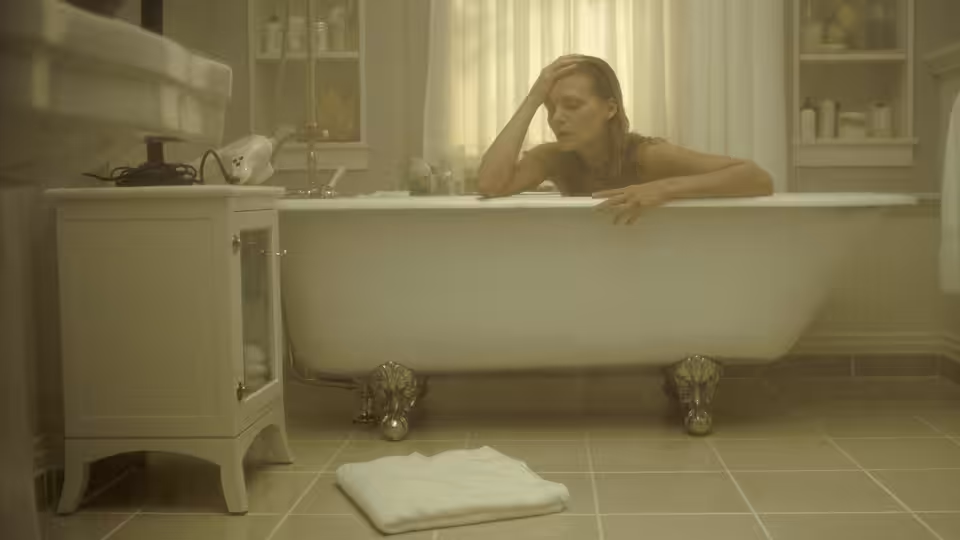
Claire Spencer (Michelle Pfeiffer) leans over the edge of a bathtub in her bathroom
Film review

What Lies Beneath

2000 · Directed by Robert Zemeckis · 2h 10m

In a sentenceA faulty door latch earns its keep; several pages of plot do not

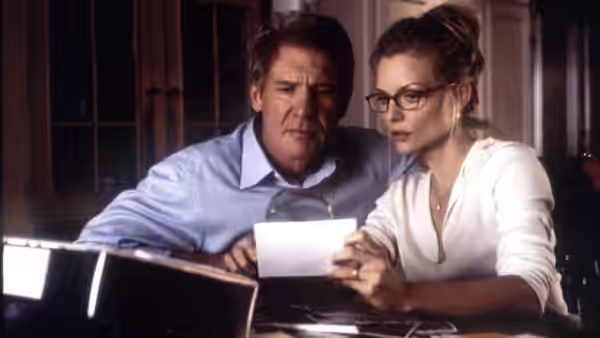
Claire Spencer (Michelle Pfeiffer) faces unease at home with Norman Spencer (Harrison Ford), a husband whose apparent perfection conceals a mistake. Jody (Diana Scarwid) and Dr. Drayton (Joe Morton) are among those drawn into the couple’s story. The trouble follows Norman home, bringing questions about their marriage into the domestic mystery and making Claire reconsider what she can take for granted. Claire is caught between the need to understand her growing fear and uncertainty about the man with whom she shares her home.

Plays from YouTube when you press play; nothing loads from them until then.

Fi1m review

Michelle Pfeiffer steadies a domestic thriller with some carefully managed scares, but Robert Zemeckis cannot keep its tangled story moving. A qualified choice for anyone who enjoys watching an elaborate scare being set up.

What Lies Beneath is good at making us apprehensive and much less good at making its story hold together. Robert Zemeckis directs a domestic thriller that spends 130 minutes keeping suspicion alive, sometimes through patient staging and sometimes through another abrupt jolt. There is pleasure here for anyone who enjoys waiting for something ordinary to go wrong. The trouble is how often Clark Gregg’s screenplay has to complicate matters to keep that waiting going.

Michelle Pfeiffer gives Claire Spencer enough composure for her nervousness to matter. She does not need to make every moment of unease a performance in itself, and that restraint helps a film which is rarely restrained elsewhere. Her distress remains believable even when the plotting begins to strain our patience. The characterisation gives her relatively little to work with, but she makes it possible to care about the woman doing the worrying.

The clearest evidence of Robert Zemeckis’s skill is the business with a faulty door latch. We tensed up at that latch, because the film makes a small mechanical failure worth watching closely. Don Burgess’s fluid widescreen photography gives the suspense time and space to develop, rather than treating every shot as preparation for a shock. In passages like this, the camera keeps us looking when we would rather the moment were over.

The production design by Rick Carter and William James Teegarden serves this close attention to domestic surroundings. Their work gives the suspense somewhere credible to happen, which matters when the plotting is already asking for considerable indulgence. Alan Silvestri’s music is less discreet. It keeps insisting on the suspense, and too often that insistence draws attention to how familiar the scene is rather than making it more frightening.

The larger pacing is harder to defend. Arthur Schmidt’s editing can sustain an individual scare, but the middle drags, with Clark Gregg’s screenplay adding complications without making the people much more interesting. Over this running time, the thin characterisation becomes a practical problem: there is too little to think about between the jolts. The plotting also asks for more belief than it earns, and its increasing complexity does not repay the time spent waiting for an explanation.

Against the standards of domestic suspense, the weakness is not that the film uses familiar devices. A door, an uneasy woman and a home that no longer feels reassuring are enough if the director can control what we notice. Robert Zemeckis often can, but he also reaches for too many jolts. Those interruptions make the patient stretches less effective, because we begin to anticipate the next sudden scare instead of attending to Claire Spencer.

Our recommendation is limited to suspense enthusiasts who are willing to forgive a mystery that strains their patience. There are enough well-managed scares to make that bargain reasonable, but not enough to make it an easy choice. If implausible plotting is what usually takes you out of a thriller, leave this one for another evening.

Critical consensus AI synthesised

54
Positive
2
Mixed
6
Negative
5

The consensus on What Lies Beneath is mixed, with praise concentrated on Michelle Pfeiffer’s performance and the staging of individual suspense sequences. Several critics find it effectively unsettling even when they dislike the plotting, and Pfeiffer earns credit for sustaining the tension through implausible material. The more favourable reviews treat its familiar devices as enjoyable craftsmanship, particularly when dialogue gives way to physical suspense.

The divide is wide over whether those strengths compensate for a stretched, convoluted script, thin characterisation and repeated jolts. Its debt to Hitchcock is especially contentious: /Film’s retrospective praises Robert Zemeckis’ use of those techniques to build tension and upset expectations, while The Guardian finds the borrowings ineffective. Total Film also responds warmly despite acknowledging the derivative approach and excessive length. A separate reservation comes from the Evening Standard, which objects to the portrayal of women as misogynistic.

Total Film
20 October 2000 · ★★★★ · Total Film
80

The review finds the film hugely pleasurable despite its derivative style and stretched-out story. It praises the masterful tension-building, especially a faulty-door-latch scene and the dialogue-free finale.

Read the full review →
RogerEbert.com
64*

The review’s verdict cannot be determined from the blocked page. Its praise or criticism is likewise unavailable.

Read the full review →
Screen Daily
21 July 2000 · John Hazelton
64*

The page identifies this as a review, but the critic’s verdict is inaccessible in the provided text. No specific praise or complaint can be extracted from the visible material.

Read the full review →
The New York Times
21 July 2000
64*

The page was inaccessible, so the critic’s verdict cannot be established. No specific praise or complaint is available in the provided text.

Read the full review →
Time Out
· DA
64*

The page is a review of the specified film, but the review text is unavailable. Its verdict and any specific praise or complaint cannot be determined from the accessible content.

Read the full review →
Empire
1 January 2000 · Ian Nathan
60*

Nathan finds it an enjoyably spooky, effectively staged thriller, though ultimately confused and let down by its script. He praises Michelle Pfeiffer’s performance and the gripping finale, while faulting the sagging middle and excessive jolts.

Read the full review →

Straight answers AI written, from our review

Is What Lies Beneath worth watching?
What Lies Beneath is worth considering for suspense enthusiasts willing to forgive implausible plotting, and we score it 63 out of 100. Michelle Pfeiffer and several patiently staged scares keep us interested, but the middle drags and the tangled mystery asks for more patience than it rewards.
How long is What Lies Beneath, and what is it rated?
What Lies Beneath runs 2h 10m. It is a drama and horror film.
Where can I watch What Lies Beneath in Indonesia?
What Lies Beneath is not on any streaming or rental service in Indonesia at the moment. It is available in 41 other countries; change your country at the top of the page to see where. Availability is checked daily.
How violent or frightening is What Lies Beneath, and is it suitable for children?
What Lies Beneath has a UK 15 certificate and is unsuitable for children, with its scares built around domestic unease, prolonged suspense and abrupt jolts. We find the patient build-ups effective; those sensitive to sudden shocks should be cautious, though we cannot give a detailed account of violence from the material covered in our review.
How does What Lies Beneath compare to The Others?
What Lies Beneath is the weaker choice beside The Others, which we recommend for its more restrained haunting and persistent dread. Both make a home unsettling, but we find Zemeckis too reliant on abrupt jolts and tangled plotting; The Others better suits those happy to wait for a scare, though its deliberate pace may test impatient viewers.
What should I watch after What Lies Beneath?
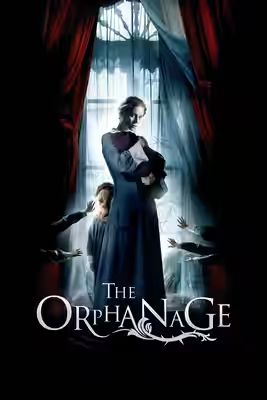
After What Lies Beneath, try The Others (2001, Fi1m 80): A more restrained haunting, built around household rules and persistent dread. Then The Orphanage (2007, Fi1m 81): A domestic haunting with more patience for the people enduring it; and Personal Shopper (2016, Fi1m 76): A quieter ghost story for those interested in the waiting between scares.

Cast

If you liked this, try…

  1. The Innocents (1961) · not reviewed yetFor another anxious household where a woman’s perceptions become everyone’s problem.

  2. Diabolique (1955) · not reviewed yetDomestic resentment and carefully managed suspense, with fewer opportunities to relax.

  3. The Others (2001, Fi1m 80)A more restrained haunting, built around household rules and persistent dread.

  4. The Orphanage (2007, Fi1m 81)A domestic haunting with more patience for the people enduring it.

  5. Personal Shopper (2016, Fi1m 76)A quieter ghost story for those interested in the waiting between scares.

Free account

Know what to watch tonight

Two lists that know where things are streaming, collections you can share, your own score beside ours, and Discover that remembers what you have seen.

  • Want to see, sorted by what is streaming now
  • Seen, with your score out of ten
  • No adverts, ever