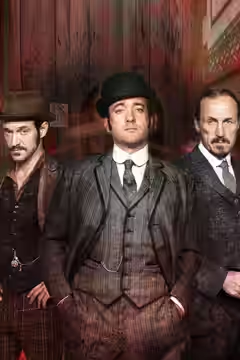
Richard Warlow’s police drama arrives with the Ripper’s blood still on the cobbles and does something braver than chase him. The cases are uneven and the talk is ornate, but the three men at the centre of it are worth your evening.
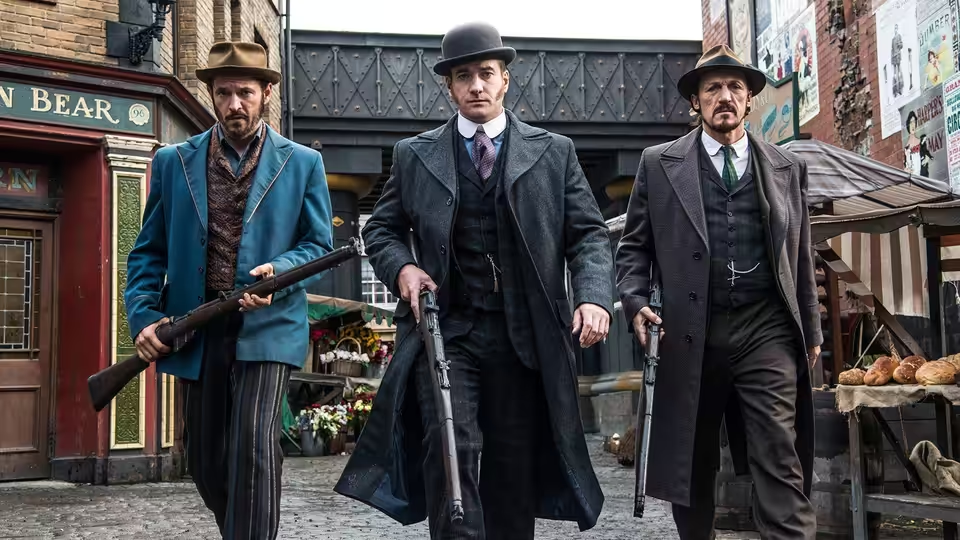
Whitechapel in 1889 is a place that would rather keep hunting a ghost than face what is actually in front of it, and Richard Warlow’s series makes its best decision before the first episode is out. The Ripper is not coming back. Detective Inspector Edmund Reid of H Division is going to have to police a slum that misses him, a press that misses him more, and a public that has got used to the idea of a monster and does not want an ordinary explanation. Matthew Macfadyen plays Reid as a careful, over-read man who believes in evidence in a district that runs on rumour, and the series is at its best when that belief is tested rather than flattered.
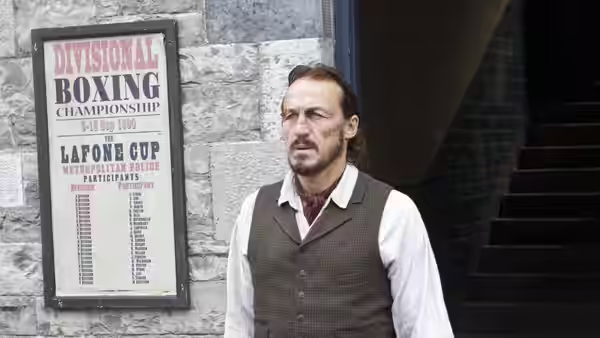
He has two men. Bennet Drake (Jerome Flynn) is his sergeant, a soldier who learned to kill for the Queen and is quietly ashamed of how good he is at it. Homer Jackson (Adam Rothenberg) is an American surgeon with a past he does not discuss, who does Reid’s post-mortems and lodges at the house kept by Long Susan Hart (MyAnna Buring), where Rose Erskine (Charlene McKenna) works. Flynn is the surprise. We were more moved than we expected by Drake standing in Susan’s parlour trying to court Rose with manners he has plainly learned from a book, a man who can break a jaw with one hand and does not know what to do with a teacup in the other. Flynn plays it without once asking for pity, and the series knows to leave him alone while he does.
The look is brown, wet and close. Leman Street station is wood, soot and iron, the streets outside are mud and gaslight, and the production design never lets a surface stay clean long enough for us to admire it. Drake’s fights are shot tight and cut hard, so we feel the weight of a punch before we see where it landed. Jackson’s dissecting table is where the series does its quietest work: a body, a lamp, and a man explaining what the wounds mean to a policeman who would rather not know. It is Victorian forensics done as theatre, and it holds.
The talk is another matter. Everyone in Whitechapel speaks as though dictating a pamphlet, and the writing team, Warlow among them, have decided that a sentence is not finished until it has a subordinate clause and a flourish. It is a style, and it is sometimes a good one, but it trips the actors in the smaller parts and gives the villains a habit of explaining themselves at length. Rothenberg handles it best; he turns the ornament into a drawl and makes it sound like contempt. Macfadyen, asked to carry most of the exposition, occasionally sounds like a man reading his own warrant.
The cases are the weak joint. Some episodes are tight and nasty and some wander, and the series has a habit of starting a story about the docks or the shipping lanes and forgetting why we should care about it by the half-hour. The effects, when it reaches for them, are not always up to the sets around them. The women are given less than the men: Amanda Hale as Emily Reid has a marriage hollowed out by a lost child to play, and does it well with little, but she is often left waiting at home in the way wives in these stories are. Buring’s Susan is the exception, a businesswoman who can out-think any man in the building, and the series gets better the more it lets her run it.
It ran to five seasons, the last two of six episodes rather than eight, and the cast widened as it went: David Dawson’s reporter Fred Best, Damien Molony’s Albert Flight, Leanne Best’s Jane Cobden, Matthew Lewis’s Samuel Drummond. The longer arcs suit it better than the cases. When it stops asking who killed this week’s body and starts asking what these three men have done to each other, it is a different and better programme, and it knows this about itself sooner than we expected.
It is a 15 certificate and earns it, mostly on the dissecting table. Watch it in the evening with the lights low and do not try to follow every clause; the faces will tell you what the sentences were for.