Tom Edge’s series sets a murder inquiry aboard a nuclear submarine and, for three episodes, the setting does the work. The plot it builds down there is sillier than the setting deserves, but Suranne Jones keeps it honest.
Tom Edge’s idea is a good one and he knows it. A death on a nuclear submarine cannot be investigated the usual way: the boat is on patrol, the patrol is the point of the boat, and the Navy will not bring it up for anybody. So the detective goes down to the crime, and once there she cannot leave, cannot phone home and cannot trust the only people who can tell her anything. That is the first three episodes and it is enough. Vigil is a good series with a silly second half, worth a Sunday evening or two if a whodunit with the hatch shut is your sort of thing.
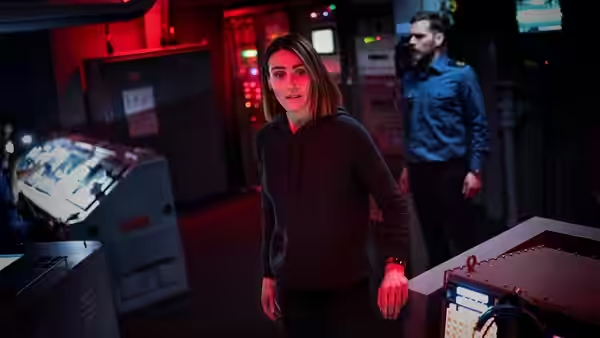
Mark Leese’s submarine set is the best thing in it. The ceilings make Suranne Jones duck through the hatches, the passageways are one person wide, and every wall is pipes and painted steel, so the camera can never get far enough back to give anyone room. Matt Gray, Nic Lawson and Ruairí O’Brien shoot the boat in the red night lighting it runs on, which makes every face look feverish. Afterhere’s score is a low hum and the odd ping, and stays out of the way. The moment that got us came early. Silva is lowered from a helicopter onto the hull in open sea, the boat rolling under her, and Jones plays a woman deciding not to be sick. We were more frightened then than the series managed to make us again, and it had shown us nothing but water.
Jones is good at being the least welcome person in a room. Silva is stiff, tactless and usually right, and Jones does not soften her: she asks the wrong question, notes it was the wrong question, and asks it again. Shaun Evans, as the coxswain Elliot Glover, assigned to mind her, is helpful in a way you cannot tell from obstruction, and gives her a proper opponent. Paterson Joseph’s Commander Newsome and Adam James’s Lt Commander Prentice run the boat as two men who disagree only in private, and Anjli Mohindra’s medical officer, Tiffany Docherty, explains what a body can and cannot tell you with some tartness. Connor Swindells, Jonathan Ajayi and Chris Jenks fill out the younger crew, sketched fast but distinguishable by the second episode, which on a boat where everyone dresses alike takes some doing.
Ashore, Rose Leslie’s DS Kirsten Longacre works the case in the rain: the dead man’s flat, the base, the peace camp at its gates. Richard Cox and Michael Harrowes cut between the strands so that a question asked under the sea is answered on land a scene later, and for three episodes it runs cleanly. Gary Lewis’s Robertson and Romola Garai’s Eliza Russell mostly tell Longacre what she may not know. Where the land strand goes soft is in Silva’s past. Edge gives her a loss she has not got over and returns to it in flashback every episode, always the same way, and by the fourth visit we had the point.
Then the series has to say what the death was for, and this is where it lets go of the rope. We will not describe the second half, except that the story stops being about a body in a bunk and becomes a story about governments, and the mechanism it settles on needs several sensible people to do things nobody sensible would do underwater. There is a fight near the end that we laughed at, and we were not meant to. The makers can still frighten us when they choose; there is a sequence, some way in, where Silva is shut in a space the size of a coffin with water coming in, and we held the arm of the sofa for the whole of it. The romance between Silva and Longacre, meant to be the warmth under the steel, is written in the past tense and played at arm’s length, and we never quite believed either woman had missed the other.
The comparison most critics made was Line of Duty, and Martin Compston in the first episode invites it. The difference is that Line of Duty trusts its interviews and Vigil trusts its corridors. Six episodes, each a little under an hour, with a 15 certificate; a second series arrived in December 2023. See it for the set and the first three episodes. Stay for the rest if you have forgiven this kind of thing before; we have.