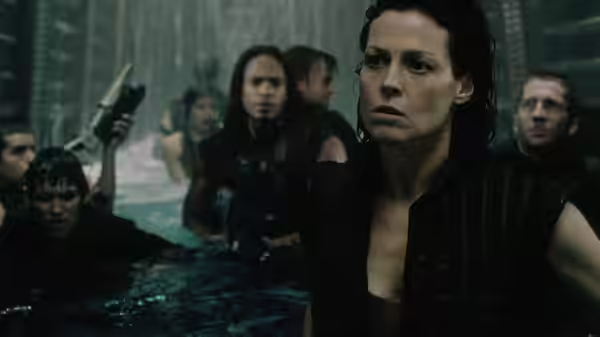
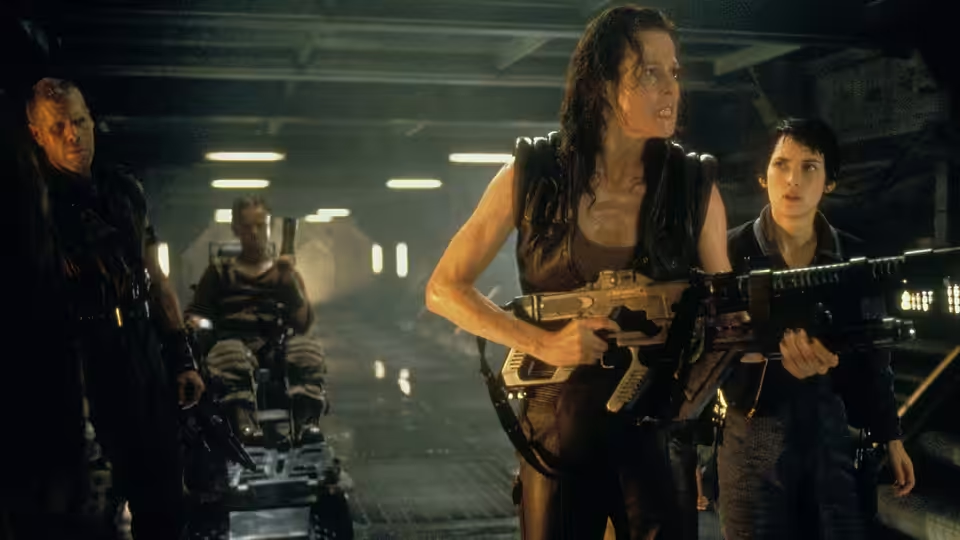
Ripley (Sigourney Weaver) holding rifles with Call (Winona Ryder) in a dim corridor
Film review

Alien Resurrection

1997 · Directed by Jean-Pierre Jeunet · 1h 49m

In a sentenceEverything on the ship drips, everyone on it grimaces, and Ripley is the only person having a good time

Aboard the military research vessel Auriga, two hundred years after Ripley (Sigourney Weaver) died, scientists led by Dr. Wren (J.E. Freeman) and Gediman (Brad Dourif) have grown her again from a blood sample. They want the alien queen she was carrying; they cut it out and keep the woman as a curiosity, under the eye of General Perez (Dan Hedaya). The clone has acid in her blood, a nose for the creatures and a memory that comes and goes. A freighter, the Betty, docks with cargo: kidnapped sleepers to be used as hosts. Its crew, Elgyn (Michael Wincott), Call (Winona Ryder), Vriess (Dominique Pinon), Johner (Ron Perlman) and Christie (Gary Dourdan), plan to take their money and go. Call has other business on board. Then the creatures in the tanks work out how to leave them.

Plays from YouTube when you press play; nothing loads from them until then.

Fi1m review

Jean-Pierre Jeunet brings Ripley back as a clone and the Alien series back as a freak show. Sigourney Weaver is remarkable and the pictures are like nothing else in the series; Joss Whedon’s script keeps interrupting both with a wisecrack.

Five years after Alien 3 (1992) killed Ripley off, the series has her back, and the film knows how strange that is. Joss Whedon’s script has the military grow her from a blood sample two hundred years on, not for her sake but for the alien queen she was carrying when she died. Jean-Pierre Jeunet, who made Delicatessen (1991) and The City of Lost Children (1995) with Marc Caro, directs his first film in English and brings the wide lenses and the sickly light with him. What he makes is the oddest of the four films, the funniest and the least frightening. It is worth an evening for the interested and for nobody else.

Weaver first. She plays the clone as something that remembers being Ripley without quite being her, and she does it mostly with her body: a loose, unhurried walk, a habit of sniffing the air before she looks, a smile that arrives a beat late. She beats Ron Perlman’s Johner at basketball without appearing to try, then puts him on the floor. The performance has stopped asking for our sympathy and is more interesting for it.

Darius Khondji lights the Auriga in the colours of a hospital at night, greens and dirty ambers with the shadows left black, and Nigel Phelps designs it as a laboratory rather than a haunted house: glass tanks, steel tables, corridors with the plumbing on the outside. Bob Ringwood puts the Betty’s crew in scuffed leather and knitwear that looks slept in. Around the midpoint there is a long sequence underwater, in a flooded galley, with the creatures swimming after the humans, the one stretch where Jeunet’s taste for the strange and the series’ need to frighten pull the same way. We held our breath with them. It is the best set piece in the film by a distance.

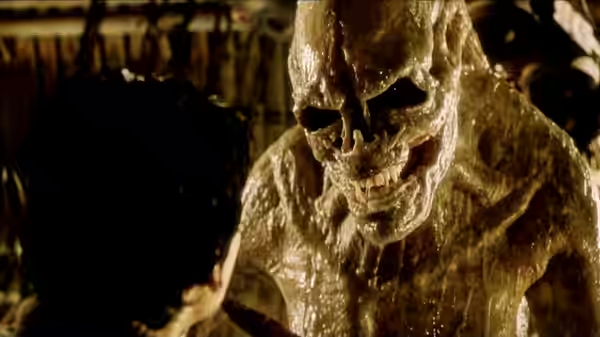
Then there is a room. Roughly halfway, Ripley opens a door, and what is behind it is the film’s one serious scene, played nearly in silence. We will not describe it. We will say it horrified us in a way nothing with teeth in the film managed, because it is about what was done to a person rather than what a monster might do next, and Weaver plays it with a stillness the rest of the picture never asks of her. Then it is back to the corridors.

The corridors are where the trouble is. Whedon writes the Betty’s crew as a gang with a line ready for every death: Perlman’s brute, Dominique Pinon’s Vriess in a chair with a gun bolted to it, Gary Dourdan’s Christie with pistols strapped to his forearms. Some of the lines are funny; all of them cost tension, and John Frizzell’s score, thick with brass and choir, keeps announcing dread the dialogue has just waved off. Winona Ryder’s Call has the only conscience on board, and Ryder plays her as if she had wandered in from a quieter film, and the second half explains why. Hervé Schneid cuts the action fast and from many angles, and we sometimes lost track of who was where.

Whedon has since disowned the result and blamed the direction rather than the words; having listened to the words, we are not sure he is right. The pictures are of a piece from first frame to last; it is the script that keeps stopping the horror film to tell a joke about it. Alien (1979) was one monster in one ship. Aliens (1986) was a war film. Alien 3 was a funeral. This one is a sideshow, with Jeunet as the barker, and the second half takes a turn we will not describe, except to say that the last twenty minutes are the silliest in the series.

See it if you liked Delicatessen and wondered what Jeunet would do with a monster and someone else’s money, or to watch Weaver take a character she has played three times and make her unfamiliar. Do not see it expecting the fourth chapter of the story you were following; that is the hope that leaves people angriest. It runs 109 minutes and carries an 18 certificate, which for once is not a formality.
Critical consensus AI synthesised

55
Positive
5
Mixed
2
Negative
4

The reviews split almost down the middle, but they agree on one thing: Sigourney Weaver. Her cloned Ripley, jaded, sardonic and not entirely human, is called the best thing in the film by admirers and detractors alike, and several critics find her more compelling than the aliens. Jean-Pierre Jeunet’s look for the film, grungy and fantastical, is widely noted, and the underwater sequence is singled out again and again as the set piece that works.

Beyond that the spread is wide. The 1997 notices are largely cold: they find it nasty and emotionally remote, and Roger Ebert dismisses it as forgettable and Winona Ryder as miscast. The defences come later, from critics who treat it as a comic-book actioneer or a grotesque art film due a reappraisal; Paste argues its oddness now looks prescient. Consequence stands furthest out, calling it the worst of the original series and blaming a mismatch between Joss Whedon’s script and Jeunet’s direction.

Slant Magazine
15 December 2003 · Ed Gonzalez
75*

The critic recommends treating the much-maligned film as a comic-book actioneer full of laughs rather than a serious entry in the series. They single out Sigourney Weaver's jaded, quotable performance and the film's goofy, entertaining set pieces for praise.

Read the full review →
Empire
25 August 2006 · Ian Nathan
70*

The critic finds Alien Resurrection a lively, humorous and atmospheric entry that improves on Alien3, though it sometimes prioritises gags and gore over sustained tension. Jeunet’s visual style, particularly the electrifying cinematography and underwater sequence, is singled out for praise alongside Sigourney Weaver’s performance.

Read the full review →
Time Out
10 September 2012 · TCh
70*

The review finds the film distinctive thanks to Jeunet's fantastical style and Joss Whedon's genetic nightmare premise, but notes the director disengages from the action set-pieces. It singles out Sigourney Weaver's intense, ambivalent cloned Ripley as the standout element, more compelling than the aliens themselves.

Read the full review →
The New York Times
26 November 1997 · Janet Maslin
55*

Maslin describes the film as the series' most freakish and macabre entry with an eerie grunge look and ghastly sideshow atmosphere, praising Weaver's buff and sardonic Ripley while noting its extreme nastiness may overwhelm some viewers.

Read the full review →
Variety
5 December 1997 · Derek Elley
50*

Elley finds the film generally cold but sometimes wildly imaginative and jokey, with gripping action set pieces including an underwater sequence, but held back by lack of emotional engagement and half-assimilated quirks.

Read the full review →
RogerEbert.com
26 November 1997 · Roger Ebert
35*

Ebert calls the film a forgettable 'geek show' with little artistic impact and no sense of wonder in its production design, while praising Sigourney Weaver's strong performance as Ripley and noting Winona Ryder is miscast.

Read the full review →

Straight answers AI written, from our review

Is Alien Resurrection worth watching?
Alien Resurrection is worth watching for the interested and for nobody else, and we scored it 60. Sigourney Weaver is remarkable as a clone who half remembers being Ripley, and Jean-Pierre Jeunet's pictures are like nothing else in the series, but Joss Whedon's script keeps interrupting the horror with a wisecrack. Do not expect the fourth chapter of the story you were following.
How long is Alien Resurrection, and what is it rated?
Alien Resurrection runs 1h 49m. It is a science fiction and horror film.
Where can I watch Alien Resurrection in Saudi Arabia?
Alien Resurrection is not on any streaming or rental service in Saudi Arabia at the moment. It is available in 48 other countries; change your country at the top of the page to see where. Availability is checked daily.
How violent or frightening is Alien Resurrection, and is it suitable for children?
Alien Resurrection carries an 18 certificate in the UK and an R in the US, and the rating is not a formality; it is not for children. Creatures kill their way through the crew, there is acid blood and surgery, and one nearly silent scene about what was done to a person horrified us more than anything with teeth. Oddly, it is the least frightening of the four films.
How does Alien Resurrection compare to Alien³?
Alien Resurrection is the stranger and funnier of the two films, and Alien³ is the more serious. Fincher's film is a funeral, all rust and candlelight, with good people and a poor creature; Jeunet's is a sideshow, with an underwater chase and Weaver's most unfamiliar Ripley. Neither is among the series' best, but the earlier film keeps its nerve where this one keeps stopping for a joke.
Do you need to have seen the other Alien films before Alien Resurrection?
Alien Resurrection is the fourth Alien film and a poor place to start; it depends on knowing who Ripley was and how Alien³ ended. Newcomers should begin with the first film. Those who have followed the series should arrive expecting a freak show rather than a continuation, since that is the hope that leaves people angriest.
What should I watch after Alien Resurrection?
After Alien Resurrection, try Alien (1979, Fi1m 92): One monster, one ship, and the fear this sequel keeps joking its way past. Then Delicatessen (1991, Fi1m 83): Jeunet and Caro’s butcher-shop comedy, where the sickly light and the grins began; and The Fly (1986, Fi1m 88): Cronenberg’s answer to the same question: what is left of a person after the lab.
What order should I watch the Alien films in?
Release order is the safe choice for Alien, and it is the order our collection page lists them in. Alien Resurrection is the most recent of the 4 Alien titles on Fi1m; before it comes Alien³. The full order.

Part of · 4 of 4

Alien

4 films on Fi1m · 1979–1997 · average 76 · best Alien 92

All 4 in order

Cast

If you liked this, try…

  1. Alien (1979, Fi1m 92)One monster, one ship, and the fear this sequel keeps joking its way past.

  2. Delicatessen (1991, Fi1m 83)Jeunet and Caro’s butcher-shop comedy, where the sickly light and the grins began.

  3. The Fly (1986, Fi1m 88)Cronenberg’s answer to the same question: what is left of a person after the lab.

  4. Event Horizon (1997) · not reviewed yetSame year, another haunted ship in deep space, and no jokes to spoil the dread.

  5. Splice (2009) · not reviewed yetScientists grow something they should not, then grow fond of it, and nobody laughs.

Free account

Know what to watch tonight

Two lists that know where things are streaming, collections you can share, your own score beside ours, and Discover that remembers what you have seen.

  • Want to see, sorted by what is streaming now
  • Seen, with your score out of ten
  • No adverts, ever