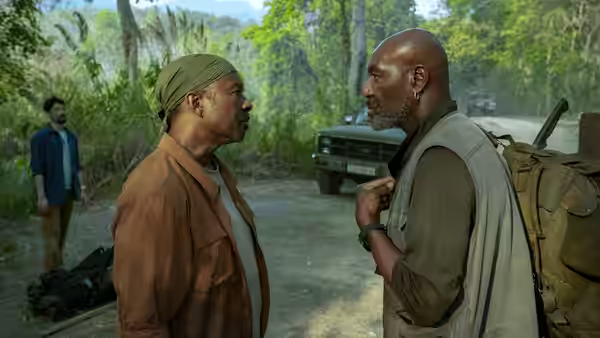
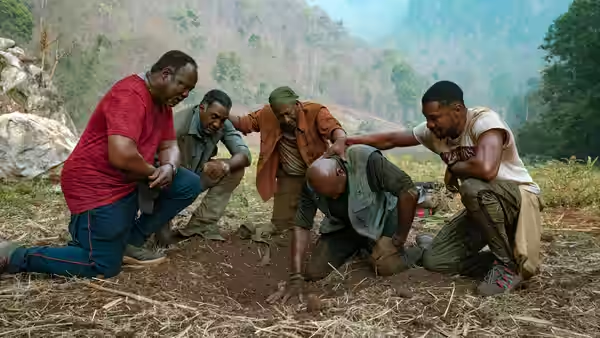
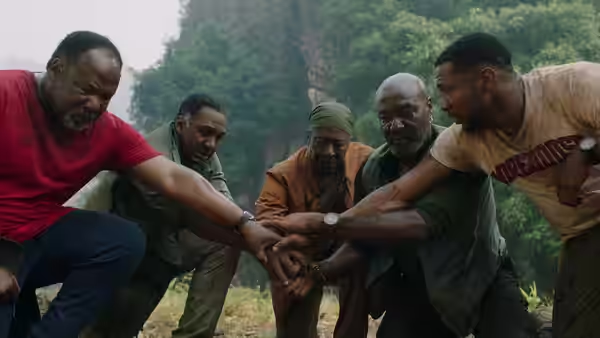
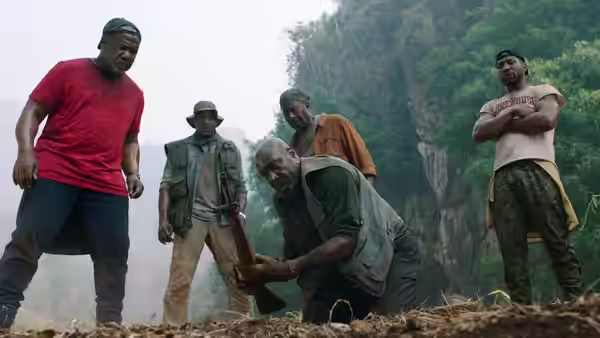
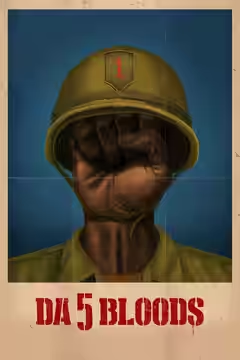
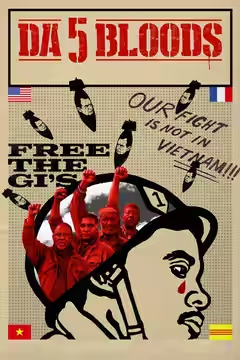
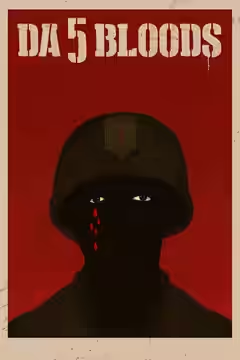
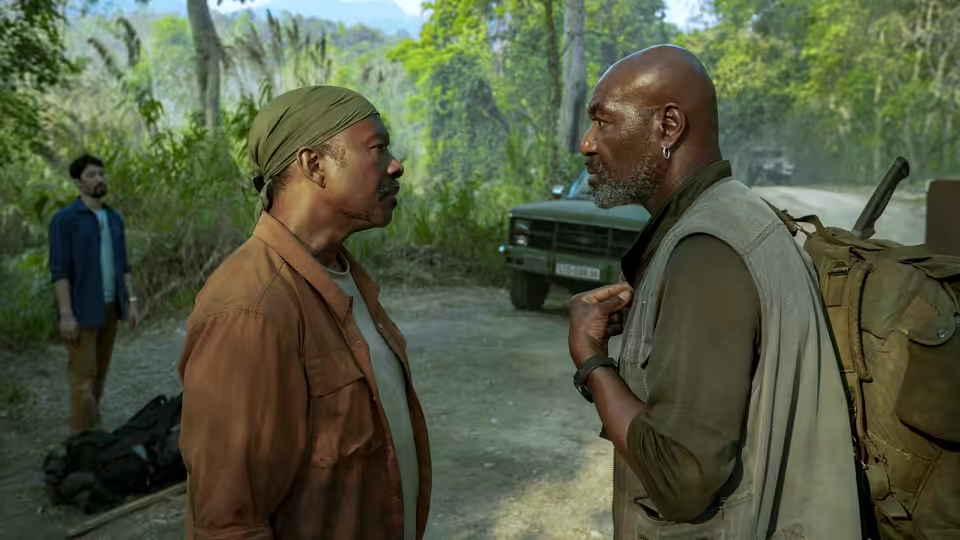
Paul (Delroy Lindo) faces Otis (Clarke Peters) beside a parked truck in the jungle
Film review

Da 5 Bloods

2020 · Directed by Spike Lee · 2h 35m

In a sentenceFour old soldiers, one MAGA hat, a jungle full of gold, and Delroy Lindo walking off with all of it

Four Black Vietnam veterans meet in a Ho Chi Minh City hotel lobby, decades after they last saw the country. Paul (Delroy Lindo), Otis (Clarke Peters), Eddie (Norm Lewis) and Melvin (Isiah Whitlock Jr.) have come back to find the remains of their squad leader, killed in action, and to dig up something else they left behind: a crate of gold bars they buried near where he fell. Paul, who wears a red MAGA cap and sleeps badly, is furious when his son David (Jonathan Majors) turns up uninvited and insists on coming. Otis looks up an old lover, Tiên Luu (Lê Y Lan), who knows someone who can move the gold quietly. A guide, Vinh Tran (Johnny Tri Nguyen), takes them upriver into the jungle.

Plays from YouTube when you press play; nothing loads from them until then.

Fi1m review

Spike Lee sends four Black veterans back to Vietnam for buried gold and a dead friend, and cannot decide whether he is making a heist film, a war film or a lecture. Delroy Lindo holds all three together, just, for 155 minutes.

Spike Lee has made a film about four Black veterans going back to Vietnam, and he has tried to make four films at once. A reunion picture: old men in a hotel bar, ribbing each other about their knees. A treasure hunt, with a buried crate of gold bars and a fixer to launder them. A war film, shot in flashback. And a history lecture, cut in as archive footage, beginning with Muhammad Ali explaining why he would not go. All four are in there for 155 minutes. Two of them are good.

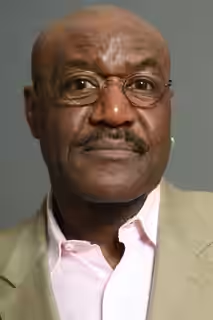
It is worth your evening, and the reason is Delroy Lindo. Paul is the one who came home angriest and stayed that way: a widower who wears a red MAGA cap around Ho Chi Minh City and dares anyone to mention it, and who cannot forgive his son David (Jonathan Majors) for turning up. Lindo plays him loud from the first scene and we braced for two and a half hours of shouting. It is not that. The moment that got at us is early and small: Paul at the floating market, screaming at a hawker over a chicken, and then the look on Lindo’s face when he sees the others staring at him. We were shaken, because we had been laughing at the man a minute before. We kept our distance from Paul for most of the film, and Lindo took hold of us anyway.

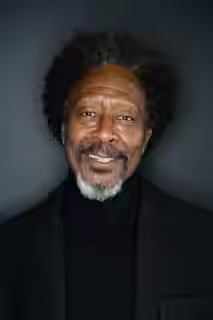
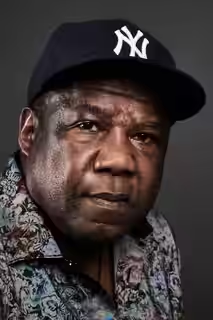
The others get less and use it. Clarke Peters is the quiet centre as Otis, the medic who arranged the trip and has a reason of his own in Tiên Luu (Lê Y Lan), the woman he left behind. Norm Lewis and Isiah Whitlock Jr. do the reunion comedy, and Whitlock gets the biggest laugh with one drawn-out word. The fifth Blood, their squad leader, appears only in flashback, and here Lee makes his best decision. Newton Thomas Sigel shoots the war in grainy, near-square 16mm, and the four old men play their young selves with no de-ageing at all: grey hair, bellies, reading glasses in a jungle. It sounds like a budget compromise and it is the truest thing in the film. They remember themselves as they are now, and him as he always was.

Present-day Vietnam is shot wide and bright, and Wynn Thomas’s production design gives us a country that has turned the war into a tourist trade: a bar called Apocalypse Now, a floating market, a hawker trying to sell the veterans a live chicken. Donna Berwick puts the four in the linen and cargo shorts of men with money for once, with Paul’s cap the only colour that matters. Lee quotes Apocalypse Now (1979) openly, Wagner on the river included, and the joke is that these men have seen it too. Terence Blanchard’s score is the trouble. Brass and strings rise under nearly every scene until we stopped hearing them. When Lee drops it for Marvin Gaye, the film breathes.

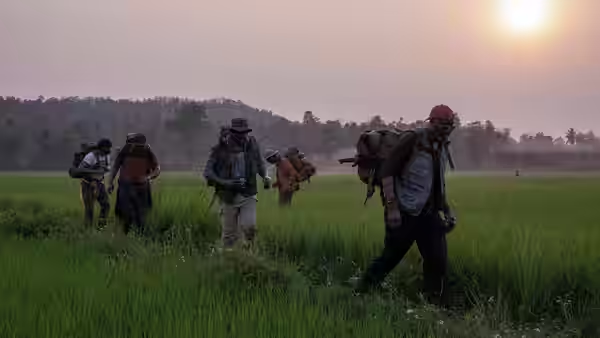
Then the shovels come out. The second half takes a turn we will not describe, except to say that it has more guns in it than the first, and that Mélanie Thierry, Paul Walter Hauser and Jasper Pääkkönen, as landmine-clearers the veterans meet in a bar, seem to have walked in from another script. The landmine scene itself is superbly done; Adam Gough cuts it slowly, on feet and faces, and we did not breathe. The shootouts are flat, the Vietnamese characters get one trait each, and Thierry’s Hedy is there to be looked at and then to be brave. Around the two-hour mark we were bored, and then irritated at being bored by a film with this much in it.

We are in two minds about the archive inserts. The cutaways to Ali, to Malcolm X, to photographs of Black soldiers who did not come home, are what Lee did in BlacKkKlansman (2018), and they land hardest when they interrupt a joke. Too often they interrupt a scene that was already making the point. Four writers, Lee, Kevin Willmott, Danny Bilson and Paul De Meo, means there is always another point to make. Do the Right Thing (1989) said as much in one hot day on one street.

See it, for Lindo and for the flashbacks, and give it the whole evening in one sitting. It is half an hour too long, and nearly all of that half hour is in the jungle. Lindo’s face is still with us a week later. So, less happily, is the score.
Critical consensus AI synthesised

76
Positive
24
Mixed
5
Negative
1

Most critics come away impressed, and the praise clusters in one place. Delroy Lindo’s performance as Paul is singled out by review after review, his late monologue named repeatedly as the moment the film earns its ambition. Beyond him, the reviews warm to the camaraderie of the veterans, to the archival footage Lee uses to tie American imperialism to racism at home, and to the flashbacks played by the older actors without de-aging. The words that recur are urgent, fierce and forceful.

The reservations recur almost as reliably. Many find the film overstuffed and uneven in tone, its treasure hunt sagging and its second half drifting towards action clichés; a few note that the women and the Vietnamese characters are thinly drawn. The spread is wide, from full marks to one outright dismissal. The AV Club finds the politics muddled rather than merely messy, and Eye for Film, the lowest notice and the latest, thinks the surplus of subplots leaves it short of its potential.

Evening Standard
12 June 2020 · ★★★★★ · Charlotte O'Sullivan
100

O’Sullivan gives the film a strong endorsement, saying it makes her yearn to be in a packed cinema. She particularly praises Delroy Lindo’s raw, compelling performance as Paul and Jonathan Majors’s crucial contribution to the ending.

Read the full review →
The New Yorker
13 June 2020 · Richard Brody
95*

Brody sees the film as a powerful, politically resonant reworking of Black veterans’ Vietnam experiences and their lasting impact. He especially praises Delroy Lindo’s performance, describing its emotional force and Shakespearean grandeur.

Read the full review →
Vulture
10 June 2020 · Bilge Ebiri
90*

Ebiri calls the film one of Spike Lee’s greatest works, praising its forceful blend of race, American history, and black patriotism. He singles out its humanizing treatment of complex characters and its sharp use of film-history references to challenge how war is depicted.

Read the full review →
RogerEbert.com
11 June 2020 · ★★★½/4 · Brian Tallerico
88

Tallerico finds the film sprawling but powerful, with Spike Lee bringing urgency to its treatment of race and war. He particularly singles out Delroy Lindo’s performance for its force.

Read the full review →
The Guardian
10 June 2020 · Peter Bradshaw
85*

Bradshaw finds the film a wildly inventive, emotionally powerful work, despite its deliberately unsettled mix of tones. He especially praises its final outpouring of sadness, grief and determination.

Read the full review →
The Hollywood Reporter
10 June 2020 · David Rooney
83*

Rooney finds the film sprawling and structurally flawed but timely, frequently brilliant, and ultimately affecting. He particularly praises Delroy Lindo’s mesmerizing performance and the ensemble’s vivid camaraderie.

Read the full review →

Straight answers AI written, from our review

Is Da 5 Bloods worth watching?
Da 5 Bloods is worth watching, and we scored it 72, chiefly for Delroy Lindo as Paul and for the grainy 16mm flashbacks in which four old men play their young selves without de-ageing. It runs 155 minutes, tries to be a reunion picture, a heist, a war film and a history lecture at once, and sags badly in the jungle half.
How long is Da 5 Bloods, and what is it rated?
Da 5 Bloods runs 2h 35m. It is a war and drama film.
Where can I watch Da 5 Bloods in Ecuador?
Da 5 Bloods is streaming on Netflix in Ecuador. Availability is checked daily; the links above go straight to each service.
How violent or frightening is Da 5 Bloods, and is it suitable for children?
Da 5 Bloods has no UK certificate but carries an R in the US, and it is a film for adults rather than children. The second half brings out guns and shootouts, there is a tense landmine sequence, and the archive footage and Paul's fury deal with war and race in plain, angry terms. Teenagers who can take that will manage; younger children should not.
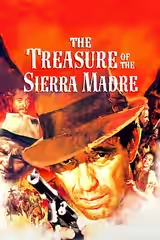
How does Da 5 Bloods compare to The Treasure of the Sierra Madre?
Da 5 Bloods openly borrows its gold-hunt from The Treasure of the Sierra Madre, with Delroy Lindo taking the Bogart role of the man who comes apart, but John Huston's film is the tighter and better of the two. Huston keeps his story on greed and its excuses; Lee adds Vietnam, a reunion comedy and a history lecture, and loses half an hour to them.
What should I watch after Da 5 Bloods?
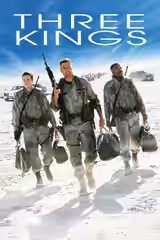
After Da 5 Bloods, try The Treasure of the Sierra Madre (1948, Fi1m 88): The gold-hunt Lee is quoting, with Bogart doing the coming apart. Then Apocalypse Now (1979, Fi1m 92): The river, the Wagner and the bar were all borrowed from here; and Three Kings (1999, Fi1m 80): Soldiers, stolen gold and a war that will not stay in the background.

Cast

Awards

Academy Awards, 2021

Nominated
Best Original Score

National Board of Review Award for Best Film, 2020

Won
National Board of Review Award for Best Film

If you liked this, try…

  1. The Treasure of the Sierra Madre (1948, Fi1m 88)The gold-hunt Lee is quoting, with Bogart doing the coming apart.

  2. Apocalypse Now (1979, Fi1m 92)The river, the Wagner and the bar were all borrowed from here.

  3. Dead Presidents (1995) · not on Fi1m yetA Black Vietnam veteran comes home to nothing and plans a robbery.

  4. Three Kings (1999, Fi1m 80)Soldiers, stolen gold and a war that will not stay in the background.

  5. Cyclo (1995, Fi1m 66)Ho Chi Minh City from the inside, on a bicycle, with no Americans in sight.