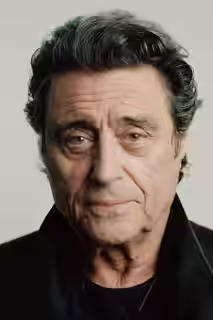
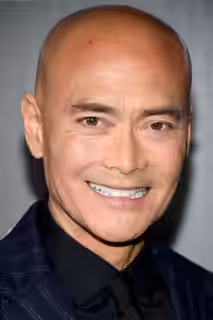
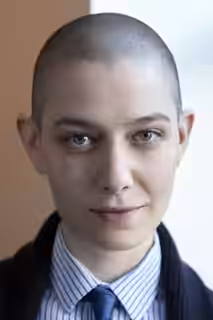
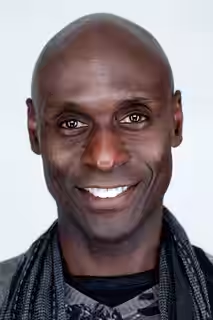
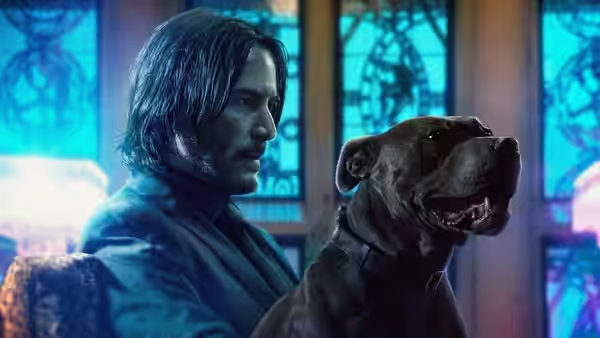
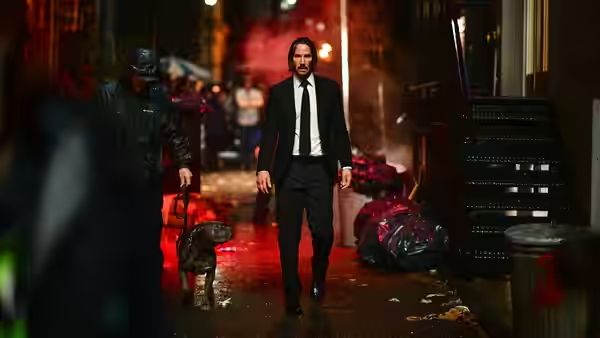
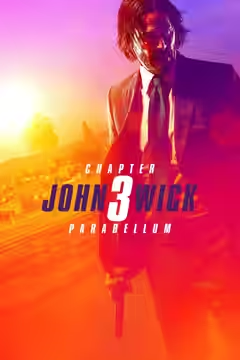
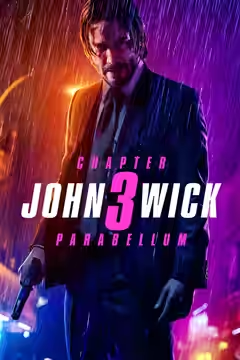
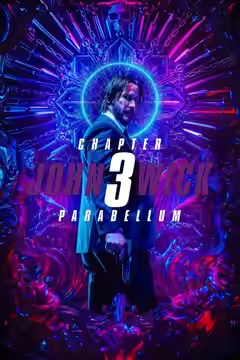
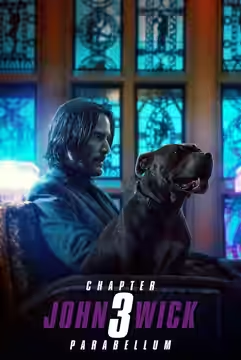
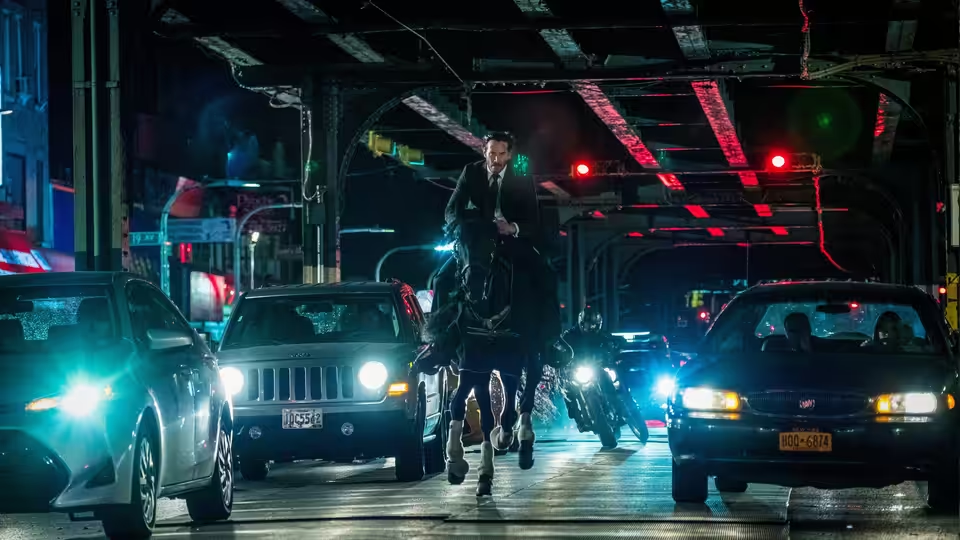
A scene from John Wick: Chapter 3 - Parabellum
Film review

John Wick: Chapter 3 - Parabellum

2019 · Directed by Chad Stahelski · 2h 11m

In a sentenceKeanu Reeves kills a man with a library book in the first quarter-hour; the rest is the film trying to top it

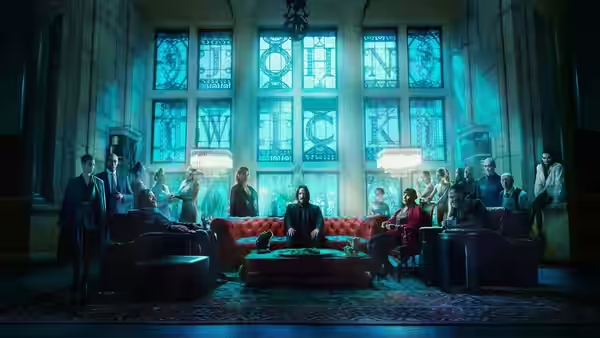
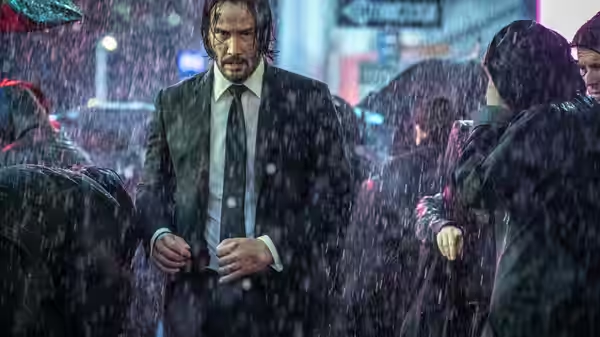
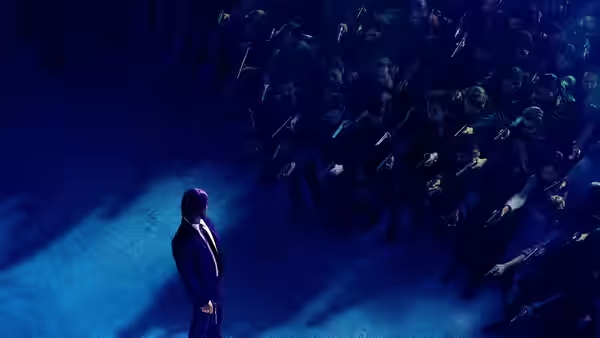
New York, at night, in the rain. John Wick (Keanu Reeves) has broken the one rule of his world by killing a man on the grounds of the Continental hotel, and its manager, Winston (Ian McShane), has given him an hour’s grace before he is declared excommunicado and a fourteen-million-dollar bounty goes live to every assassin with a phone. John needs to get out of the city, and to do it he calls in old debts: with the Director (Anjelica Huston), and with Sofia (Halle Berry). Behind him, an Adjudicator (Asia Kate Dillon) from the High Table arrives to punish everyone who helped him, Winston and the Bowery King (Laurence Fishburne) included.

Plays from YouTube when you press play; nothing loads from them until then.

Fi1m review

Chad Stahelski’s third John Wick film is the best-staged action of the series and also the longest, and those two facts are related. Come for the knives, the horse and the dogs; the mythology and the Moroccan desert you will have to sit through.

John Wick: Chapter 3 – Parabellum starts minutes after Chapter 2 ended and does not stop for a while. John Wick (Keanu Reeves) has killed a man inside the Continental, the New York hotel where assassins are forbidden to kill anyone, and the price is a bounty on his head and an hour’s head start. The whole of the first act is that hour. Chad Stahelski, a former stunt coordinator, has built the series on the belief that a fight is worth filming properly, and this is the film where he has the most money and the fewest excuses. It is the best-staged of the three and the longest, and we enjoyed it a great deal until we began to notice how long it was.

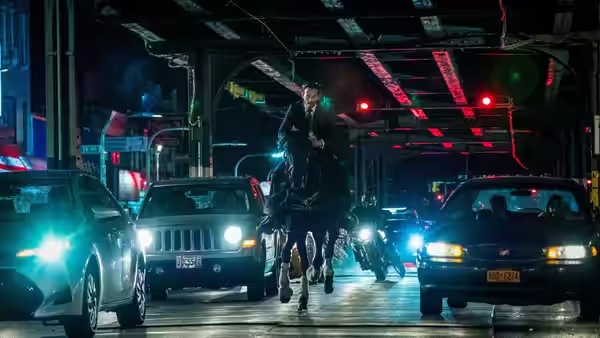
The fights are the point, and they are remarkable. Wick kills a giant in the New York Public Library with a hardback. He fights his way through an antiques shop whose display cases are full of knives, and the scene becomes a throwing contest, blades bouncing off glass and lodging in people. He escapes on a horse and has it kick a pursuer in the chest. We laughed out loud at the horse, winced at what the knives did, and then felt slightly ashamed of ourselves, which we suspect is exactly what Stahelski wanted. Each fight has its own rules: a room, an object, a problem to be solved with the body. Nothing is cut so fast that you lose track of who hit whom.

Dan Laustsen shoots New York as a wet city of blue and gold neon, so every puddle carries a second set of lights, then moves to the ochre of Casablanca and the white glare of the desert. Kevin Kavanaugh’s production design supplies the furniture of Wick’s world: the Continental’s brass and marble, the antiques shop, the library stacks. Evan Schiff holds shots long enough for the choreography to register and cuts on the pause rather than the punch, which is why you can follow the fights rather than merely hear them. Tyler Bates and Joel J. Richard provide a low electronic thud that rises and falls with the bodies and gets out of the way when it should.

Reeves says perhaps two hundred words in 131 minutes, a good number of them “yeah”, and it does not matter. He plays Wick as a man tired to the bone who keeps going because stopping is worse, and his stiff, heavy way of moving has become the character. Ian McShane’s Winston is all raised eyebrow and Lance Reddick’s Charon is courtesy with a shotgun. Laurence Fishburne is given more speeches than he needs. Asia Kate Dillon plays the Adjudicator with a bureaucrat’s calm, and Mark Dacascos is the film’s best addition: Zero, a sushi chef turned assassin who is thrilled to be fighting his hero and says so mid-fight. Halle Berry’s Sofia gets one long sequence in Casablanca with two dogs who do more damage than she does.

The trouble is everything between the fights. Four credited screenwriters have thickened the mythology of the High Table with markers, oaths and an Elder in the desert, and none of it gives the violence anything to be about. The Casablanca stretch, which most critics have also flagged, brings the film to a halt for a long walk through sand and a lot of talk about fealty. Wick is thrown off buildings and hit by cars and gets up; the first film’s man who felt every blow is now nearer a cartoon. At 131 minutes it is the longest of the series, and twenty minutes could go without anyone noticing.

Against the series, it is more inventive than Chapter 2 and less of a film than the first John Wick, which had a story, a dead dog and a sense of when to finish. Most critics have been a few points warmer than we are; the difference is how much repetition one can take, and we found our limit around the ninetieth minute. Against the wider genre it sits comfortably beside the Indonesian and Hong Kong pictures it borrows from, and it is a good deal more coherent than most American action films of its size.

See it for the antiques shop, the horse and the dogs, and see it with someone who will not mind you laughing at violence. It is made by people who love the work of fighting, and the plot is slight because they know it is not why you came.
Critical consensus AI synthesised

76
Positive
17
Mixed
5
Negative
0

Most critics like it, and they like it for the same reason: the fighting. Nearly every review singles out the action choreography and Chad Stahelski’s staging, with the antiques-shop knife fight, the glass-walled offices, the horses and the dogs named as the set pieces that earn the ticket. Keanu Reeves is generally credited with holding it together, tired-looking and sincere. Several reviews also welcome the expanded mythology, though mostly as a bonus rather than the draw.

The reservations cluster around length and repetition. Variety and Collider find the mayhem hollow without stakes or character to attach it to; The Times feels the film-makers run out of puff by the final act, and The Independent finds the violence one-note. The Casablanca stretch with Halle Berry divides opinion: The Guardian calls it the weakest section while Radio Times enjoys it. The spread is narrow, with no outright negative reviews; the sharpest dissent comes from The New Yorker, which finds the extended fights numbing.

The Guardian
18 May 2019 · Peter Bradshaw
90*

The third instalment overwhelms with opulent martial arts set pieces and a riotous, relentless aesthetic of hi-tech baroque spectacle. It makes an art of pain in a curiously life-affirming way, though the Casablanca segment with Halle Berry is the weakest.

Read the full review →
Empire
10 May 2019 · Nick de Semlyen
85*

The review lauds the gloriously raucous entry that deepens the mythology and delivers inventive, wince-inducing action sequences, singling out the magnificently orchestrated dust-ups and confident world-building for praise while noting the self-serious tone enhances the fun.

Read the full review →
Evening Standard
17 May 2019 · Matthew Norman
80*

The review praises the film as massively entertaining for viewers with a high tolerance for stylised lethal force, highlighting Chad Stahelski’s kinetic direction that turns gruesome action into something fluid and almost beautiful, along with Keanu Reeves’ gravitas.

Read the full review →
Film Comment
1 May 2019 · Michael Sragow
80*

The critic praises the sustained hyperbole, dark whimsy, and Chad Stahelski's direction of the action sequences, noting that Reeves convinces viewers Wick is worth rooting for through his mix of agility, shrewdness, and sincerity.

Read the full review →
Little White Lies
16 May 2019 · 4/4/3 · Matt Thrift
80

Praises the film's astonishing action set-pieces and staging while noting it remains a solid franchise entry despite being the longest and somewhat bloated by digressions.

Read the full review →
Los Angeles Times
15 May 2019 · Jen Yamato
80*

The critic notes the film bursts with sleek and squishy top-notch action and winking humor that breaks the characters out of genre bounds. She singles out the sublimely inventive close-quarters fights with the lethally graceful Reeves for praise.

Read the full review →

Straight answers AI written, from our review

Is John Wick: Chapter 3 - Parabellum worth watching?
John Wick: Chapter 3 – Parabellum is worth watching for anyone who wants two hours of the best-staged fights in the series, and we scored it 72. The library, the antiques shop and the horse are as good as American action gets; the High Table mythology and a long Casablanca stretch are what you sit through to reach them.
How long is John Wick: Chapter 3 - Parabellum, and what is it rated?
John Wick: Chapter 3 - Parabellum runs 2h 11m. It is an action and thriller film.
Where can I watch John Wick: Chapter 3 - Parabellum in Vietnam?
John Wick: Chapter 3 - Parabellum is not on any streaming or rental service in Vietnam at the moment. It is available in 42 other countries; change your country at the top of the page to see where. Availability is checked daily.
How violent or frightening is John Wick: Chapter 3 - Parabellum, and is it suitable for children?
John Wick: Chapter 3 – Parabellum is a 15 in the UK and R in the US, and the violence is constant, close and inventive, with knives, guns, dogs and a hardback all used to kill. It is not frightening in the horror sense, but it is far too bloody for children; it suits teenagers over fifteen and adults who can laugh at carnage.
How does John Wick: Chapter 3 - Parabellum compare to John Wick: Chapter 2?
John Wick: Chapter 3 – Parabellum is more inventive than John Wick: Chapter 2 and longer, and the two facts are related. Its fights have more ideas in them, each built around a room and an object, but its mythology is thicker and its Casablanca detour slower. Choose it for the set pieces; the earlier film is the leaner watch.
Do you need to have seen the other John Wick films before John Wick: Chapter 3 - Parabellum?
John Wick: Chapter 3 – Parabellum begins minutes after Chapter 2 ends and assumes you know why John is being hunted, so it is not a good place to start. The fights make sense on their own, but the hotel rules, the bounty and the characters who help him mean far more if you have seen the first two films.
What should I watch after John Wick: Chapter 3 - Parabellum?
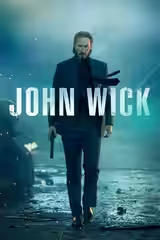
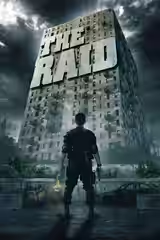
After John Wick: Chapter 3 - Parabellum, try John Wick (2014, Fi1m 80): Where it began: shorter, sadder, and every blow still hurts somebody. Then The Raid (2011, Fi1m 83): One tower block, one squad, and Indonesian fight choreography Stahelski plainly studied; and Hard Boiled (1992, Fi1m 86): John Woo’s hospital shoot-out is the long take every gunfight since has chased.
What order should I watch the John Wick films in?
Release order is the safe choice for John Wick, and it is the order our collection page lists them in. John Wick: Chapter 3 - Parabellum is number 3 of the 4 John Wick titles on Fi1m; before it comes John Wick: Chapter 2 and after it John Wick: Chapter 4. The full order.

Cast

If you liked this, try…

  1. John Wick (2014, Fi1m 80)Where it began: shorter, sadder, and every blow still hurts somebody.

  2. The Raid (2011, Fi1m 83)One tower block, one squad, and Indonesian fight choreography Stahelski plainly studied.

  3. Hard Boiled (1992, Fi1m 86)John Woo’s hospital shoot-out is the long take every gunfight since has chased.

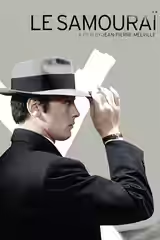
  4. Le Samouraï (1967, Fi1m 88)Alain Delon as the original silent killer in a hat, doing almost nothing.

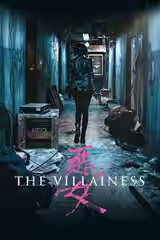
  5. The Villainess (2017) · not on Fi1m yetKorean revenge film whose opening corridor fight makes the library look polite.