Gareth Edwards stages dinosaurs with more patience and scale than the series has managed in years, and two long sequences are close to wonderful. David Koepp’s script sends people we barely know on an errand that runs out before the film does.
Seven films in, the series has hired a director who likes looking at large animals. Gareth Edwards made Monsters (2010), Godzilla (2014) and Rogue One (2016), and in each the camera sits low and waits for something enormous to fill the sky. Here he has a whole island of enormous things and a script by David Koepp, who wrote the first Jurassic Park in 1993. The dinosaurs are the best the series has had in years. The people are an errand.
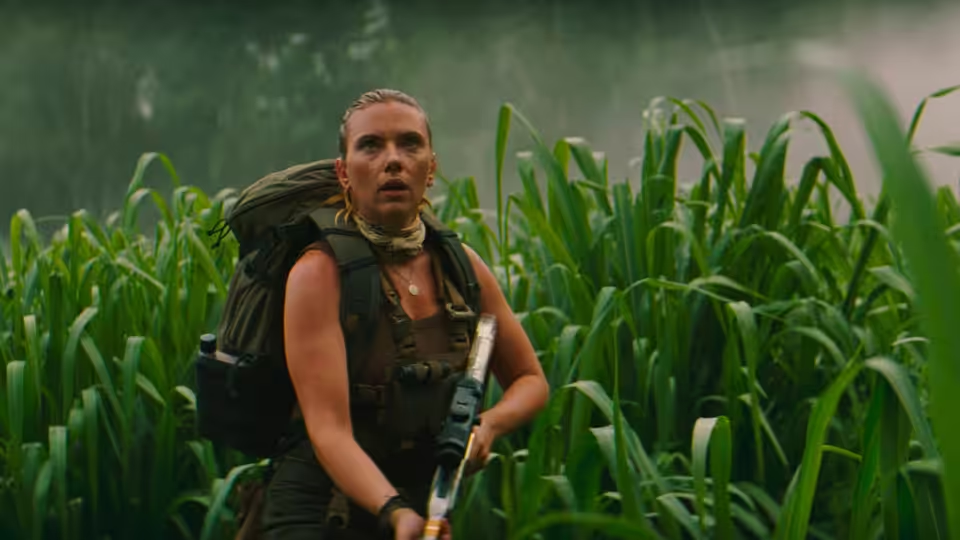
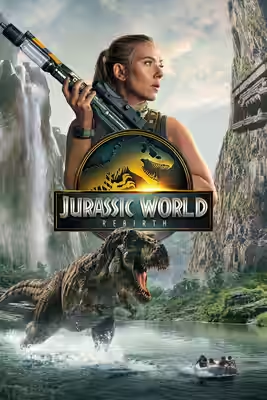
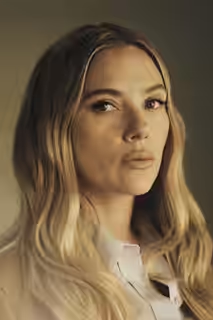
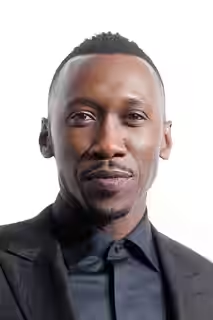
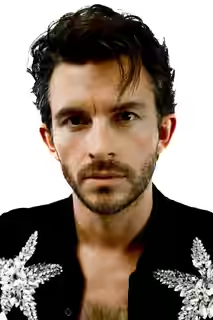
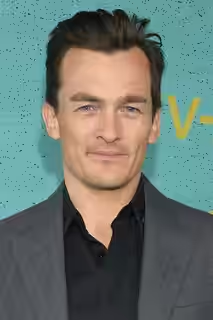
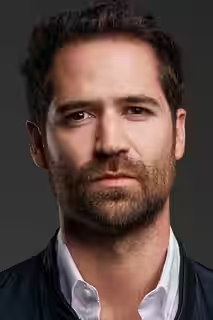
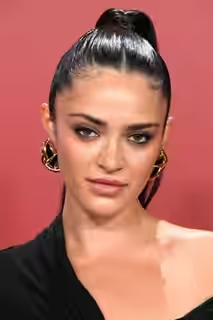
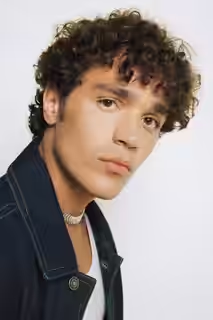
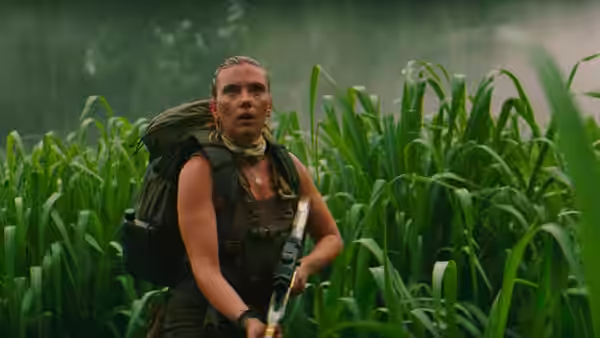
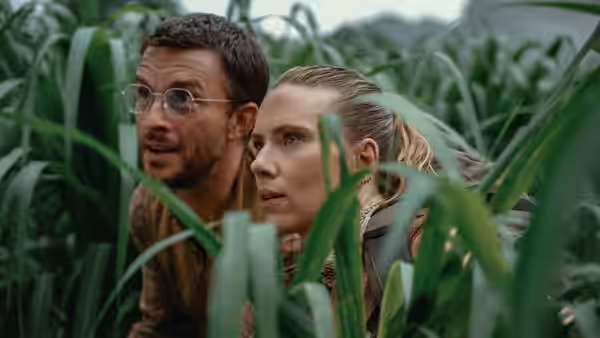
The errand is this. A pharmaceutical man, Martin Krebs (Rupert Friend), needs blood from three of the biggest animals left alive, one on land, one at sea and one in the air, and he hires Zora Bennett (Scarlett Johansson) to get it. She brings a boat captain, Duncan Kincaid (Mahershala Ali), and a palaeontologist, Henry Loomis (Jonathan Bailey), who has never seen a living specimen and would like to before the funding runs out. On the way they pick up the Delgados, a father (Manuel Garcia-Rulfo), two daughters (Luna Blaise, Audrina Miranda) and a boyfriend (David Iacono), whose sailing holiday has met something with a great many teeth. Three samples, three set pieces, 134 minutes.
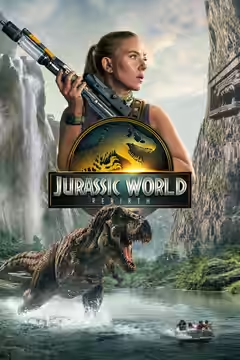
Two of those set pieces are as good as anything the series has done since the first film. The louder one is the river: an inflatable raft, a fast current, a family who cannot make much noise, and a tyrannosaur that has decided to come in after them. Edwards holds on the water and lets the thing arrive in its own time. Jabez Olssen cuts it slowly, with no more shots than the sequence needs, and John Mathieson keeps the light flat and grey so the animal is simply there, not lit for its close-up. We were tense in a way we had stopped expecting from a dinosaur film, and we kept looking for the join between the digital animal and the real water and never found it.
The quieter one is a valley. Loomis stands at the edge of it and watches a herd of long-necked animals move through the morning, and Alexandre Desplat, who has John Williams’s themes to hand, lets the old one in softly rather than at full volume. It moved us more than we had thought a seventh film could. The reason, on reflection, is Bailey, who plays the awe rather than explaining it; his face does the work the earlier films handed to speeches.
Koepp has written the rest of the people as job descriptions. Zora is a mercenary with a loss she mentions once and the film forgets; Kincaid has a loss of his own, produced when a scene needs weight. Johansson is dry and capable and could do this in her sleep, and the part more or less asks her to. Ali is warm with little to be warm about. Friend plays Krebs as the company man, and you know his whole arc from his first sentence, which is not his fault. Only Loomis is written with any pleasure, and it shows.
There is also the matter of the title, which promises a new era and delivers a mutant. The film opens in an old laboratory where an experiment has gone wrong, and what came of it we will leave the film to show you. James Clyne’s rotting station, jungle through every window, is the best thing about that whole strand. In the final stretch we were checking our watch, and a little cross about it, because the river had shown us the film knew better.
Set against the series, this is a clear improvement in one department. The last few entries had stopped being interested in the animals as animals; Edwards is interested in almost nothing else, and it shows in every wide shot. What he has not been given is anyone to stand in front of them worth caring about, and Koepp, of all people, ought to know that the first film worked because it had both.
See it on the largest screen you can find, for the river and the valley, and forgive it the last half hour. At home it shrinks to a competent adventure with two good bits, which is not the worst way to spend 134 minutes. It carries a 12A, and the tyrannosaur earns it.