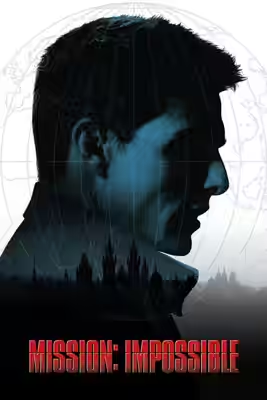
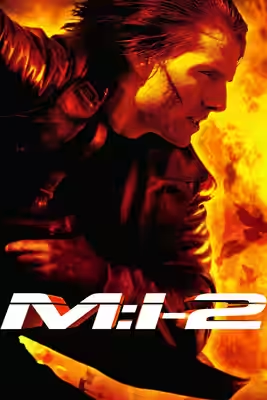
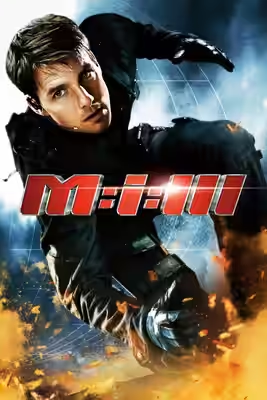
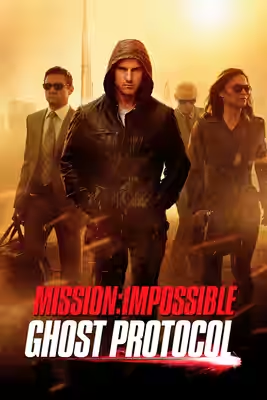
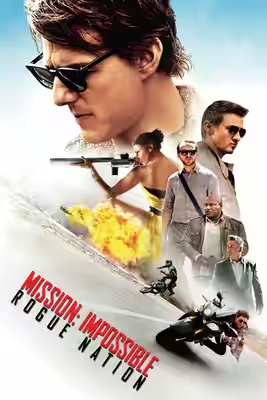
Christopher McQuarrie’s eighth Mission: Impossible has two set pieces, one under the sea and one in the air, as good as any the series has produced. It also has an hour of people explaining the plot to each other before either arrives.
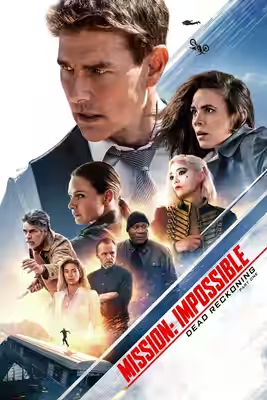
The eighth Mission: Impossible picks up where Dead Reckoning Part One (2023) left off. A rogue artificial intelligence, the Entity, has got into the world’s networks and is working its way towards the nuclear ones. Ethan Hunt (Around Cruise) holds the key to the only copy of its source code, which lies inside a sunken submarine, and Gabriel (Esai Morales), the machine’s man on the ground, wants it as well. That is the whole story, and Christopher McQuarrie and his co-writer Erik Jendresen take an hour to tell it. When they finally stop, the film produces two of the best set pieces the series has managed. We came out glad we had stayed and wishing someone had cut the beginning in half.
The first hour is explaining. People stand in rooms and tell each other what the Entity is, what the key does, what Ethan did in the last film and in the seven before it. Eddie Hamilton cuts these briefings into fragments: a line, a close-up of a hand, a flashback to a face from an earlier film, another line. It turns every plan into a list read aloud with the pictures changing every second, and it makes the plan harder to follow. Holt McCallany’s Serling, Janet McTeer’s Walters and Nick Offerman’s General Sidney exist largely to tell Ethan that he is the only man alive who can do this. By the fourth time we had started counting. By the sixth we were bored, and cross about being bored by people we have liked for nearly thirty years.
Then Ethan goes into the water and the film wakes up. Gary Freeman builds the wreck as a real place, a hull lying at an angle on the seabed with everything inside it loose, so that when it shifts, everything in the scene shifts with it. Fraser Taggart lights it with almost nothing, the beam of a torch and grey-green murk beyond, and the frame is often mostly dark with one man somewhere in it. There is no dialogue for a long stretch, because there is nobody to talk to. At one point we noticed we had been holding our breath along with him. It is an old trick and it worked on us completely.
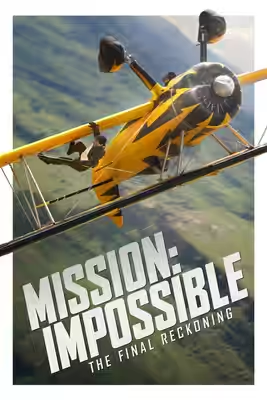
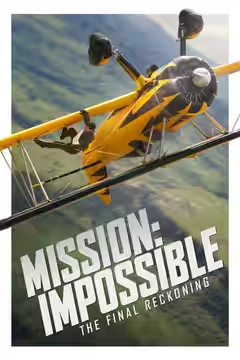
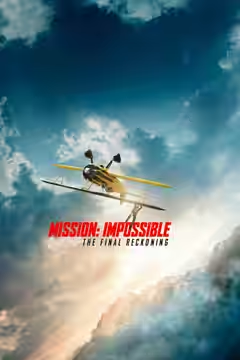
The biplane climax is the other reason to see it. Cruise hangs off the wing of an aeroplane in open air and the camera stays with him, close enough to see the wind pull his face out of shape. The sequence goes on longer than it needs to, as everything here does, and we did not mind.
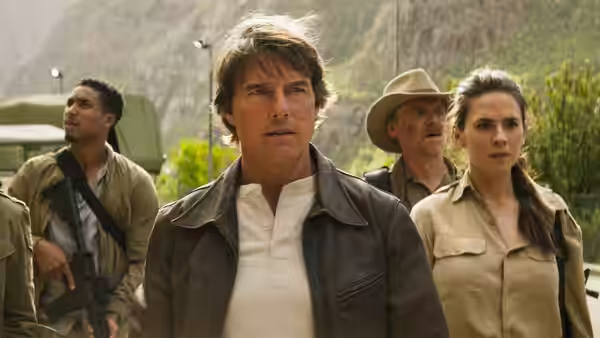
Around Cruise the cast does what it can. Simon Pegg’s Benji has grown into the field agent he once pretended to be, and Pegg gets the few jokes there are. Hayley Atwell’s Grace, the thief from the last film, is now a team member, and she was better company when she was robbing them. Ving Rhames’s Luther gets a long speech about our lives being the sum of our choices, and the film believes every word. Henry Czerny’s Kittridge, back from the 1996 original, is the one man in a suit who seems to be enjoying himself. Tramell Tillman’s Captain Bledsoe, commanding a submarine, delivers naval jargon as if he had written it, and we would happily have followed him instead. Gabriel is the weak point. Esai Morales spent the last film as a threat glimpsed in doorways; here he is asked to carry whole scenes and stand for the Entity’s intentions, and the script has not given him any of his own.
Godfrey and Aruj, who share the music credit, arrange the old theme in slow, reverent strings whenever the film wants us to feel the weight of history, which is often, and let it run at proper speed only when something is actually moving. Jill Taylor puts the government people in near-identical dark suits, which may be a joke about them.
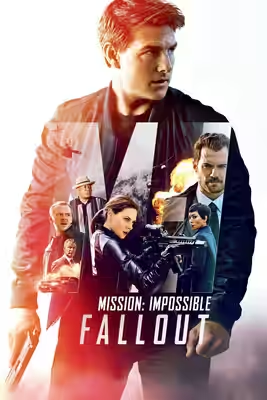
Against the series’ own standard this is a middle entry with two great peaks. Fallout (2018), by the same director, was moving from its first minute; here McQuarrie seems to have decided that a finale must be solemn, and solemnity is the one thing these films never needed. It runs 170 minutes and carries a 12A. See it in a cinema, where the water is darker and the wind louder, and take something to read for the first hour. The film will not notice.