Film review

Mission: Impossible III

2006 · Directed by J.J. Abrams · 2h 06m · MPA PG-13

In a sentencePhilip Seymour Hoffman counts to ten and a franchise this expensive looks, for once, frightened

AdventureActionThriller

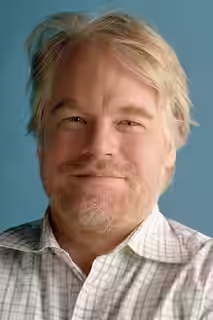
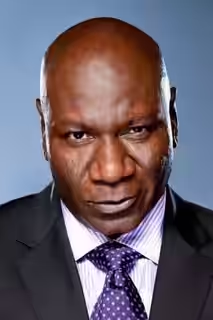
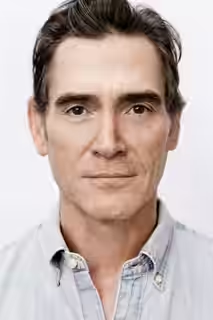
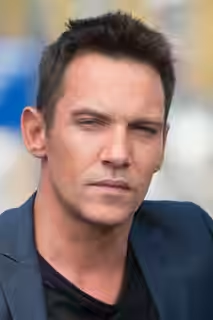
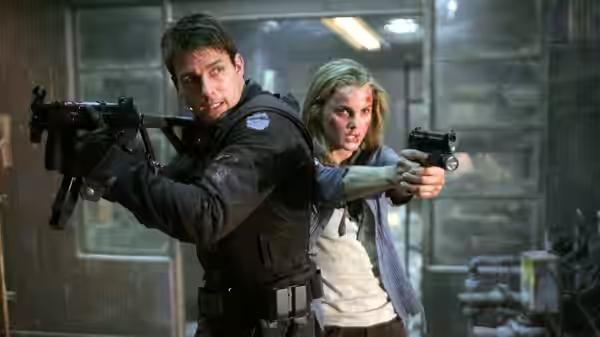
Ethan Hunt (Tom Cruise) has left fieldwork to train recruits for the Impossible Missions Force and is about to marry Julia (Michelle Monaghan), a nurse who has no idea what he does. At their engagement party his handler Musgrave (Billy Crudup) tells him that Lindsey Farris (Keri Russell), the agent he trained, has been captured in Berlin by men working for the arms dealer Owen Davian (Philip Seymour Hoffman). Hunt takes a team, Luther (Ving Rhames), Declan (Jonathan Rhys Meyers) and Zhen (Maggie Q), into a Berlin factory to get her out. The rescue goes wrong, and Hunt turns his attention to Davian himself, a trader in weapons who is about to sell something called the Rabbit’s Foot.

Plays from YouTube when you press play; nothing loads from them until then.

Fi1m review

J.J. Abrams’s first film is the fastest of the three, with a bridge sequence that had us ducking and, in Philip Seymour Hoffman, a villain who never raises his voice. Underneath, the plot is television, and the object everyone chases is never explained.

J.J. Abrams had never directed a film when Tom Cruise handed him this one. The third Mission: Impossible moves faster than either of its predecessors and has a villain who could frighten a room by clearing his throat. It also has a plot that would not detain a Tuesday-night television audience, built round an object the script refuses to explain. We enjoyed it a great deal.

Ethan Hunt (Cruise) has stepped back from the field to train recruits and is engaged to Julia (Michelle Monaghan), a nurse who believes he works in traffic. At his engagement party Musgrave (Billy Crudup) arrives to say that Lindsey Farris (Keri Russell), Hunt’s protégée, has been taken in Berlin by people working for the arms dealer Owen Davian (Philip Seymour Hoffman). Hunt goes, with Luther (Ving Rhames), Declan (Jonathan Rhys Meyers) and Zhen (Maggie Q), and the rescue does not go cleanly.

Hoffman is the reason to watch. He plays Davian soft and bored, a heavy man in a good suit who does not raise his voice because he has never needed to. The film opens with him counting to ten over a bound and bleeding Hunt, and we felt something we do not often feel in this series: real fear that he would reach ten. He never plays the villain’s pleasure; he plays a man doing accounts. Cruise looks smaller in every scene they share, and the film uses that.

The action is the other reason. The best is on a bridge over Chesapeake Bay, where a convoy is hit from the air and Hunt, knocked flat by one missile, gets up and runs at the camera while another comes in. Dan Mindel shoots it handheld in hard afternoon light, the sun flaring into the lens and the frame shaking with every impact, and Mary Jo Markey and Maryann Brandon cut it so that we always know where the drone is, where Hunt is, and how far apart they are. We ducked. Michael Giacchino keeps the old Lalo Schifrin theme in the brass and lets it loose only when the running starts. Scott Chambliss builds a Vatican for a heist with a cassock and a mask made in the back of a van, and Colleen Atwood gives Davian the best suits in the film.

The trouble is everything the running is for. The object everyone wants is called the Rabbit’s Foot, and nobody in the film knows what it is. Simon Pegg’s Benji, a lab technician, has a theory involving the end of the world; the script offers it as a joke and then asks us to care about the thing for another hour. We laughed at the joke and then felt slightly cheated, because a thriller that will not say what is at stake has decided the stakes do not matter. The agency politics, Laurence Fishburne’s Brassel barking and Crudup smoothing, run a course anyone who watched Abrams’s Alias will have mapped by the half-hour.

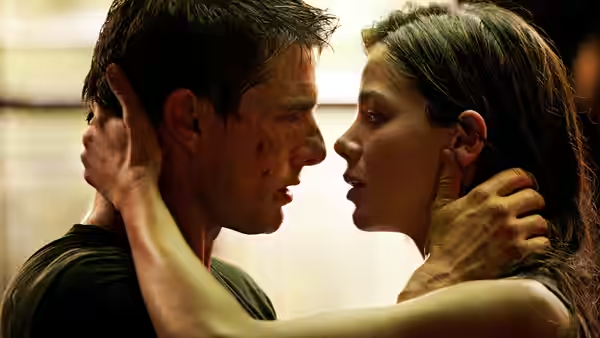
Julia is the film’s attempt at a heart, and Monaghan does what she can with a smile and a hospital corridor. The idea, that Hunt has something to lose this time, is stated at the engagement party, stated again in a lift, and then set aside until the plot needs it. Cruise is at his best sprinting, sweating, hanging from the side of a Shanghai tower on a rope. He is less convincing when asked to stand still and feel things, and Abrams, Roberto Orci and Alex Kurtzman write him a good deal of standing still.

Set against the series, this is the one that runs. Brian De Palma’s 1996 film was a puzzle; John Woo’s 2000 sequel was a pose. Abrams makes a chase, which is what the title promised. It runs 126 minutes and carries a 12A. The reasons to see it are Hoffman and the bridge. As for what the Rabbit’s Foot is, nobody knows, and the film has no intention of finding out.

Critical consensus AI synthesised

62
Positive
9
Mixed
6
Negative
4

Most critics come down in favour, though without much heat. Nine of the nineteen reviews are positive, and the praise gathers in two places: Philip Seymour Hoffman’s villain, described as chilling, single-minded and a stronger presence than Cruise, and the set pieces, the Chesapeake bridge attack and the Shanghai sequence among them. Abrams is credited with a leaner, faster film than the second entry, and several reviews welcome the attempt to give Hunt a private life.

The reservations gather around the plot, which even admirers call flimsy or contrived, and around Abrams’s television background, which some see as a virtue of pace and others as a lack of stamina for a full-length film. The spread is wide, from warm reappraisals written years later to outright dismissals. The Guardian stands alone in finding Hoffman uncharismatic, The Independent calls Abrams a hack, and The New York Times objects to the maudlin romance.

Little White Lies
29 July 2015 · David Ehrlich
85*

Hoffman's Owen Davian is the highlight as a terrifyingly single-minded villain who strips Hunt of his personal life and identity, making this the pinnacle of the series through a stripped-down approach. Abrams understands that less can be more in crafting one of the most engaging mega-budget action films in years.

Read the full review →
The AV Club
3 May 2006 · B+ · Keith Phipps
83

The critic finds the film a strong directorial debut for Abrams that blends personal stakes and drama with globe-trotting action and intrigue in the style of his TV work like Alias. Hoffman’s chilling villain and the visceral set pieces stand out as highlights in an otherwise formulaic but well-executed summer blockbuster.

Read the full review →
Total Film
4 May 2006
80*

Abrams brings a lean, urgent, no-flab style that meshes perfectly with Cruise’s energy for a breathless, pummelling action machine that improves on prior entries and stands as the best of the trilogy.

Read the full review →
Empire
29 April 2006 · Ian Nathan
70*

Mission 3 is a step ahead of its predecessors with cracking sequences, gadgetry and personal stakes, but remains a ragged whole of contrived plotting and predictable closure despite urgent pacing and strong set pieces.

Read the full review →
Los Angeles Times
5 May 2006 · Kenneth Turan
70*

The film plays like two consecutive one-hour TV shows, one standard and the other stocked with excitement, with the second hour ramping up involvement. Hoffman's picture-making villain performance raises the tension and overmatches Cruise.

Read the full review →
Screen Daily
3 May 2006
70*

The film returns the franchise to its TV origins as a frenetic, fast-paced and engaging blockbuster directed by small-screen icon JJ Abrams. It lacks the cinematic grandeur of its predecessors but delivers slick, TV-style treatment of emotional elements like Ethan's wife.

Read the full review →

Cast

If you liked this, try…