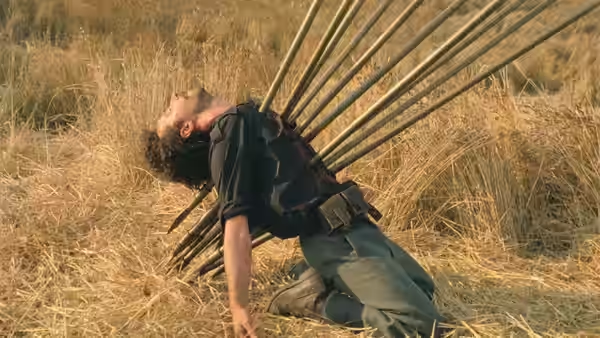
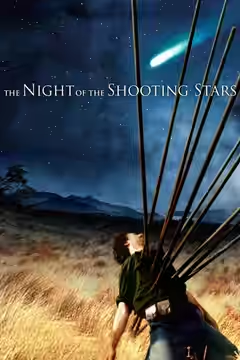
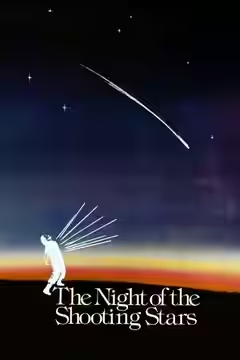
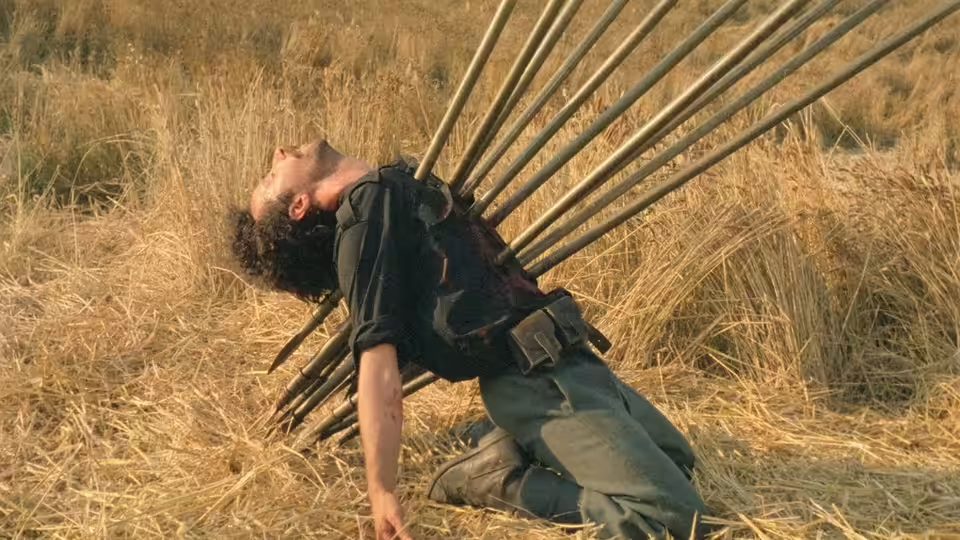
A man falls backward into dry grass with long poles jutting from his back
Film review

The Night of the Shooting Stars

1982 · Directed by Paolo Taviani, Vittorio Taviani · 1h 45m

In a sentenceHalf a village walks out into the wheat at night to find the Americans; the other half stays behind and prays

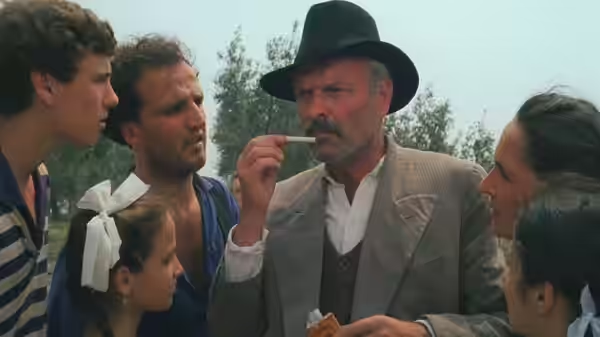
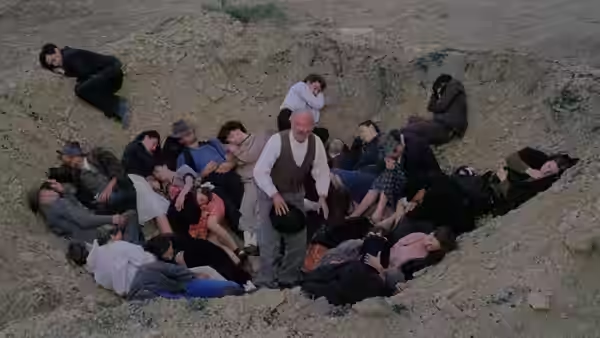
A Tuscan hill town, August 1944. The Germans, retreating north, have ordered everyone into the cathedral and will blow up the houses behind them. The Bishop (Giorgio Naddi) tells his flock to obey. Galvano (Omero Antonutti), a farmer never put in charge of anything, thinks otherwise, and at night leads those who will follow him out of the town and across country to find the Americans. Among them are Concetta (Margarita Lozano), whom Galvano has loved from a distance for most of his life; Corrado (Claudio Bigagli) and Belindia (Miriam Guidelli), married in a hurry the evening before because she is pregnant; and six-year-old Cecilia (Micol Guidelli), whose grown-up voice tells the story years later to her own child on the night of San Lorenzo, when shooting stars grant wishes.

Plays from YouTube when you press play; nothing loads from them until then.

Fi1m review

The Taviani brothers tell a Tuscan village’s flight from the Germans in 1944 as a bedtime story, and it pays off. Funny, then abruptly not, and lit like a summer holiday, which makes the violence worse. See it.

The Night of the Shooting Stars is a war story handed to a child. A woman’s voice tells her infant what happened to her Tuscan town in August 1944, when she was six. Because the teller was a child, the story keeps a child’s shape. The grown-ups are enormous and slightly ridiculous, the danger never arrives when expected, and once or twice something impossible happens and nobody objects. Paolo and Vittorio Taviani wrote it with Tonino Guerra and their producer Giuliani G. De Negri, and it runs 105 minutes.

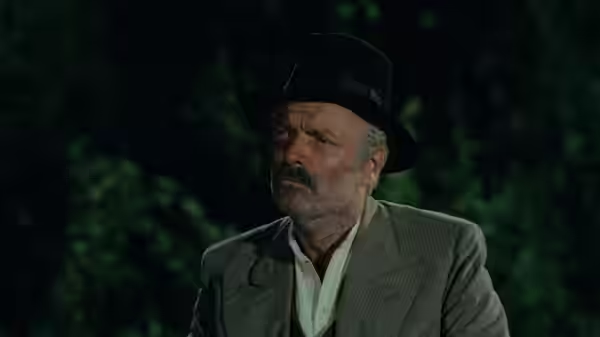
The plot is a walk. The retreating Germans have told the townspeople to gather in the cathedral before they blow up the houses. The Bishop (Giorgio Naddi) says go. Galvano (Omero Antonutti), a farmer with no authority beyond the fact that people listen to him, says the opposite, and leads a party out of the town in the dark to look for the Americans, said to be to the south. Antonutti plays him gently, a man never asked to decide anything, and carries the weight of it in his shoulders. The film’s spine is his slow, unspoken business with Concetta (Margarita Lozano), whom he has wanted since they were young.

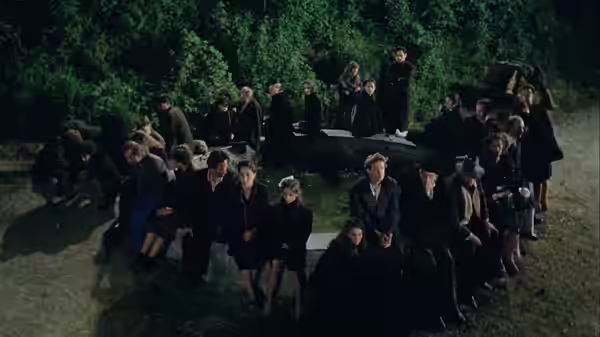
For its first half the film is nearly a comedy. Corrado (Claudio Bigagli) and Belindia (Miriam Guidelli) are married on the eve of departure because she is pregnant, and the wedding is conducted with the impatience of people who have packing to do. The walkers argue about whether God is in the cathedral or out here with them. Lina Nerli Taviani dresses them in dark wool and blankets over summer clothes, so that from a distance the column looks like a village fete that has wandered off. We laughed a good deal, and the film wanted us to.

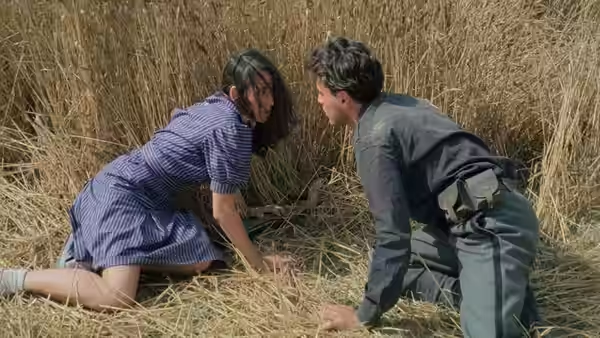
It also wanted us defenceless, and we were. Franco Di Giacomo shoots the Tuscan countryside in warm afternoon light, gold on the wheat and white on the roads, with no shadow for a threat to hide in. Gianni Sbarra’s production design keeps the town small: a square, a church, a few streets. When the killing comes, in the second half, it comes in that same lovely light and is over in a second. There is a sequence in a wheat field that we will not describe. We had been smiling a minute before, and then we were not, and we sat through the next scene not really watching.

The fantasy belongs to Cecilia (Micol Guidelli). Because she is six, what she sees in the field is not quite what happened, and the Tavianis film her version without apology. Roberto Perpignani cuts it in flat against the realism on either side, no dissolve, no change of light, so it lands as fact. Nicola Piovani’s score does the same job with sound, a tune that could be a children’s song under scenes that are not for children. We can imagine a viewer who finds it precious. We did not. A child is doing the remembering, and the film said so in its first line.

Not everything holds. The younger lovers, Nicola (Massimo Bonetti), Mara (Enrica Maria Modugno) and Rosanna (Sabina Vannucchi), are sketched where Galvano and Concetta are drawn, and their scenes mostly give the walk a rest. The narration occasionally tells us what to feel about a face that has already told us. And Piovani brings his melody back once or twice more than he needed to.

Most critics have been warm, one or two rapturous, and we are nearer the second group. Watch it in one sitting and do not read about the wheat field first. The light will tell you nothing is coming, and that is the point.
Critical consensus AI synthesised

3 of 6
Positive
2
Mixed
1
Negative
0
The New Yorker
30 January 1983 · Pauline Kael
95*

Kael gives the film an ecstatic, strongly positive verdict, calling it thrilling and unlike anything else. She especially praises its vivid blend of comedy, tragedy, and fantasy in depicting wartime village life.

Read the full review →
Time Out
9 August 2015 · ★★★★ · David Ehrlich
80

Ehrlich regards the film as a minor classic. He singles out its child’s-eye perspective on World War II.

Read the full review →
The New York Times
30 January 1983
64*

The page is inaccessible, so the critic’s verdict cannot be determined. No praise or complaint can be verified from the available text.

Read the full review →

Straight answers AI written, from our review

Is The Night of the Shooting Stars worth watching?
The Night of the Shooting Stars is worth watching, and we scored it 87. The Taviani brothers tell a Tuscan village's flight from the Germans in 1944 as a story a woman tells her child, close to comedy for its first half and then abruptly not. It suits anyone who can bear a war film that lulls before it strikes; the younger lovers' scenes are its one slack stretch.
How long is The Night of the Shooting Stars, and what is it rated?
The Night of the Shooting Stars runs 1h 45m. It is a war and drama film.
Where can I watch The Night of the Shooting Stars in the UK?
The Night of the Shooting Stars is available to rent from Amazon Prime Video from £2.49. Availability is checked daily; the links above go straight to each service.
How violent or frightening is The Night of the Shooting Stars, and is it suitable for children?
The Night of the Shooting Stars has no UK or US certificate on record, and it is not a film for children, though a six-year-old does the remembering. The first half is funny; the second brings killing in bright afternoon light, sudden and over in a second, including a wheat-field sequence that left us not really watching the scene after it. Teenagers and the reasonably steady will manage it.
How does The Night of the Shooting Stars compare to Rome, Open City?
The Night of the Shooting Stars is the warmer and stranger of the two films; Rome, Open City is the harder and more direct. Rossellini shot his in 1945 with the rubble still warm, and its suffering is hard to shake, though its villains and music sometimes insist too much. The Tavianis tell theirs as a bedtime story in golden light, so the violence lands as a shock rather than a weight.
What should I watch after The Night of the Shooting Stars?
After The Night of the Shooting Stars, try Rome, Open City (1945, Fi1m 89): The film all Italian war stories answer to, shot while the rubble was still warm. Then Come and See (1985, Fi1m 92): A child’s eye on the same war, with none of the mercy and all of the terror; and Forbidden Games (1952, Fi1m 86): Two children build a cemetery for animals while France falls around them.

Cast

Awards

International Submission to the Academy Awards, 1983

Nominated
International Submission to the Academy Awards

Cannes Film Festival, 1982

Won
Cannes Film Festival Grand Prix

If you liked this, try…

  1. Padre Padrone (1977) · not on Fi1m yetThe Tavianis and Antonutti again, harder and colder, in the Sardinian hills.

  2. Rome, Open City (1945, Fi1m 89)The film all Italian war stories answer to, shot while the rubble was still warm.

  3. Come and See (1985, Fi1m 92)A child’s eye on the same war, with none of the mercy and all of the terror.

  4. Forbidden Games (1952, Fi1m 86)Two children build a cemetery for animals while France falls around them.

  5. Grave of the Fireflies (1988, Fi1m 94)Japanese animation about a brother and sister in the firebombing; bring a handkerchief.

The Night of the Shooting Stars (1982) review: a village flees the war (the UK) | Fi1m