Bernardo Bertolucci’s mystery rewards close attention to faces and places, with Giulio Brogi’s double role its most unsettling feature. We recommend it, though the intricate storytelling sometimes keeps feeling at a distance.
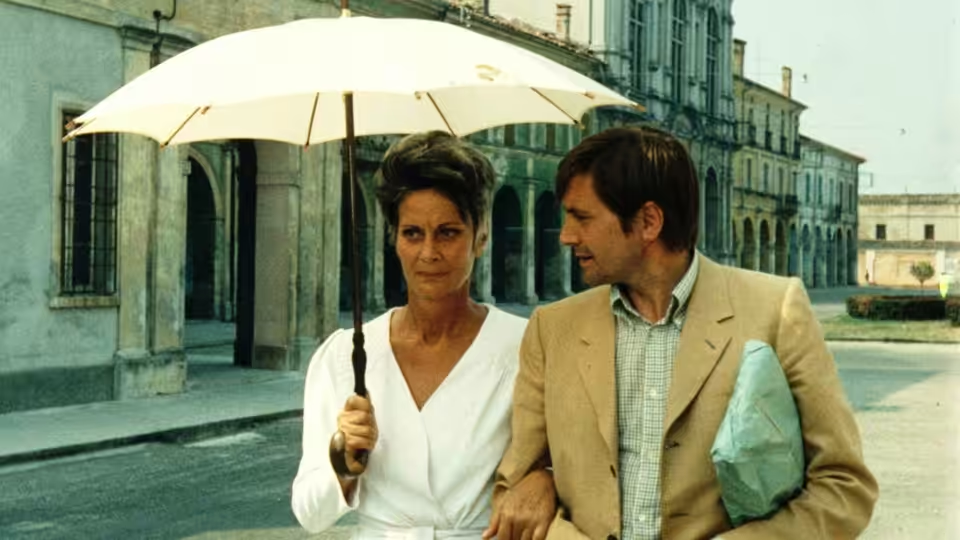
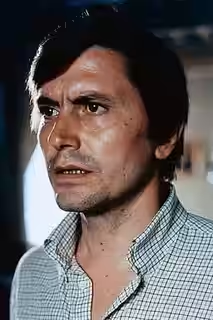
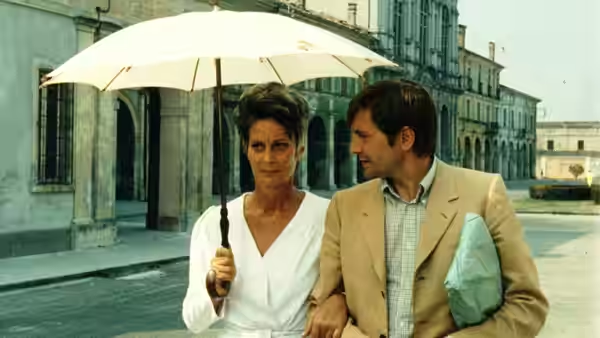
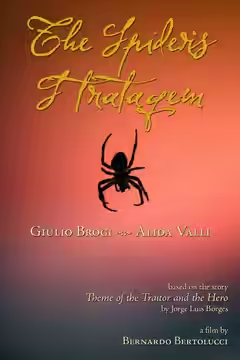
The Spider’s Stratagem is a rewarding mystery with a specific limitation: its people can feel remote even when its images hold our attention. Bernardo Bertolucci puts Giulio Brogi in the roles of Athos Magnani Jr. and Athos Magnani Sr., giving us a face we cannot attach to just one man. That is a strong reason to keep watching closely. The film makes good use of the complication, although its intricacy occasionally gets between us and the characters.
Brogi is the chief reason this does not become an exercise in admiring cleverness. A double role encourages comparisons, and his presence makes those comparisons worth making without exhausting our interest in either man. We found the shared face unsettling. Whenever we consider one Athos, the other remains available to us in the same features, and that simple fact gives the performance a pressure no amount of explanatory dialogue could supply.
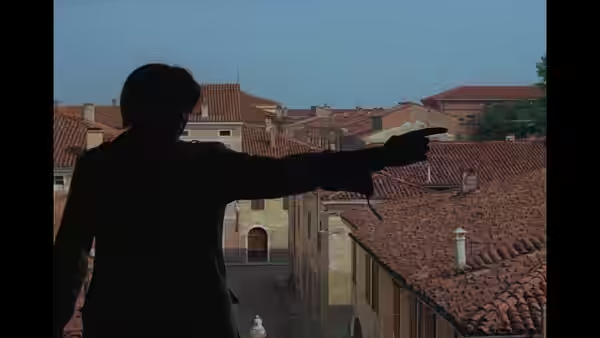
Franco Di Giacomo and Vittorio Storaro share the cinematography credit, and the images deserve the attention they ask for. The locations convey the younger Athos’s unease, encouraging us to examine his surroundings for ourselves. Looking becomes an active part of following the mystery. The photography gives us something to do beyond waiting for the next piece of information, and it makes that work pleasurable without making the places feel reassuring.
Maria Paola Maino handles both production design and costumes, two contributions worth considering together here. The visual coherence matters when one actor already requires us to distinguish between two characters; clothes and surroundings become things to attend to, not merely appreciate in passing. Roberto Perpignani’s editing helps sustain the uncertainty. We stay curious, though the concentration required sometimes makes the experience feel a little too much like an examination, even one we are enjoying.
The screenplay is credited to Marilù Parolini, Eduardo de Gregorio and Bernardo Bertolucci. Our reservation concerns how much room the construction leaves for an uncomplicated interest in another person. With Brogi, there is always the additional fascination of the doubled role; elsewhere, the people can seem chiefly important because of their place in the mystery. Alida Valli’s Draifa gives us another compelling presence, but our attention keeps returning to the puzzle. This is the same limitation that makes the intricate images occasionally feel distancing.
Within the mystery genre, Bertolucci places considerable trust in our willingness to look again. We welcome that trust, especially when so much suspense depends on simply withholding a piece of information until the appointed moment. Here the faces and locations remain interesting while we wait. The film is less satisfying when our interest in how it works overtakes our concern for the people, but that does not cancel the pleasure of watching it work.
At 100 minutes, it asks for a manageable stretch of undivided attention. The reservation is emotional distance, not a shortage of things worth noticing, and Brogi gives that attention a firm centre. Choose it when close looking sounds like a pleasure; this is not a mystery to keep half an eye on.