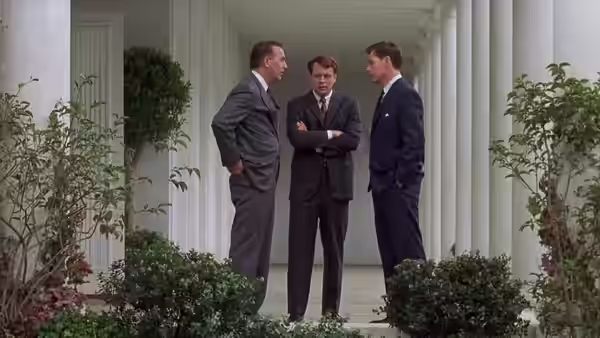
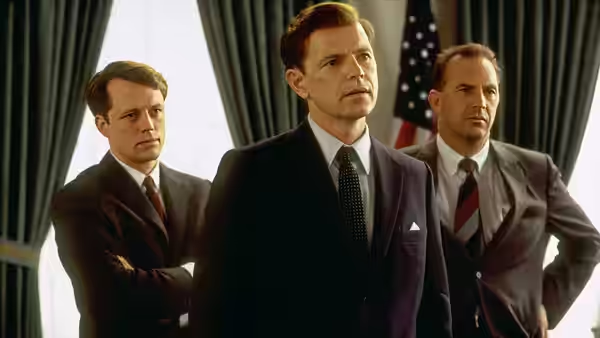
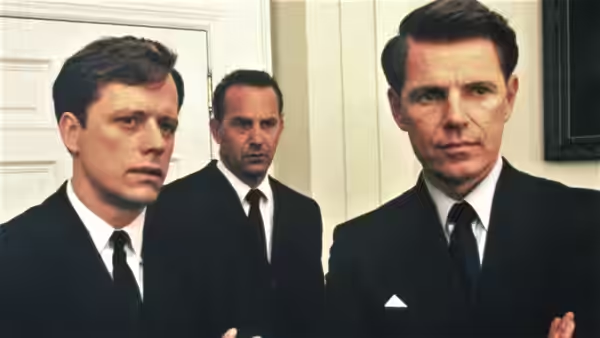
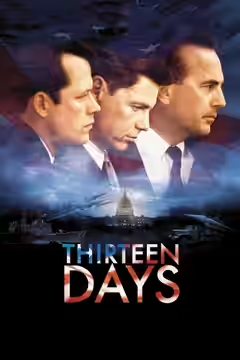
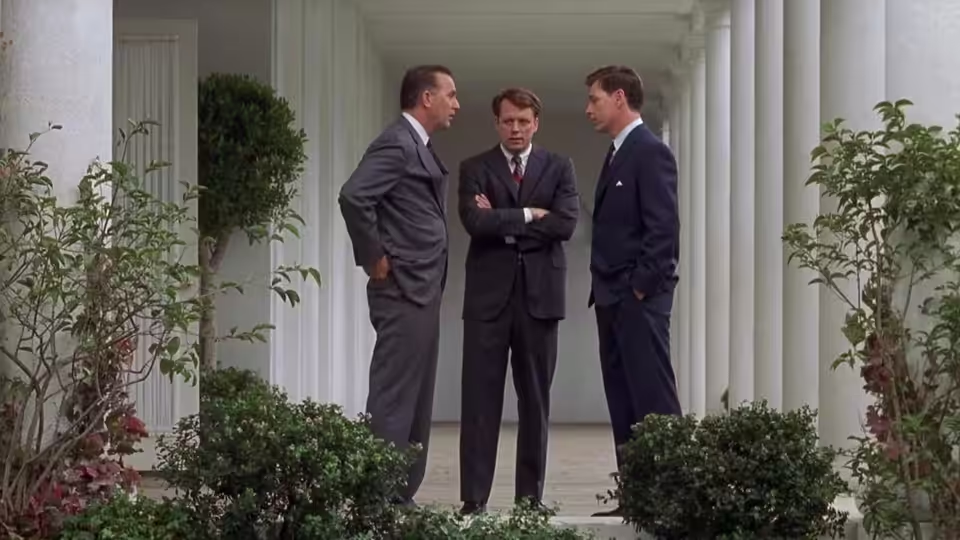
Kenneth O'Donnell (Kevin Costner) talks with two men beneath the White House colonnade
Film review

Thirteen Days

2000 · Directed by Roger Donaldson · 2h 25m

In a sentenceThe fate of the world decided by men in shirtsleeves, narrated by the one whose Boston accent keeps slipping

Washington, October 1962. A U-2 flight over Cuba brings back photographs of Soviet nuclear missiles being assembled ninety miles from Florida. Kenneth O’Donnell (Kevin Costner), special assistant to the President, is among the first to be told. President John F. Kennedy (Bruce Greenwood) and his brother, Attorney General Robert F. Kennedy (Steven Culp), gather an advisory group in the Cabinet Room: Defence Secretary Robert McNamara (Dylan Baker), Secretary of State Dean Rusk (Henry Strozier), and the Joint Chiefs under Gen. Maxwell Taylor (Bill Smitrovich), with Air Force chief Gen. Curtis LeMay (Kevin Conway) pressing to bomb the sites before they are ready to fire. Kennedy wants a course that does not start a war. He is told he has days, not weeks.

Plays from YouTube when you press play; nothing loads from them until then.

Fi1m review

Roger Donaldson’s account of the Cuban missile crisis is a sober, well-built thriller that finds real tension in men arguing round a table, and Bruce Greenwood is a fine Kennedy. It is twenty minutes too long and tells it through the wrong man.

Roger Donaldson’s film takes the thirteen days of October 1962 in which Soviet missiles were found in Cuba and the United States had to decide what to do about them, and spends nearly all of its 145 minutes in rooms in Washington. There are no Russians to speak of and almost no Cubans. David Self’s screenplay is built from meetings: the Cabinet Room, the Oval Office, a corridor, a telephone. It knows that we know how the fortnight ended, and it bets we will be gripped anyway by watching the decision get made. For most of its length that is what happens.

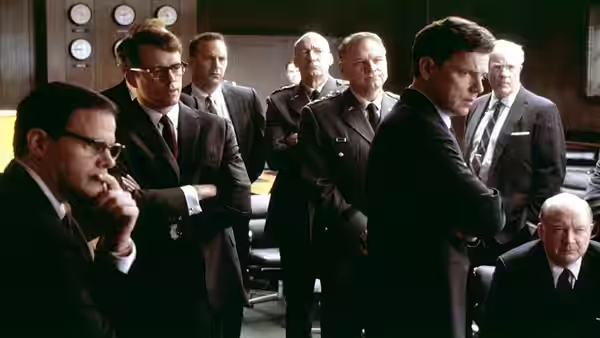
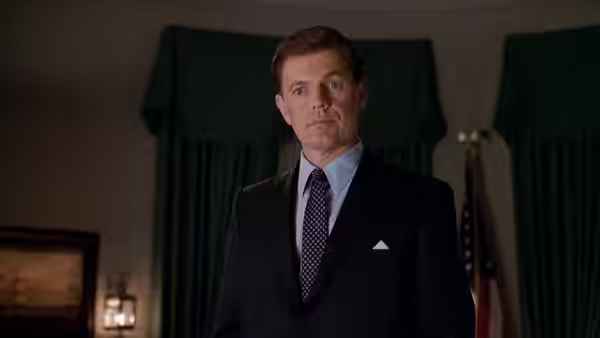
The Cabinet Room scenes are the film. Bruce Greenwood plays Kennedy as a tired, careful man who asks questions and lets other people talk, and he carries the picture on the face of someone who can see that every option in front of him is bad. Steven Culp’s Robert Kennedy is quicker and angrier, the brother who says what the President cannot. Dylan Baker’s McNamara is all slide rule and no pulse, and Kevin Conway’s Curtis LeMay is a frightening piece of work, a general who tells the President he is in a pretty bad fix and means it as advice. We knew how the week turned out and we were tense anyway, leaning forward through an argument about whether a blockade counts as an act of war, because Donaldson lets the argument run at the length and in the order the men might actually have had it.

Andrzej Bartkowiak shoots the rooms in flat, pale light, white shirts under strip lamps, and the film drops into black and white for stretches, which gives it the look of the newsreels these men would have watched. J. Dennis Washington’s Cabinet Room is a long table, a wall of maps and easels of reconnaissance photographs, and we return to it so often that we learn where everyone sits. Isis Mussenden’s narrow ties and the generals’ rows of ribbons sort the civilians from the soldiers before anyone speaks. Trevor Jones’s score is brass and snare drum, and it is laid on thickest in the scenes where the actors have already done the work. Conrad Buff IV cuts the flights over Cuba, the low-level runs with ground fire coming up through the frame, fast and loud; they are the film’s only action sequences.

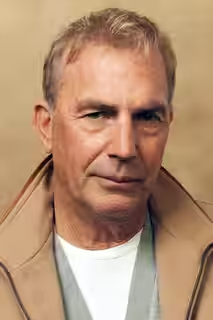
The trouble is Kenneth O’Donnell. The film is told through him, a special assistant whose work here is to stand at the back of every room, walk the brothers down corridors telling them what they already think, and ring a pilot to ask him not to report being shot at. The cutaways to his wife and children at breakfast are there to remind us what is at stake, and each one stops the picture for a minute or two. Kevin Costner, who also produces, plays him with real decency and a Boston accent that comes and goes, sometimes inside one sentence, and we winced for him more than once.

The narrowness has other costs. Khrushchev is a name on a cable. The United Nations gets one scene, and it belongs to Michael Fairman’s Adlai Stevenson, the man everyone at the table has already written off. London, Moscow and Havana are elsewhere. The film is honest about where its interest lies, and the result is that we only ever see one side of the crisis.

Donaldson made No Way Out (1987) with Costner, and he still knows how to make a Washington corridor feel like somewhere a man might be ambushed. He is less sure what to do with daylight. The date captions, the family breakfasts and the swelling brass give the film the shape of expensive television. It runs 145 minutes, and the twenty that could go are the family scenes.

See it for the table, for Greenwood, Culp and Conway, and for the slow, unglamorous business of grown men trying not to do the obvious thing. It carries a 12 and will hold a teenager who can sit still for talk.
Critical consensus AI synthesised

64
Positive
5
Mixed
2
Negative
2

Most critics come down in favour of Thirteen Days, and the praise gathers around the cast. Bruce Greenwood’s Kennedy is the performance singled out most often, with several reviewers calling it compelling or better, and Kevin Costner draws warm notices from some. The film itself is generally described as a gripping, intelligent reconstruction of the missile crisis, restrained in tone and careful in its handling of the arguments around the table, and admirers credit it with avoiding triumphalism.

The reservations cluster on scope. More than one review notes that the film stays inside Washington and leaves out the wider diplomacy, Britain’s part in events and any women of consequence. Variety finds the presentation conventional enough to resemble expensive television. The spread is wide: two critics reject the film outright, with The AV Club judging Costner’s character superfluous and Eye for Film calling the whole thing dull and the Kennedy portrayals unconvincing.

Empire
1 January 2000 · William Thomas
85*

The critic finds it a riveting, intelligent political thriller and a powerful tribute to Washington’s leaders. They single out the performances, especially Bruce Greenwood’s portrayal of JFK, for praise.

Read the full review →
Radio Times
★★★★ · Joanna Berry
80

Berry finds the historical drama fascinating and its performances compelling. She singles out Bruce Greenwood as mesmerising and Kevin Costner as superb.

Read the full review →
Evening Standard
10 April 2012
75*

The critic finds the docudrama gripping and intelligently re-enacted, while noting that it is shaped by Hollywood values rather than historical hindsight. They praise its tense portrayal of the crisis and the graphic re-creation of the aerial incidents, but fault its omission of Britain’s role.

Read the full review →
The Guardian
18 March 2001 · Philip French
75*

French finds the film an engrossing, restrained docu-drama that presents the crisis without triumphalism. He praises its depiction of the Kennedy brothers’ response, while noting the absence of wider diplomatic efforts and women in positions of power.

Read the full review →
Variety
1 December 2000 · festival review · Todd McCarthy
70*

McCarthy finds the film a solid, absorbing historical thriller, though its conventional presentation has the feel of a high-end television production. He praises the capable ensemble and the measured handling of tense political debates.

Read the full review →
The New York Times
25 December 2000
64*

The page could not be accessed, so the critic’s verdict is unavailable. No specific praise or complaint can be verified from the accessible material.

Read the full review →

Straight answers AI written, from our review

Is Thirteen Days worth watching?
Thirteen Days is worth watching for anyone who can be gripped by men arguing round a table about the end of the world, and we scored it 70. Bruce Greenwood's Kennedy, Steven Culp's Robert Kennedy and Kevin Conway's LeMay make the Cabinet Room scenes tense even though we know how the fortnight ended. It is twenty minutes too long, and Kevin Costner's O'Donnell is the wrong man to tell it through.
How long is Thirteen Days, and what is it rated?
Thirteen Days runs 2h 25m. It is a history and thriller film.
Where can I watch Thirteen Days in Mexico?
Thirteen Days is not on any streaming or rental service in Mexico at the moment. It is available in 14 other countries; change your country at the top of the page to see where. Availability is checked daily.
How violent or frightening is Thirteen Days, and is it suitable for children?
Thirteen Days carries a UK 12 certificate and is almost entirely talk; its only action is a handful of fast, loud reconnaissance flights over Cuba with ground fire coming up through the frame. There is no gore and nothing to frighten a squeamish adult. The dread is in the arguments, so it will hold a teenager who can sit still for two and a half hours of meetings, and bore a younger child.
How does Thirteen Days compare to Threads?
Thirteen Days shows the men in Washington trying to stop a nuclear war; Threads shows what happens to ordinary people in Sheffield when men like them fail. The Donaldson film is a sober, well-built thriller with a soft centre and a long runtime, and we recommend it with reservations. Threads is the better and far more frightening film, and a punishing evening that gives you little room to recover.
What should I watch after Thirteen Days?
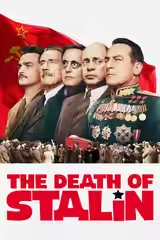
After Thirteen Days, try Threads (1984, Fi1m 92): What happens when the men at the table get it wrong, set in Sheffield. Then Z (1969, Fi1m 84): Costa-Gavras on how a government actually behaves once the generals have the upper hand; and The Death of Stalin (2017, Fi1m 83): The other side’s table, played for laughs that curdle; the terror is the same.

Cast

If you liked this, try…

  1. Fail Safe (1964) · not reviewed yetLumet’s black-and-white nightmare of the same hotline, with no reassuring history to hide behind.

  2. Threads (1984, Fi1m 92)What happens when the men at the table get it wrong, set in Sheffield.

  3. Z (1969, Fi1m 84)Costa-Gavras on how a government actually behaves once the generals have the upper hand.

  4. The Death of Stalin (2017, Fi1m 83)The other side’s table, played for laughs that curdle; the terror is the same.

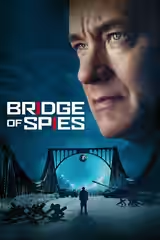
  5. Bridge of Spies (2015, Fi1m 75)Spielberg’s Cold War as negotiation rather than brinkmanship, with Rylance quietly stealing every scene.